Astronomers have found that both the core of our Milky Way and the earliest proto-galaxies in the universe share a surprising trait: They are unusually calm and quiet in terms of harsh radiation. This tranquility is not just a cosmic curiosity; it may be essential for forming complex molecules that provide the ingredients of life.
A new study published in The Astrophysical Journal Letters highlights how the Milky Way’s center and mysterious early proto-galaxies known as “little red dots” (LRDs) harbor massive black holes within peaceful, dust- and gas-rich environments. These conditions create natural laboratories for prebiotic chemistry, suggesting that the universe may have supported life’s chemical precursors far earlier than previously imagined.
The work was led by Professor Remo Ruffini and Professor Yu Wang from the International Center for Relativistic Astrophysics Network (ICRANet) and the Italian National Institute for Astrophysics (INAF).
Little red dots: Cosmic seeds with massive black holes
Not long ago, the James Webb Space Telescope (JWST) began uncovering tiny red specks in its deep views of the early universe. Astronomers affectionately dubbed these specks “little red dots” (LRDs); they show up as faint, very red pinpoints of light in JWST’s infrared images. What are they? It turns out these are ultra-compact protogalaxies from a time when the universe was only a few percent of its current age.
They are just a few hundred light-years across in radius; for comparison, our Milky Way spans over 100,000 light-years. Despite their small size, LRDs hold a big surprise: Evidence suggests many of them contain a central black hole of millions of solar masses, similar in mass to the one in the Milky Way’s core. In other words, these are like miniature galaxies built around an outsized black hole.
The discovery of such massive black holes inside tiny, early galaxies came as a major surprise. One emerging interpretation is that LRDs represent galactic “seeds,” early building blocks in which the central black hole may constitute the observed significant fraction of the galaxy’s total mass, at the level of tenths of a percentage point. This is in sharp contrast to normal massive galaxies like the Milky Way, where the central black hole contributes only a minuscule fraction of the total mass, typically below 0.01%.
In addition, the origin of the apparent abundance of million-solar-mass black holes in the early universe challenges the standard models of black hole growth and galaxy assembly, which currently is a highly compelling research topic. Motivated by this problem, the authors of this work were led to compare LRDs with the Milky Way’s central black hole, and in a separate study (Ruffini & Vereshchagin, 2025) they proposed that direct collapse of a self-gravitating fermion system could provide a viable formation channel for these early massive black holes.
Crucially, these little red dots don’t radiate like one might expect for a young galaxy with a big black hole. They glow warmly in optical, but are dim in energetic light such as X-rays. That was our first clue that something about them is different; they seemed to lack the high-energy radiation usually associated with growing black holes or rampant star formation. In fact, their properties look intriguingly similar to the center of our own Milky Way. To understand why that matters, let’s first look at what makes the Milky Way’s core special.
A peaceful heart: The Milky Way’s surprisingly calm core
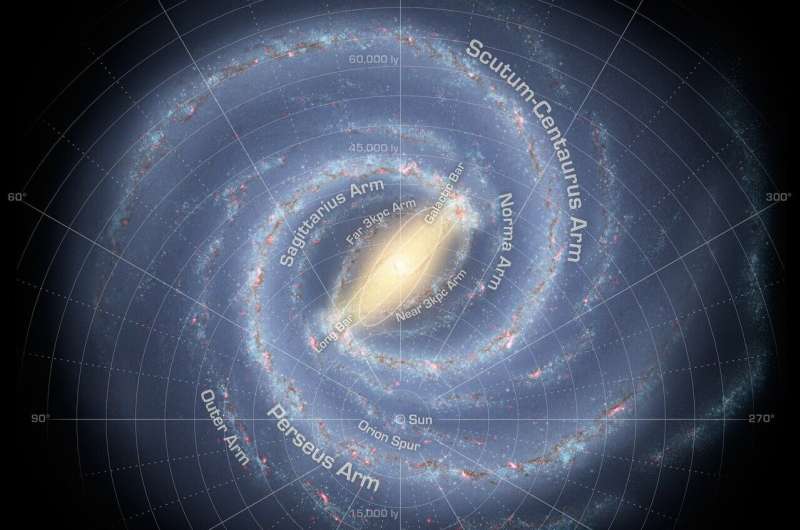
The Milky Way is a giant spiral galaxy bustling with stars, but at its very heart lies a region of unexpected calm. Nestled there is a supermassive black hole called Sagittarius A*, about 4 million times the mass of our sun. You might think a black hole of that size would dominate our sky with violent energy, but actually Sagittarius A* is practically dormant. It’s currently eating (accreting) so little material that it shines at less than a billionth of its theoretical maximum luminosity. Unlike a quasar or other active galactic nuclei, our black hole isn’t firing off jets or intense X-ray bursts into space. It’s quiet, an astronomical gentle giant.
Because the black hole is so quiescent, the environment around it is unexpectedly calm and cool. The innermost region of the Milky Way is dominated by a dense concentration of interstellar clouds known as the central molecular zone (CMZ), rich in cold gas and dust. Observations of the galactic center do not reveal the ionized, high-velocity outflows typical of a powerful active nucleus. Instead, they show mainly low-energy emissions and clear signatures of ongoing star formation and nebular structures. Together, these observations paint a picture of a tranquil galactic core.
Cosmic quietude fosters complex chemistry
Why do astronomers care that a galaxy’s center is quiet in an electromagnetic sense? Because in the absence of harsh radiation, molecules can survive and thrive. Many of the building blocks of life, organic molecules like water, methanol, nitriles, amino acids and so on, are fragile, easily broken apart by energetic UV light or X-rays. These molecules tend to form in cold, dark environments such as dust grains inside molecular clouds, but a blast of radiation can dissociate them in an instant. A peaceful core like the Milky Way’s means those clouds are shielded from destructive rays and can become rich chemical factories.
In our Milky Way’s CMZ, astronomers have indeed found a rich inventory of complex organic molecules floating in space. One striking example comes from a cloud called G+0.693-0.027, only a few light-years from the galactic center. This cloud is cold (~100 Kelvin) and dense and notably has no new stars forming inside (so it’s not flooded with UV starlight). Within that cloud, researchers detected nitriles, the organic molecules containing a cyanide group (–C≡N). Nitriles are precursors to RNA nucleotides, the building blocks of RNA, which is a crucial biomolecule for life as we know it. In other words, these are prebiotic molecules, the kind that could eventually help form the first genetic material for life.
It’s astonishing to think of an RNA precursor floating in a cloud at our galaxy’s center. And that’s not all; scientists suspect that many of the organic compounds we find in meteorites or comets in our solar system were cooked up in such interstellar clouds before becoming incorporated into young planetary systems. According to the “RNA world” hypothesis, for instance, some essential molecules for life’s origin might have been delivered to early Earth by comets and meteorites, effectively jump-starting prebiotic chemistry on our planet. The Milky Way’s tranquil core may have been one of the cosmic kitchens where these ingredients were prepared, protected by its calm conditions, long before Earth formed.
Life’s ingredients brewing in the early universe
If complex organics could form in the Milky Way’s core, could the same be happening (or have happened) in those tiny red proto-galaxies 13 billion years ago? The new study suggests the answer is probably yes.
In the little red dots, compact, dust-enshrouded nuclei can maintain cold molecular cloud conditions, with temperatures only a few tens of kelvin above absolute zero. In this cold environment, atoms and simple molecules readily stick to dust grains and remain there long enough to react. Meanwhile, the very high densities of gas and dust provide abundant raw material, and the grains act as microscopic reaction surfaces, allowing simple ices to build up step by step into larger organic molecules.
Most importantly, little red dots do not show evidence for strong ultraviolet or X-ray radiation, so fragile molecules are less likely to be destroyed and instead can survive, accumulate, and continue evolving over long periods. Taken together, these features make LRDs quiet, dust-rich chemical laboratories on galactic scales, where prebiotic molecules could plausibly form even in the early universe.
The notion that life’s ingredients might have been brewing in the universe’s earliest galaxies is a profound shift in perspective. Previously, many scientists assumed that complex organic chemistry on a large scale required several generations of stars, and a fairly quiescent niche like a mature galaxy’s molecular cloud, to evolve. The early universe, by contrast, is often pictured as harsh and intense: blazing young stars, frequent supernovae, and galaxies colliding in a frenzy of formation. It’s not exactly the kind of scene where you’d expect delicate molecules to survive. But the little red dots hint at pockets of calm amid the chaos even when the universe was in its infancy.
These LRD protogalaxies were common in the young universe; it means the ingredients for life might have been assembled far earlier and more widely than we thought. As the universe evolved, some of these tiny galaxies likely merged or were incorporated into larger galaxies. During these processes, the organic molecules from LRDs would have been spread across space, seeding the surroundings with prebiotic material.
Think of it this way: Galactic structures might have influenced biology before biology even existed. Our own existence may owe something to the fact that the Milky Way’s black hole went quiet, allowing a rich chemical soup to simmer in the darkness. Now imagine that many such soups simmering across the young cosmos. The cosmic budget of prebiotic molecules could have been quite significant early on, long before there were planets to host life. This radically expands the timeline and locations for the origin of life’s ingredients. It suggests that the universe was biologically fertile in potential, almost from the outset.
Of course, the connection between galactic cores and actual life is still speculative. Complex organic molecules are a far cry from living organisms. But to find them in unexpected places and times bridges the gap between astronomy and biology. It means the story of life is not isolated to Earth or even to planetary systems; it’s intertwined with the story of galaxies and stars. It’s like discovering that galaxies have been “baking the bread” of life’s recipe and scattering it around, ready to be incorporated into new worlds.
This discovery relies on data from the James Webb Space Telescope, operated by the Space Telescope Science Institute (STScI), which is a member of the International Center for Relativistic Astrophysics (ICRA).
Publication details
Remo Ruffini et al, Islands of Electromagnetic Tranquility in Our Galactic core and Little Red Dots that Shelter Molecules and Prebiotic Chemistry, The Astrophysical Journal Letters (2026). DOI: 10.3847/2041-8213/ae3a76
Provided by
International Center for Relativistic Astrophysics Network
Citation:
Galactic islands of tranquility: ‘Little red dots’ may have brewed life’s building blocks (2026, March 12)
retrieved 12 March 2026
from https://phys.org/news/2026-03-galactic-islands-tranquility-red-dots.html
This document is subject to copyright. Apart from any fair dealing for the purpose of private study or research, no
part may be reproduced without the written permission. The content is provided for information purposes only.