NSF–DOE Vera C. Rubin Observatory / NOIRLab / SLAC / AURA / R. Proctor; Star map: NASA GSFC SVS; Gaia DR2: ESA / Gaia / DPAC Image processing: M. Zamani (NSF NOIRLab)
The Vera C. Rubin Observatory promised to discover up to half a million new solar system objects each year of operation. It isn’t fully operational yet, and it’s already delivering on that promise.
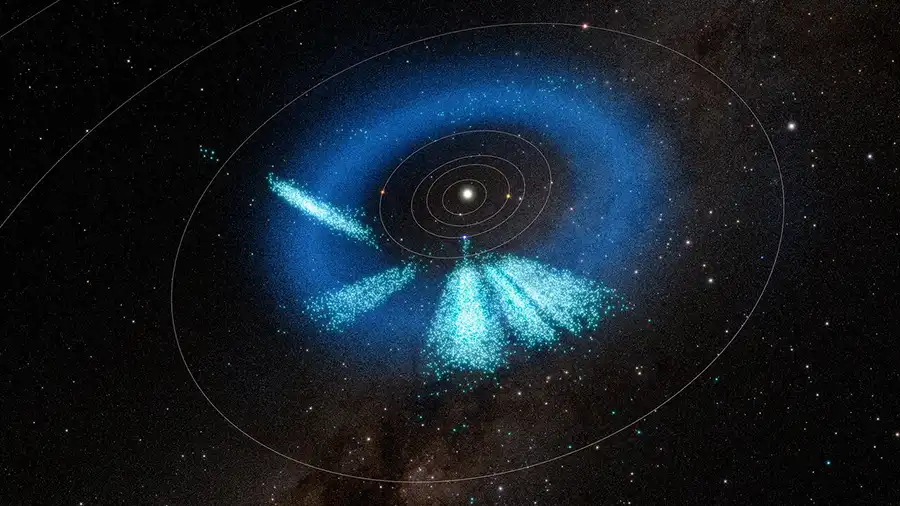
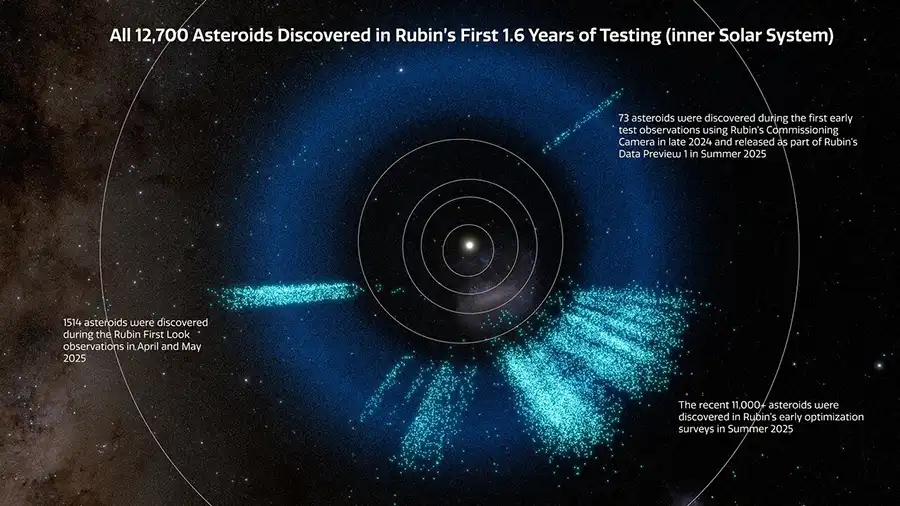
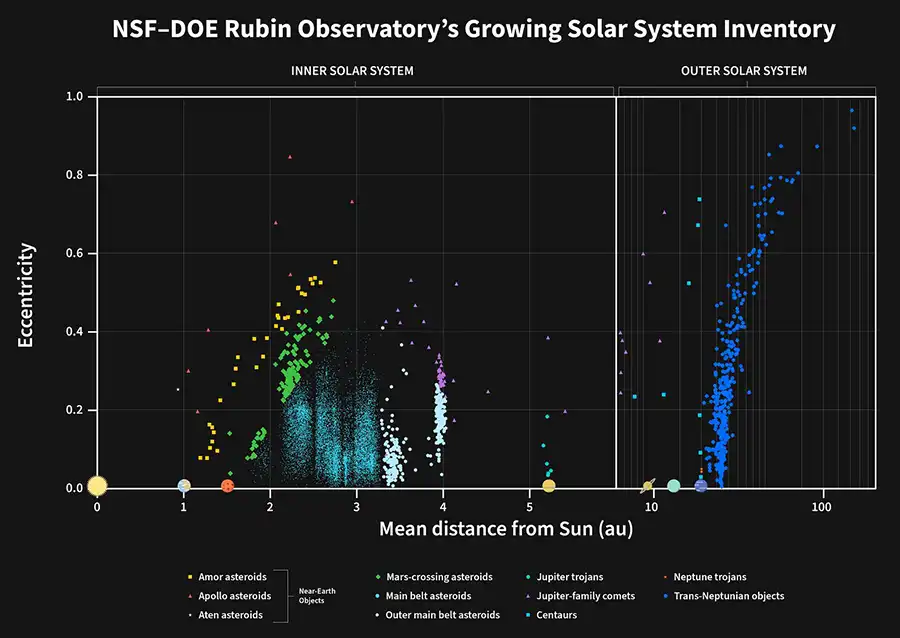
Last week, the International Astronomical Union’s Minor Planet Center confirmed the discovery of more than 11,000 new asteroids captured by Rubin during a 1½-month observation period. That period wasn’t even part of its planned Legacy Survey of Space and Time (LSST), just a test run to check systems and optimize observations. Still, it was enough for Rubin’s powerful 8.4-meter Simonyi Survey Telescope to make thousands of discoveries. While most of them are in the main asteroid belt, the list includes 380 trans-Neptunian objects (TNOs) that orbit beyond Neptune, and 33 previously unknown near-Earth objects.
This latest submission to the Minor Planet Center (MPC) included approximately 1 million individual observations that tracked about 90,000 objects, of which 80,000 were already known. This tally includes several “lost” objects that were discovered at some point but with orbits too uncertain to keep track of them. By reverting these orbits back in time, researchers at the MPC could backtrack their location at the time of discovery, confirming that they were the same objects. All of these numbers are additional to the 1,500 or so other asteroids identified during Rubin’s “First Look” observation campaign, from when the observatory went online last year.
NSF–DOE Vera C. Rubin Observatory / NOIRLab / SLAC / AURA / R. Proctor; Star map: NASA GSFC SVS; Gaia DR2: ESA / Gaia / DPAC Image processing: M. Zamani (NSF NOIRLab)
“The significance of this is that Rubin is just starting,” says Mario Jurić (University of Washington), leader of Rubin’s solar system team. Currently, there are about 1.5 million asteroids known in our solar system. At that discovery rate, the observatory is expected to bump that number by fivefold in less than a decade, well into the 6 million range. “So, this is a ‘it’s here, it’s working, it’s coming’ type of demonstration,” Jurić adds.
Beyond Neptune
The rapid growth of the known trans-Neptunian population is particularly relevant. Only about 5,000 of these icy bodies have been discovered over the last 30 years. Rubin identified 380 TNO candidates in less than two months — nearly 8% of the total known population. In a year, Rubin data will more than double the known number of TNOs, with the expectation that the observatory will yield up to 32,000 more in the coming years.
The discoveries will “tell us how planets moved early on in the solar system — where Jupiter, Neptune, and Saturn started,” Jurić says. We know Neptune and Uranus were about twice as close to the Sun when they formed and then migrated out, jostling smaller bodies along the way. “These small objects will tell us how fast that happened and what caused the migration.”
NSF–DOE Vera C. Rubin Observatory / NOIRLab / SLAC / AURA / R. Proctor; Star map: NASA GSFC SVS; Gaia DR2: ESA / Gaia / DPAC Image processing: M. Zamani (NSF NOIRLab)
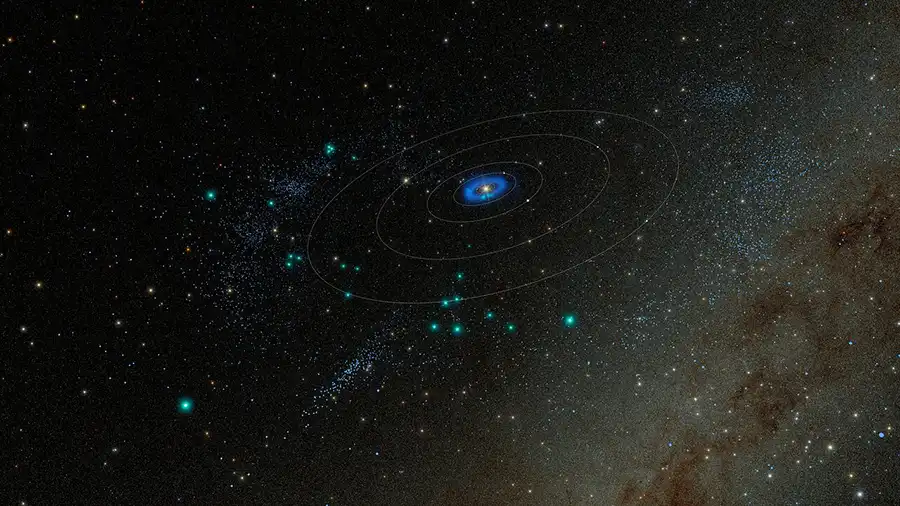
Two new discoveries, provisionally named 2025 LS2 and 2025 MX348, are among the most distant asteroids ever recorded, with orbits that reach roughly 1,000 times farther from the Sun than Earth’s.
Careful analysis of the orbits of TNO’s, especially those with extremely elongated orbits, could eventually determine if there is a putative planet 9 lurking in the outskirts of the solar system.
Imminent Impactors
The 33 newly discovered near-Earth objects (NEOs) do not pose a threat to Earth. But they are part of a much larger incoming population: Rubin is expected to find nearly 90,000 new NEO’s, some of which could be potentially hazardous. Rubin is expected to find at least 80% of asteroids 140 meters in diameter or more — big enough to cause continent-scale destruction if they hit Earth. If discovered with decades to spare, we’ll have time to plan a collision-avoidance strategy similar to NASA’s DART mission.
“That’s our advantage over the dinosaurs — we have a space program,” Jurić says.
On the other hand, Rubin is expected to discover small asteroids that are bound to hit Earth. Most sub-meter bodies that currently impact Earth go unnoticed, typically disintegrating mid-air or landing as small meteorites. Over the last 20 years, the entire world has found only 11 of these objects, usually with a lead time of just hours.
In a paper in The Astrophysical Journal, Jurić and colleagues predict that LSST will detect at least one or two “imminent impactors,” with sizes ranging between one and two meters per year. It will do so with a warning time of a day and a half on average, and for a quarter of them, more than three days before impact, giving scientists — and the public — more time to prepare.
Finding these relatively harmless objects before they hit Earth will allow scientists to set up specialized equipment ahead of time, observing the object while it’s still in space and watching the meteor disperse. If a meteorite is recovered, it could be taken to the lab, giving scientists the full life cycle of a falling space rock.
A Living Catalogue
The Rubin science team keeps pace with the deluge of discoveries, cross-referencing and labeling images as soon as they come in.
NSF–DOE Vera C. Rubin Observatory / NOIRLab / SLAC / AURA; Acknowledgement: M. Juric (Univ. of Washington)
“As images are taken during the night, we have the expected on-sky position of every known asteroid, sitting ready to be checked against the image,” says graduate student Jacob Kurlander (University of Washington). Labeled images are made available to the public “within 2 minutes of the shutter closing,” he adds.
This impressive feat is only possible due to close coordination with the Minor Planet Center, the referee and bookkeeper for every solar system object ever discovered. They keep track of all new and past asteroid observations, made not only by Rubin, but by every other observatory in the world.
Once the Rubin’s decade-long survey is running at full steam, it will send between 100 to 200 million observations to the MPC every year, whereas currently the center receives about 50 million annual observations from all of the telescopes on Earth put together. To prepare for the onslaught of data, the MPC has stepped up the pipelines that take in the data.
“We’ve automated as many things as we possibly can, so that people don’t have to look at very much of the data at all,” says MPC director Matthew Payne (Center for Astrophysics, Harvard & Smithsonian). “Our systems have gotten a lot better over the past couple of years in preparation for that.”
Thanks to this work, when Rubin starts its 10-year Legacy Survey of Space and Time, and millions of asteroids are discovered, the data will be publicly available immediately.
“I think the more we can make a tremendous fraction of astronomy data available to everyone with as few barriers as possible, the more science will come out of it,” Kurlander says.