Andy Tzanidakis
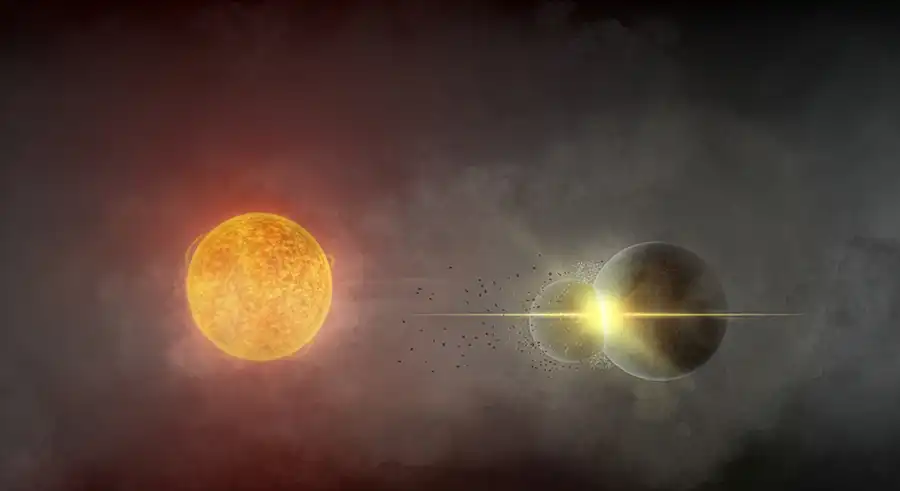
More than 11,500 light-years away, in an infant version of our solar system, two primordial planets have crashed into each other, vaporizing into a dusty disk of debris that’s now blocking light from their star. The event has the potential to help us understand our own solar system’s history.
Astronomers suspect that giant impacts played a role in sculpting our own solar system, from creating the Moon to explaining Uranus’s tilt and Saturn’s rings. But we can’t wind back the clock to study our own solar system’s formation. Seeing this process happening around other young stars could yield answers, providing a striking window into their turbulent pasts.
“What’s exciting about this [event] is that we’re actually seeing it happen in real time,” says Anastasios Tzanidakis (University of Washington), the graduate student who led the observations of this system published in The Astrophysical Journal Letters.
When the Light Diverges
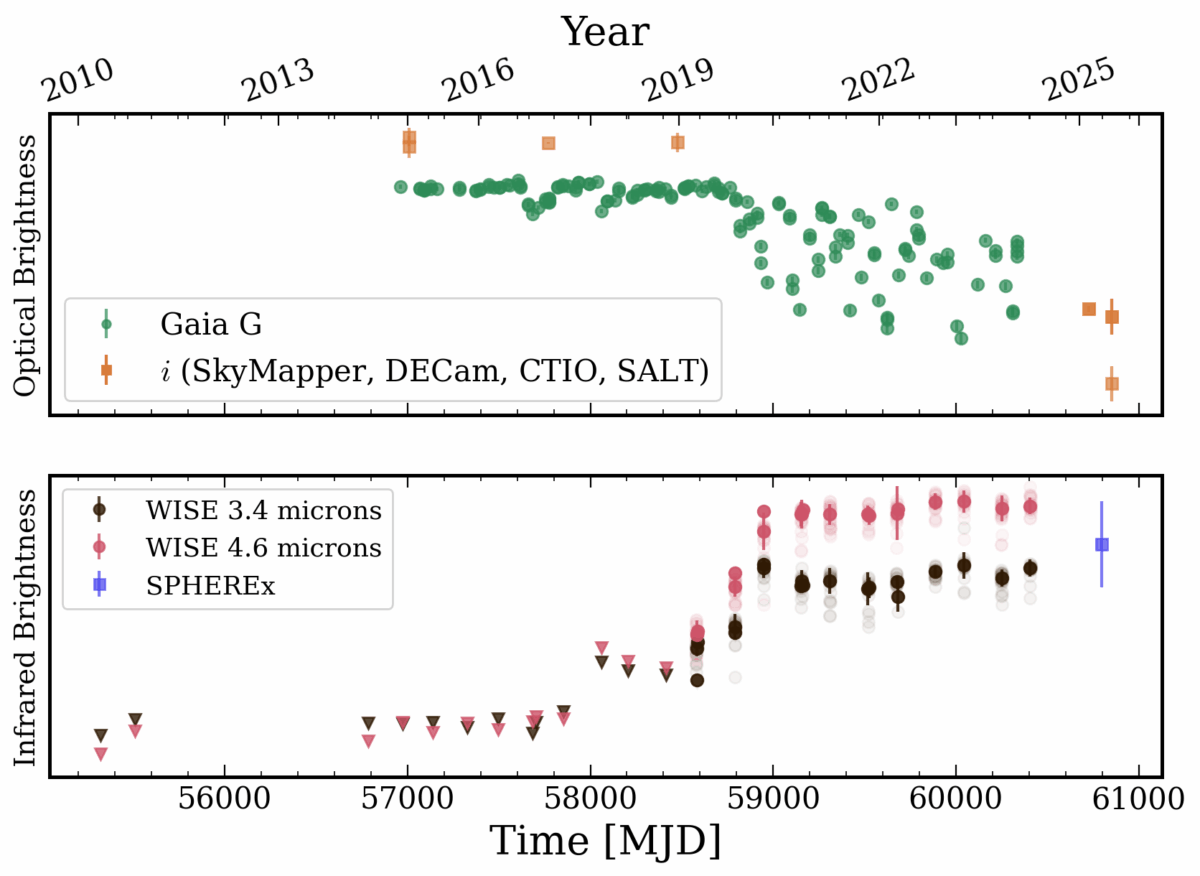
Tzanidakis first noticed the unusual dimming of a Sun-like star, called Gaia-GIC-1, as part of his research looking “for weird stars that could tell us all sorts of stories.” The European Space Agency’s Gaia telescope flagged the star’s variability as it was monitoring more than 2 billion stars in the Milky Way.
But when the astronomers took observations of Gaia-GIC-1 at infrared wavelengths, they didn’t see the star dimming; instead, it was glowing brighter than expected.
Tzanidakis et al. / Astrophysical Journal Letters 2026
That’s when the team realized that a planet collision could create the signatures they observed. As dust from the collision obscured the star, it would dim Gaia-GIC-1’s light in visible wavelengths, while spiking in the infrared as heat radiated off of the collision’s dusty aftermath.
To explain the observations, the cloud of debris would have to span a whopping 16 million kilometers (10 million miles) across, or about a third of the way from the Sun to Mercury. The collision would have heated the dusty gas to 900 kelvin (1160°F).
With the dust cloud weighing as much as a small icy moon, such as Saturn’s Enceladus, the collision is certainly catastrophic enough to form a new moon or planet. It’s possible that we observed a collision akin to the very same one theorized to have occurred between Earth (or, Earth 1.0) and a Mars-sized object, nicknamed Theia. That long-ago crash is thought to have pulverized both worlds into a gooey mess that eventually coalesced into our Earth (really, Earth 2.0) and the Moon.
The Gaia observations initially showed the star’s visible light dimming every 380 days or so, suggesting that the dust cloud is orbiting its star at a little more than the distance between Earth and the Sun.
Over time, though, the dust cloud grew bigger, Tzanidakis says. That explains why the infrared light appeared after the visible light, because the dust took time to heat up and expand. The expansion causes the cloud to elongate along the path of its orbit, which is why, once the cloud started emitting infrared radiation, the star’s visible light started flickering irregularly, as the expanding dust cloud began covering up the star.
While astronomers think giant impacts were a formative part of our system’s history, only a handful have been spotted in other systems. That might be because astronomers didn’t know what they were looking for, until now.
“What’s really cool is that methods like this […] actually open up a whole new way of looking for planet collisions, which is really exciting,” Tzanidakis says. Previous studies focused on studying the infrared glow around some young stars that indicates the presence of a dusty debris disk. Astronomers suspect that collisions between asteroids or planets replenish the dust in at least a fraction of these disks. By looking for fast fades in stellar light, matched with spikes in infrared radiation, astronomers could find dramatic changes in these disks.
The system under study isn’t the first one to have evidence of a cataclysmic collision. In 2023, a team of astronomers led by Matthew Kenworthy (Leiden Observatory, The Netherlands) discovered a similar observational signature from what they suppose was a pair of ice giants. “We’re starting to get lots of little pieces of evidence coming together that collisions are happening at all scales,” Kenworthy says, who wasn’t involved in the current study of Gaia-GIC-1.
“I’m really looking forward to seeing what they find when they investigate it further,” he adds.
A Population of Planet Collisions
There’s an “old astronomer’s joke,” Kenworthy says: “If you find one thing, that’s unusual; but, if you find two things, that’s a population.” Kenworthy and Tzanidakis’s findings could kickstart the discovery of many more collisions, helping astronomers understand how (and how often) giant impacts sculpt planet formation.
The team hopes to observe more of the debris disk in longer infrared wavelengths with the James Webb Space Telescope, to give the team a better handle on how much dust is present, how hot it is, and what it’s made of. With more information, “we can go to our colleagues, the theorists, and then they can run simulations and basically smash things together,” Tzanidakis says, “to see what could produce this sort of signal.”
Finding more collision candidates will help, too. The upcoming Vera C. Rubin Observatory will observe billions of stars over the next 10 years, helping astronomers spot more planetary crashes as they happen, and alerts will trigger follow-up at infrared wavelengths. “It’s definitely guaranteed that there’s more of these systems lurking out there,” Tzanidakis says.