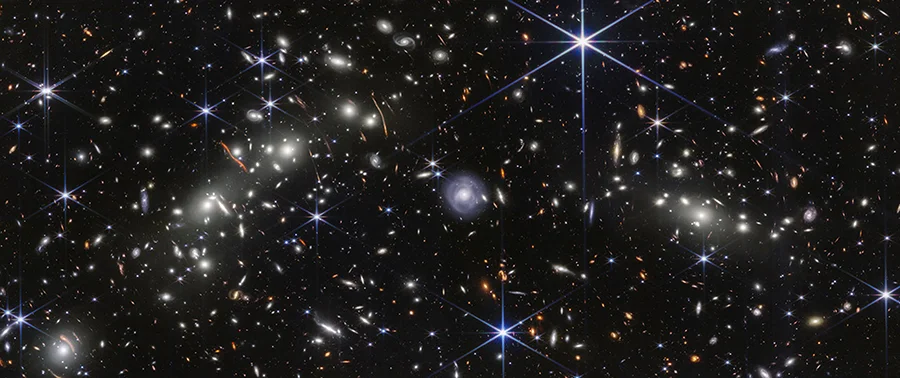
NASA /ESA / CSA / STScI; Science: James Jee (Yonsei University / UC Davis), Sangjun Cha (Yonsei University), Kyle Finner (IPAC / Caltech)
When astronomers identified two early galaxies at less than 150 million years after the Big Bang, ideas abounded as to how these objects might have formed so far faster than theory would have predicted. Now, new data suggests these “galaxies” may actually be a pair of very cold brown dwarfs in our own galaxy.
The Measure of Extreme Distances
Since astronomers deployed the James Webb Space Telescope to peer back to the universe’s infancy, one big surprise has been the discovery of an unusually large number of bright galaxies that exist when the universe was only half a billion years old.
Astronomers identify the distance of such galaxies by their redshift, the decrease in photons’ energy as they travel through expanding spacetime. The most accurate way of measuring redshift is through spectroscopy. By measuring the shift of spectral emission or absorption lines to longer wavelengths, astronomers obtain precise estimates of an object’s redshift and thus distance.
But observing an object’s spectrum takes time, so large galaxy surveys often first use a substitute, called photometric redshift. Researchers can use an object’s brightness as seen through different filters as a proxy for a spectrum. More distant galaxies will “drop out” of filters shorter than a specific wavelength because hydrogen absorbs all light below this band. Depending on their distance, galaxies will drop out at different wavebands: nearby galaxies disappear in the ultraviolet range, while more distant galaxies, whose light is redshifted to longer wavelengths, drop out at infrared wavelengths.

Bradač et al. / arXiv/2604.23668

Bradač et al. / arXiv/2604.23668
Earliest Galaxies?
The earliest galaxy found to date, confirmed using spectroscopy, is MoM-z14, which exists just 280 million years after the Big Bang. But earlier this year, another team identified an early-galaxy candidate called Capotauro. Its photometric redshift suggests it is 200 million years older than MoM-z14. To exist at such an early time requires these galaxies to form at a furious rate — so the finding surprised and intrigued astronomers.
What’s more, Capotauro isn’t alone. In a Webb survey of the nearby Bullet Cluster, in the constellation Carina, researchers identified two objects last year that appeared to be similarly extremely early galaxies. The photometric redshifts suggested that one of these two appeared even earlier in the universe than Capotauro.
Estimating distance using only photometry can be ambiguous, because other cosmic objects can mimic more distant objects. For example, dust in star-forming galaxies can block their shorter-wavelength light, which can also cause them to “drop out” in the same was as early galaxies. Yet, like Capotauro, the other two objects didn’t appear even in images at relatively long wavelengths, at which light can pass through dust. Capotauro-like objects thus seemed more likely to be very early galaxies.
Follow up Reveals Ultra-Cool Brown Dwarfs
Nevertheless, astronomers wanted to obtain a spectrum of these objects. “Astronomers never trust imaging only,” says Maruša Bradač (University of Ljubljana, Slovenia). She led a study of Webb near-infrared spectroscopy of the objects that appears on the arXiv preprint server. Bradač and colleagues followed up on the two objects, again using Webb to take images (in January 2026) as well as spectra (in March 2025).
The new images revealed that the two objects are moving across the sky, showing proper motion. No distant galaxy will appear to move over consecutive images, so the images show without a doubt that the objects are not in the early universe. They are here, within our own galaxy.
Analyzing the objects’ spectra, the researchers conclude that the apparent galaxies are actually brown dwarfs, “failed stars” that are more massive than planets but not quite massive enough to sustain fusion as stars do. These two objects both lie 1,000 to 1,300 light-years away, well within the Milky Way. Though at similar distances, they’re different motions and brightnesses suggest they’re not physically associated.
These brown dwarfs, named Bullet-BD1 and Bullet-BD2, respectively, were able to masquerade as distant galaxies because they’re so unusual. The team’s analysis of the spectra revealed that their surface temperatures to be roughly 350 and 410 kelvin (about 77 and 137°C), respectively. That makes them among the coolest brown dwarfs recorded so far. Brown dwarfs cannot continuously generate their own energy through fusion as stars do, so they cool off over time. These two objects are likely quite old, Bradač’s team concludes.
Marco Castellano (Astronomical Observaory of Rome), who wasn’t involved in the research, says the findings are compelling, adding they “highlight an important source of contamination in searches for the earliest galaxies: Cold dwarf stars may mimic the colors and brightness of extremely distant objects more often than previously appreciated.”
The findings imply that other photometrically-identified galaxies, such as Capotauro, may also turn out to be cold brown dwarfs. However, Pablo Peréz-González (Spanish National Research Council, Madrid), who was also not involved in the study, says that Bullet-BD1 and Bullet-BD2 are tens to hundreds of times brighter than many other early-galaxy candidates. It remains to be seen whether the distance estimates of those other candidates hold.