NASA / JPL-Caltech
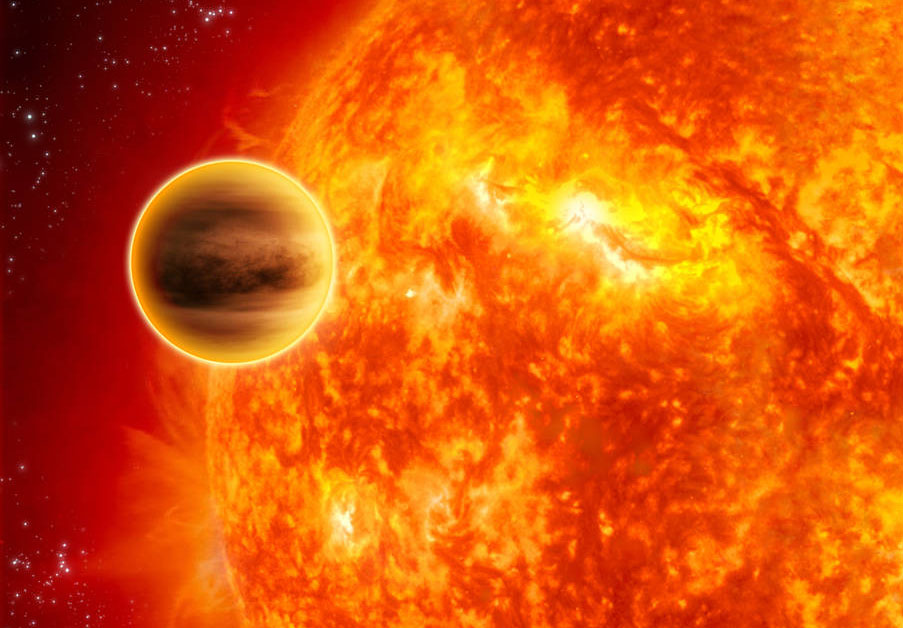
In 2019, astronomers discovered a planetary odd couple: a Neptune-sized world zipping around its star every four days, with a hot Jupiter orbiting close by. Hot Jupiters with inner companions are exceedingly rare — astronomers suspect that they nudge any close companions out of their orbits — so the team followed up on the system with the James Webb Space Telescope, to better understand how it could have formed.
Using JWST to observe the atmosphere of the smaller world, TOI-1130b, the team found that it’s full of volatiles, such as carbon dioxide, water, and sulphur dioxide — molecules that typically gather around planets much farther away from the star. To collect these materials, the Neptune-like world probably formed beyond the ice lines, which define where various volatiles can freeze into ices. For TOI-1130b, the water ice line is about half as far from the star as Earth is from our Sun.
Then, after it formed there, it gently migrated inward through the star’s protoplanetary disk, the thick, planet-forming disk of gas and dust around a baby star. The hot Jupiter, which also likely formed far from the star, must have accompanied it on its journey.
“This is the strongest evidence yet to support the idea of disk migration” for both planets, says Chelsea Huang (University of Southern Queensland, Australia), a co-author on the paper who also led the team that discovered the planetary system in 2019.
A Volatile-Rich Atmosphere
At around 3½ times the size of Earth and nearly 20 times heavier, TOI-1130b is dubbed a mini-Neptune by astronomers. It’s a common type of exoplanet between the size of Earth and Neptune, although we don’t have one in our own solar system.
“When we discovered this system with TESS, we knew the architecture it has is very special,” Huang says, “and thought it would be great to use it to test planet migration theories.”
In August 2024, the team observed TOI-1130b’s atmosphere as the world passed in front of its star. During the transit, molecules in the mini-Neptune’s atmosphere absorb starlight at different wavelengths, imprinting their own unique fingerprints that astronomers can measure in the near-infrared spectra.
Capturing the exact moment of transit was tricky, since the planets are in synchronous orbits; the mini-Neptune circles its star in half the time that the hot Jupiter does. Each planet therefore wobbles and tugs on the other slightly, making their paths less predictable.
But when the team captured the mini-Neptune’s spectrum, they discovered a heavy, volatile-rich atmosphere. That, coupled with the system’s unusual architecture, confirmed that the planets must have formed together farther out, then spiraled inward together.
While pebble-like pockets of volatiles can sometimes drift inwards from the ice line, the hot Jupiter would block any grains from making it into the mini-Neptune. “This planet . . . can be better explained, if you assume that it formed outside the ice line,” says Saugata Barat (MIT), a postdoc who led the paper published in The Astrophysical Journal Letters.
Migrating Worlds

NASA / ESA / CSA / Dani Player (STScI)
In fact, many hot Jupiters are thought to form farther out from their star. Gravitational interactions then perturb their orbits, tossing them violently inward towards a much closer path around the star. Any inner planets cannot survive this turbulent process; the hot Jupiter often scatters them out of the system.
However, astronomers theorized that these two planets settled in their present position due to a much less turbulent process. Interactions with the gas-and-dust disk surrounding the star gradually slowed the planets down, sending them gently spiraling inwards. The planets’ synchronous orbits had already hinted at a smooth inward migration; the discovery of TOI-1130b’s volatile-rich atmosphere confirmed the idea.
“It has been shown that when multiple planets migrate simultaneously through the disk, they can get trapped into these stable equilibria,” says Barat, referring to the planets’ synchronous orbits. “Once it gets trapped in that, it can remain in that state through its life.”
The result also helps resolve a mystery of mini-Neptune formation. Some mini-Neptunes found inside the ice lines might form there. They would quickly accrete mostly lighter elements — that is, hydrogen and helium — before cooling and contracting. But these planets would end up smaller than TOI-1130b, only two or three times Earth’s size. To form bigger mini-Neptunes this close requires migration.
Additional observations of the hot Jupiter’s atmosphere will tell the team more about the planet pair’s history. Since the hot Jupiter gathered material as it was forming, the compounds in its atmosphere can indicate exactly where in the disk it was coalescing. “We’re analyzing that as we speak,” Barat says.
A Population of Mini-Neptunes
According to Rafael Luque (Institute of Astrophysics of Andalusia, Spain), who wasn’t involved in this study, the result enables astronomers to “start routinely measuring the composition of sub-Neptunes.”
Luque is leading another JWST program to measure more mini-Neptune atmospheres in multi-planetary systems like TOI-1130b, but across a range of different ages. “That age dimension will be useful,” he says, “[to] see if the atmospheres were at birth this volatile-rich,” or whether they might’ve acquired more volatiles through chemical processes.
“We need to look at these systems as a population,” Barat agrees. “We’ve looked at a system like this, with an inner Neptune and an outer hot Jupiter, for the first time, and one system cannot tell the entire story.” Studying more worlds will help the team distinguish between mini-Neptunes that form closer to their stars from migratory worlds like TOI-1130b.
“This is a rapidly evolving field,” says Barat. “There’s a lot of work that remains to be done.”