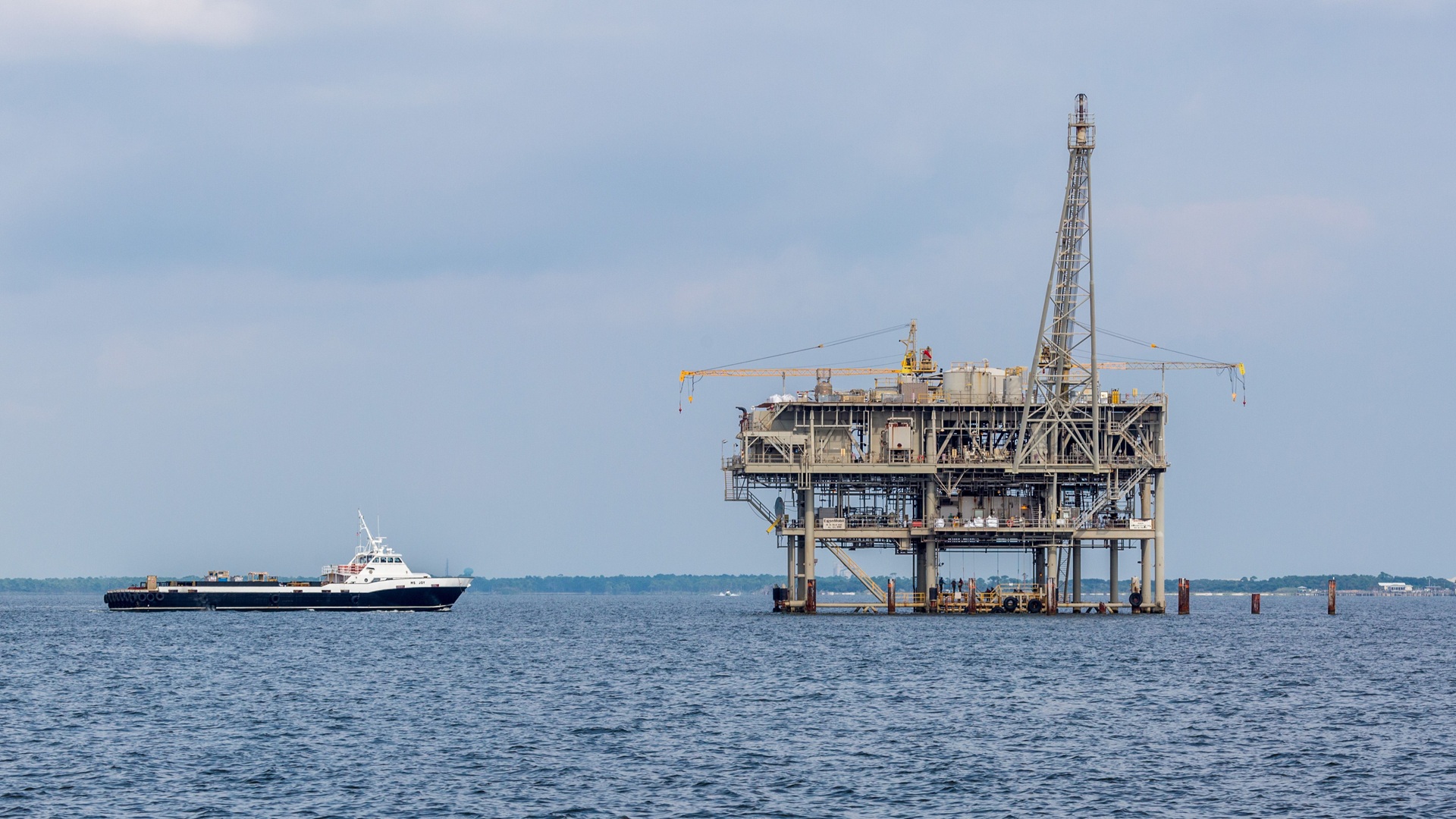
The US Air Force is examining the feasibility of converting retired offshore oil and gas platforms into sea-based rocket recovery infrastructure, a concept that would extend launch and recovery operations well beyond the continental United States, according to a report by BSEE.
The structural case for repurposing steel platforms
Offshore oil platforms are built to withstand extreme marine environments, support heavy mechanical loads, and operate with a degree of logistical self-sufficiency. Semi-submersible and jackup rigs in particular offer large, flat deck areas capable of bearing substantial static and dynamic loads — characteristics that make them plausible candidates for rocket landing zones. Their existing ballasting systems, mooring arrangements, and onboard power generation also reduce the infrastructure investment required to make them operational in a new role.
The structural geometry of a vertical rocket recovery operation — where a booster descends under powered deceleration and touches down on a discrete pad — places intense, concentrated compressive loads on the landing surface at the moment of contact. Whether legacy rig decks can be certified to those specifications without extensive reinforcement remains an open engineering question.
Positioning and mobility
Fixed land-based launch and recovery sites constrain the orbital inclinations accessible to a given mission and create predictable geographic signatures. A mobile sea platform, repositioned to different ocean coordinates, could theoretically support a wider range of trajectory profiles, including polar or sun-synchronous orbits that are difficult to service from sites like Cape Canaveral due to overflight restrictions.
SpaceX has already demonstrated the viability of sea-based rocket landing using its Autonomous Spaceport Drone Ships, purpose-built vessels with stabilization systems designed for booster recovery. The Air Force concept differs in that it involves repurposing existing structures rather than constructing dedicated platforms, which carries both cost benefits and engineering constraints tied to the original design intent of the rig.
Logistics, maintenance, and risk exposure
Operating rocket recovery infrastructure at sea introduces logistical complexity that land-based facilities avoid. Propellant handling, including the safe transfer and storage of cryogenic oxidizers and fuels in a marine environment, requires containment and venting systems rated for saltwater exposure and wave-induced motion. Recovered boosters must also be inspected, potentially refurbished, and transported back to shore, all while the platform is subject to weather windows and sea state constraints.
Corrosion is a persistent risk with any offshore structure, and the thermal and acoustic loads produced by a landing rocket engine are categorically different from drilling operations the platforms were designed around. Structural fatigue analysis would need to account for repeated high-impulse events rather than the relatively static loading cycles typical in hydrocarbon extraction.
There are also regulatory and jurisdictional considerations. Operations in international waters fall outside the standard FAA commercial launch licensing framework, and the Air Force would need to define a clear chain of authority for safety oversight, range control, and emergency response.
Context within broader reusability programs
The Air Force’s interest aligns with its ongoing push to reduce the cost per kilogram of delivering payloads to orbit and to diversify the infrastructure that supports national security space missions. Reusable launch vehicles are central to that calculus. For readers interested in how the military is expanding its space logistics posture, reusable rocket programs in the US Space Force context offer useful background on the operational drivers shaping these decisions.
Whether the oil rig conversion concept advances to a formal acquisition program or remains a study-phase proposal will depend on the structural assessments, cost modeling, and inter-agency coordination that such a novel infrastructure transition demands.