Australia has unveiled what it describes as the southern hemisphere’s first 3D-printed uncrewed surface vessel (USV), designed for defense, surveillance, and maritime security operations.
The 15-foot (4.6-meter) drone boat, called the ASTRA 460, was officially revealed at the Indian Ocean Defence and Security (IODS) conference in Perth, by Western Australia’s Defense Minister Paul Papalia.
The vessel was developed by Henderson-based advanced manufacturing startup, Hyperion Systems, together with marine architecture, engineering and consulting company Versatile Marine, and AI specialist Greenroom Robotics. It is expected to speed up the progress of low-cost autonomous naval systems and strengthen the nation’s domestic manufacturing capabilities.
“USVs provide strong force-multiplication advantages,” Jacob Kleinman, ASTRA project manager, said. “They are significantly cheaper to build and operate than traditional crewed vessels, enable persistent maritime presence, and act as force multipliers for manned fleets.”
Made for defense missions
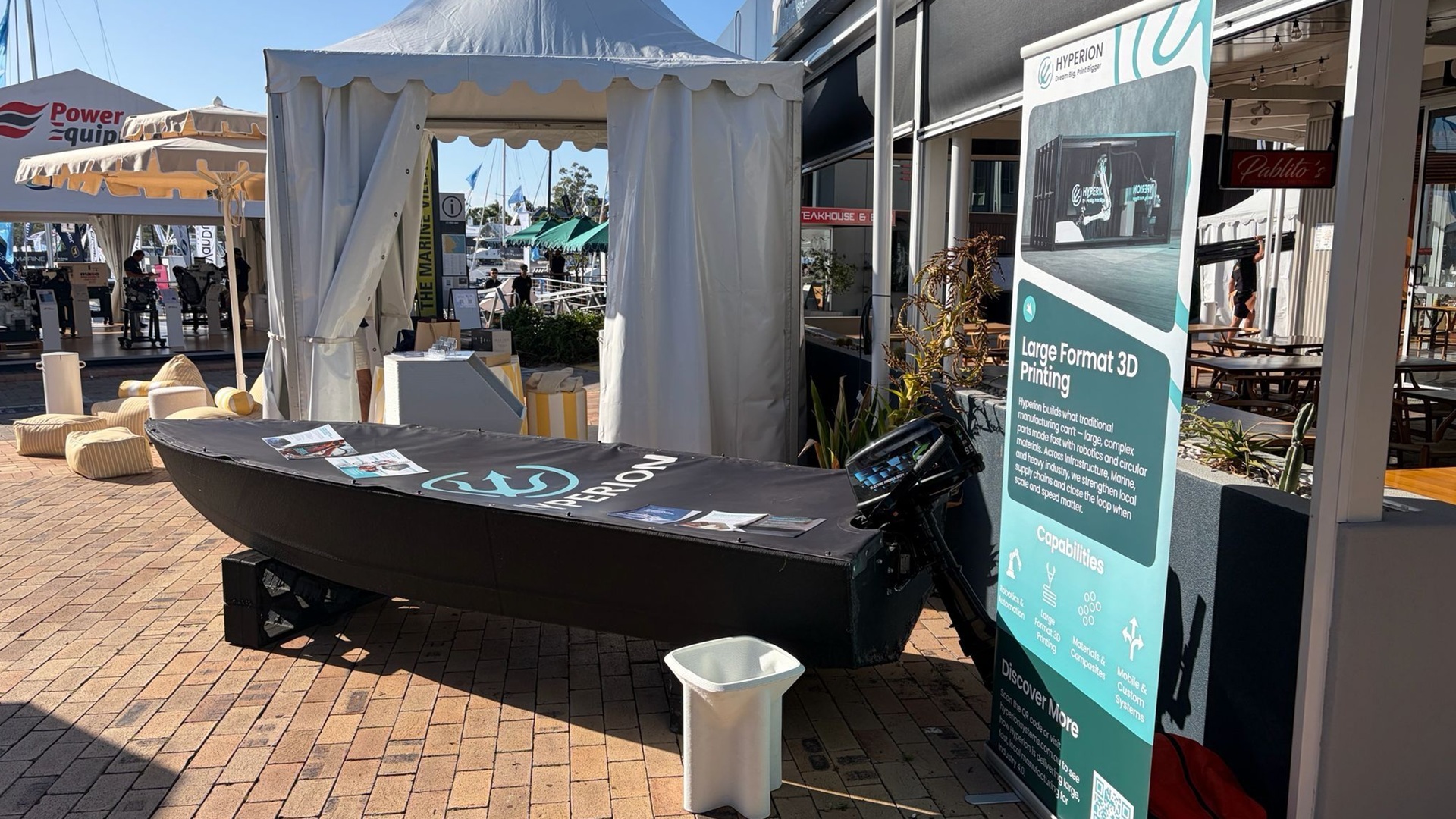
According to Hyperion Systems, ASTRA 460’s hull can be manufactured in about 40 hours by using large-format additive manufacturing (LFAM). The process is a form of industrial-scale 3D printing made for fast production of large parts.
To manufacture the hull, the engineering team utilized recycled polymer waste at the company’s Henderson facility. The process is further powered by the TitanCell production platform. It is described as a factory-in-a-box that combines robotics, large-scale 3D printing, and recycled materials.
Credit: Hyperion Systems
Joshua Wigley, Hyperion CEO, stressed that conventional boat-building methods would have taken four to six weeks to finish the hull. “This dramatic reduction in production time highlights the transformative potential of additive manufacturing for rapid maritime capability and sovereign industrial resilience,” Wigley added.
Harry Hubbert, Greenroom Robotics CEO, stated that the vessel has autonomous navigation and control software, that was made using their GAMA platform. This would result in a great tactical advantage in changing operational environments.
“In contested environments, the ability to quickly adapt a vessel to meet evolving mission requirements delivers a significant asymmetric advantage,” he added. “In a matter of days, a vessel can be printed, autonomy enabled and on the water.”
A smart drone vessel
Another advantage is that the vessel can operate without an onboard crew, due to the smart system. Designed as a multi-role platform, the ASTRA 460 is set to begin a series of sea trials later in May 2026.
It reportedly features a top speed of around 40 knots, cruising speeds between 20 and 30 knots, as well as a range of up to 124 miles (200 kilometers). It can handle different sea conditions while carrying modular payloads for surveillance, border security, reconnaissance, and defense.
Kleinman stated that the ASTRA is set to support missions including intelligence gathering and maritime security operations. “Its modular payload capability also allows rapid reconfiguration for mission-specific roles,” he said.
Wigley reported that Hyperion’s AI systems and 3D-printing capabilities will allow ASTRA vessels to be manufactured in a range of formats and mission setups. “We are immediately provisioning to build 10 units a month and can scale to over 100 as needed,” Wigley added.
The company disclosed that a 26-foot (eight-meter) prototype will be delivered to a European navy later in 2026, for participation in a major naval exercise.