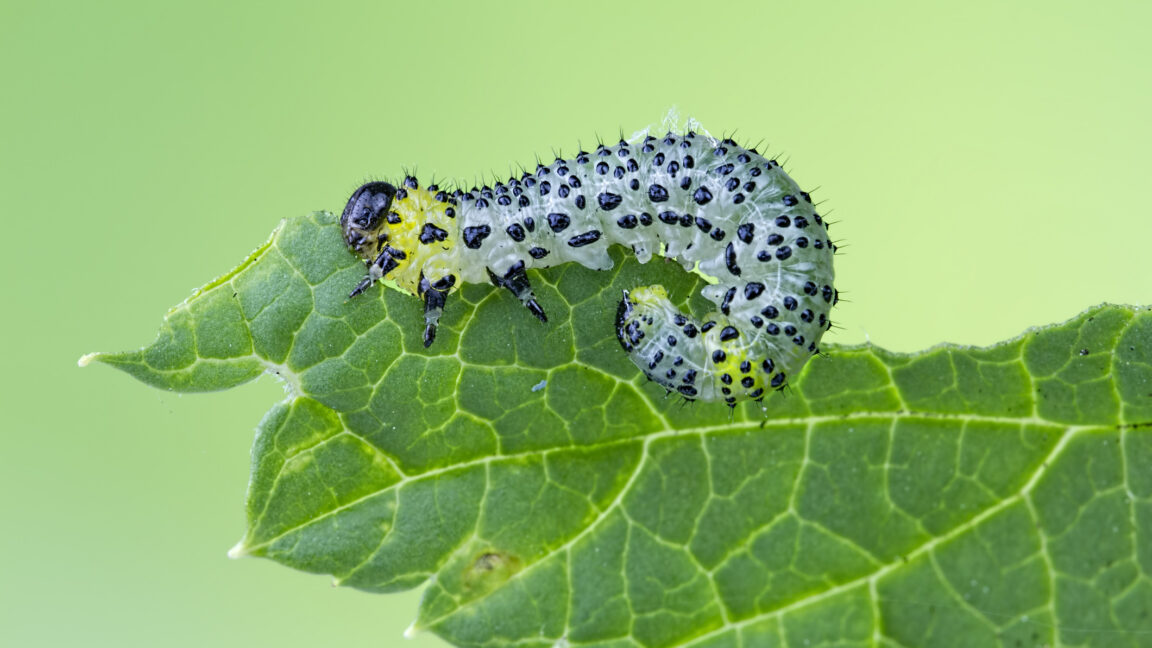
At the same time, the plants unable to detect the molecular signature of the caterpillar’s drool were largely ignored by the wasps. They weren’t completely defenseless, though. “There are other papers that show if you knock out all immune signaling, the caterpillars grow twice as big—they get enormous,” Steinbrenner says. This, he suggests, indicates the immune system had other pathways to deter herbivores like the caterpillars.
Crop defense systems
While the team connected the broken inceptin receptor to a muted distress call, the exact downstream immune signaling pathway isn’t fully understood. The authors suspect that the highly specific caterpillar detection they saw piggybacks on the plant’s general wound response, potentially triggering secondary internal alarms known as damage-associated molecular patterns, or DAMPs. Exactly how the initial receptor activation ultimately translates into the production of volatile organic compounds remains a puzzle.
Another caveat lies in the choice of the attacker. The Spodoptera exigua, known as the beet armyworm, is a generalist herbivore, meaning it feeds on a wide variety of plants and is rather susceptible to botanical defenses. Specialist herbivores that feed on specific plants likely evolve metabolic countermeasures to detoxify or otherwise bypass chemical defenses of their hosts. In the study, the researchers acknowledge that we’re not yet sure whether a functional inceptin receptor provides broad-spectrum resistance, or if specialized pests can fool this alarm system.
Finally, in the Oaxacan field test, the team showed that predatory wasps use the airborne distress signals to find their prey, but the relative importance of direct leaf defenses versus this indirect wasp recruitment isn’t clear. In their future research, the scientists want to investigate this in more detail. Still, the team hopes their work will help us better protect crops like bean plants from pests.
“Today, we do that with chemicals, with pesticides, but if we could use the best receptors and the best volatiles from lots of different plants, maybe we might be able to confer immunity to most problematic pests or pathogens in a sort of targeted way,” Steinbrenner says. “That’s the big picture, the goal of our lab in the long run. And I think doing that would mean understanding more of these types of receptors and volatiles.”
Science Advances, 2026. DOI: 10.1126/sciadv.aec3229