
NASA
Picture yourself at dusk. The Sun is below the horizon and the first stars are beginning to appear in the twilit sky. Jupiter is visible, and it quickly draws attention with its steady bright glow. Now, imagine aiming a simple pair of binoculars at the giant planet. The most interesting thing visible in this scenario might not be Jupiter itself, but the delicate string of four tiny moons on either side of the planet.
These glowing dots may look small, but they are each a world unto themselves. The most distant of these, Callisto — a magnificent icy moon that orbits Jupiter from farther away than the others — has an especially dramatic landscape worth a closer study.
An Icy World
NASA / JPL / DLR
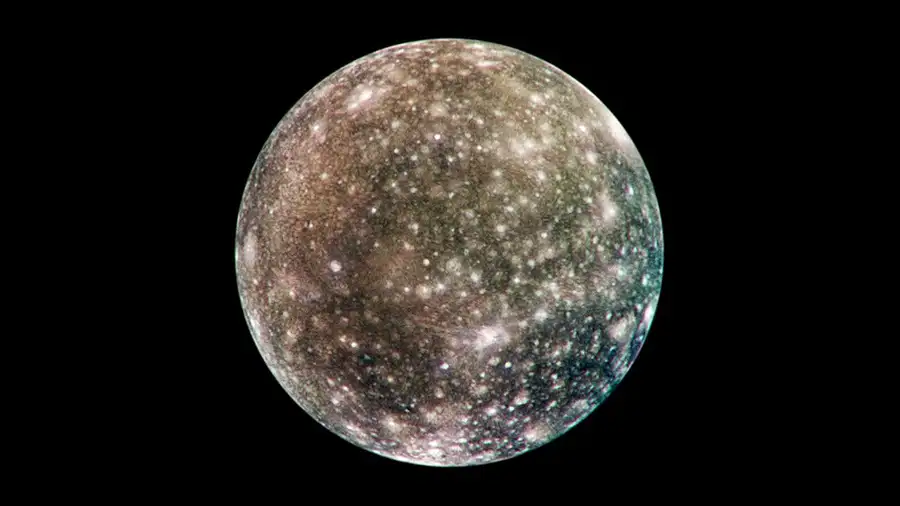
With a diameter of about 4,820 kilometers (2,995 miles), Callisto is nearly identical in size to Mercury (and bigger than our Moon). However, its composition is different. Dense metals dominate Mercury, while Callisto is a comparatively light mixture of water ice and rock. As with so many moons that reside far from the Sun’s warmth, ice is a dominant building material, making up more than half of Callisto. As a result, the moon’s mass is only about ⅓ of Mercury’s, and its gravitational pull is a little weaker than our Moon. So Callisto may be a planet-size world, but it lacks planetary heft.
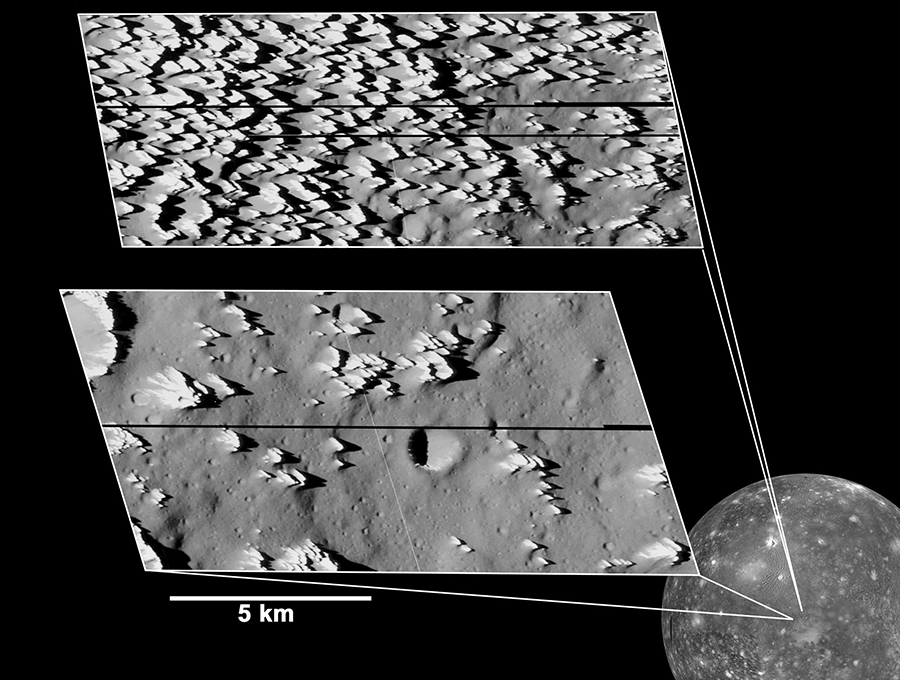
No matter. Callisto is a spectacular place of rugged beauty, with vast cratered plains and jagged cliffs. Among the most interesting features are the towering ice spires — tall spikes likely created in impacts and eroded in the eons since. The spires can soar 100 meters (300 feet) above the surface and would make a majestic sight from the ground.
NASA / JPL / Arizona State University, Academic Research Lab
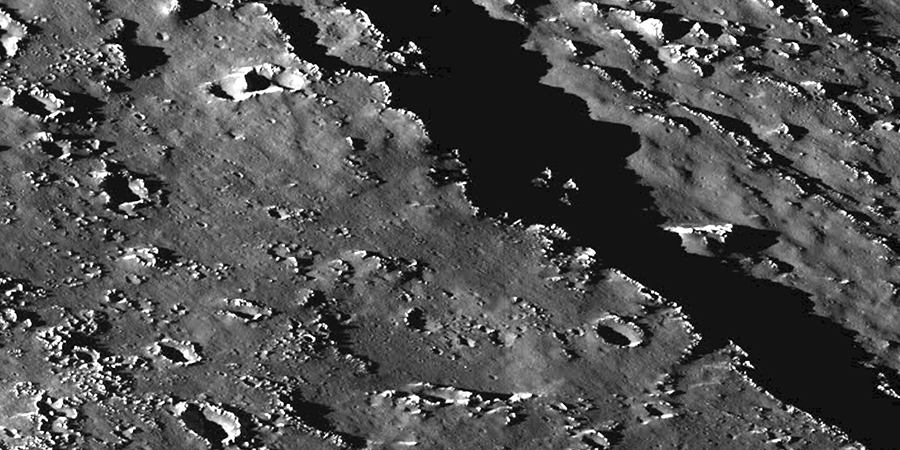
Of no less interest is Callisto’s Valhalla region — a massive multi-ring impact analogous to the smaller Mare Orientale on Earth’s Moon. The force of the Valhalla impact deformed the ice-and-rock surface around it, creating huge wave-like structures. Closer views of these regions from the Galileo spacecraft turned up scarps, tremendous cliffs.
NASA / JPL / ASU
Astronomers also suspect that Callisto, like Europa, hosts an underground ocean, due to irregularities in the moons’ magnetic fields.
Despite all of these points of interest, Callisto has a reputation for being among the solar system’s most uninteresting objects, due its surface, riddled with impact craters. NASA calls it the most heavily cratered object in the solar system. Such a surface indicates a long lack of geological activity, which would otherwise erase older craters (as has happened on Earth and other solar system objects). But the craters themselves, as revealed in spacecraft images, are striking in a way that’s different from other heavily cratered objects such as the Moon or Mercury.
True-color views from the Galileo spacecraft or the Voyagers show a brown surface, often with a background tinge of pinks or purples, splashed all over with impact craters. The colors and textures make Callisto look almost like a Christmas tree ornament. With about 120 million square kilometers of surface, Callisto has roughly the same amount of area as Asia. Far from dull, Callisto offers wonders.
Potential for Human Exploration
When you consider nearby places in the solar system that humans might realistically visit in the foreseeable future, the list is a short one. There’s Earth’s Moon, of course—on which humans have already tread — and there’s Mars.
At one point, though, Callisto was also on the table. A 2003 NASA study suggested the moon as a destination for humans, in the interest of establishing an outpost in the outer solar system. While there’s no question that Jupiter is a long trip — about 5 astronomical units from the Sun — humans have sent eight robotic spacecraft there over the decades, with more on the way.
Callisto is the closest and safest option in the outer solar system. Jupiter’s magnetosphere is so powerful that it captures tremendous quantities of charged particles cast off by the Sun. This magnetic field and associated radiation stretch far into space around the planet, but the intensity decreases with distance. Poor Io, orbiting closest, gets the worst of it, with Europa and Ganymede experiencing strong but progressively weaker radiation. Callisto, dancing a safe 2.9 million km away from its host planet, receives the least radiation, making it a potentially safe haven for human visits.
While NASA ultimately didn’t pursue further study of this concept, it’s fun to imagine such a future. If you could stand on the surface of Callisto, the view would be fascinating. The moon is tidally locked to Jupiter, so if you stood on the nearside, the giant planet would appear to hover in the sky, while Io, Europa, and Ganymede perform slow 1:2:4 orbital revolutions around it, like clockwork, as the hours pass.
How to See Callisto
Returning to reality, you may not be able to visit Callisto, but you can definitely see it. Some of the solar system’s natural satellites are difficult to find with a telescope, but that’s not the case with Callisto. In fact, Callisto is among one of the easiest astronomy targets to seek out.
To do it, you’ll first need to find Jupiter. The planet is visible at some point during the night except during a few weeks every year, when it’s hidden behind the Sun from Earth’s perspective. An astronomy app or chart will help you determine which times Jupiter is visible, and what direction you should look — but it will be somewhere along the ecliptic, the path across the sky that all the planets travel from night to night. (Check our interactive sky chart or our weekly Sky at a Glance post to find the planet.)
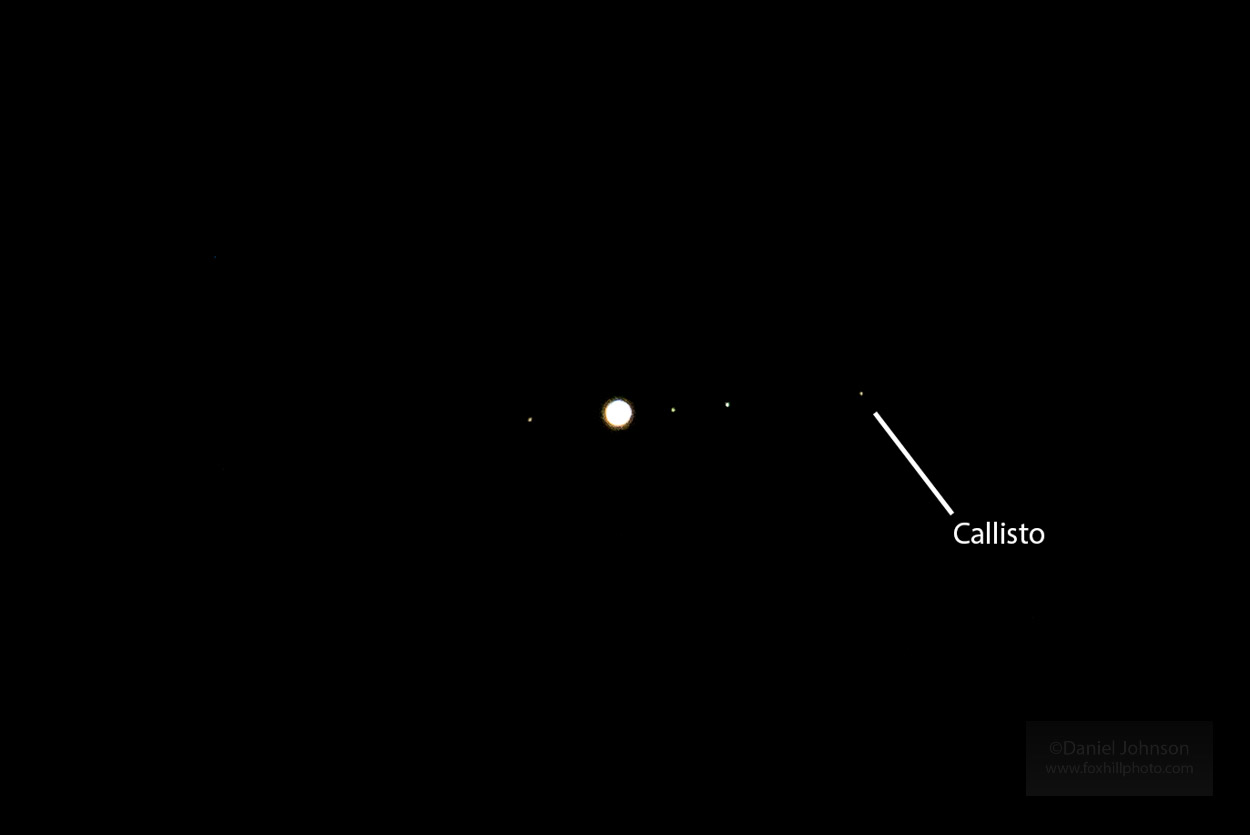
Jupiter is visible without optical aid, appearing as a bright, slightly yellow star; though, unlike twinkling starlight, its light is steady. Now, apply a small telescope to Jupiter — or even 7×50 binoculars will do — and a whole system snaps into view.
Daniel Johnson
Four tiny points of light may appear in line with Jupiter (not coincidentally, this line is also aligned with the ecliptic). These four points are the Galilean satellites, the four largest moons of Jupiter. If you only see two or three, not to worry — sometimes one or more are hiding behind the giant planet. Callisto is the one farthest away from Jupiter, but because you’re seeing a 2D projection of a 3D system of moons that are in constant motion, Callisto might also appear close to the planet in a line-of-sight illusion.
Callisto orbits Jupiter in about 17 days, so it moves rapidly from night to night. (So do the other three). You can check the handy chart in Sky & Telescope magazine that shows Callisto’s position for each day of the month, or use the online observing tool.
When you see the moon, you’ll only see a point of light. But there’s something amazing about seeing an object like this with your own eyes. As those photons travel from Callisto and into your binoculars, it’s almost as if you can reach out and touch the icy moon yourself.