The skyrocketing costs of memory chips are changing the product mix of smartphone makers – cheaper, lower-margin phones aren’t selling so well, while pricier, high-performance models have bigger margins that helped them to absorb the blow. All of this has had an effect on the chipset market for smartphones, reports Counterpoint.
MediaTek remains the largest vendor, though its market share has declined from 38% in Q1 2025 to 32% in Q1 this year. MediaTek’s strong presence in the entry-level and mid-tier segments is being undermined by the reduced smartphone sales in those segments.
According to the analysts, it’s unlikely that the company will launch a Dimensity 9500+ as smartphone makers are focused on using the current 9500 instead. Meanwhile, the Dimensity 8450 has boosted shipments in the mid-range market thanks to popular models like the Oppo Reno15 Pro, Reno15 Pro Mini and Reno15 Pro Max.
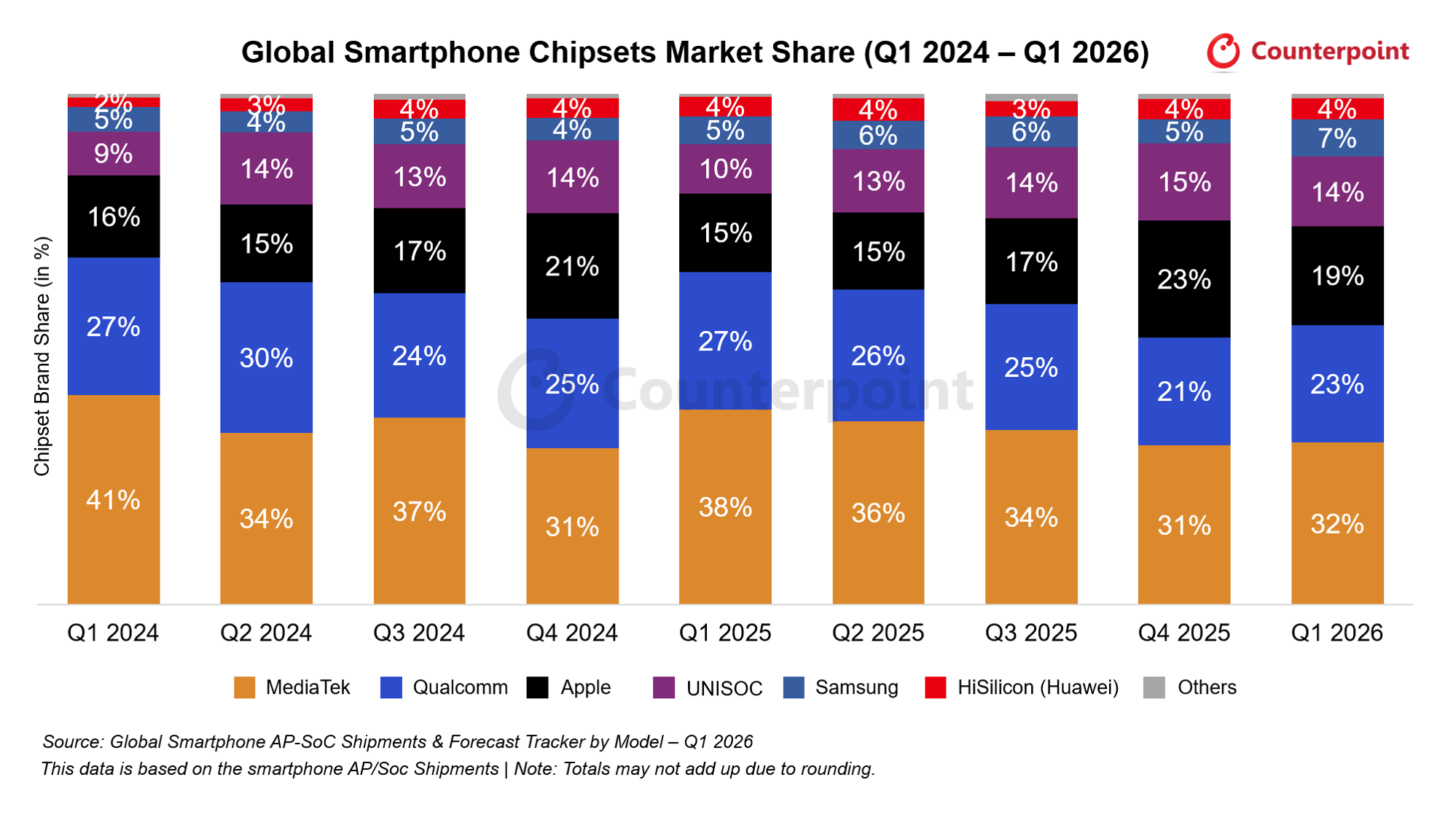
Qualcomm is the second largest chipset vendor and its market share has declined year-over-year too. Counterpoint blames this on the Galaxy S26 series – not only did the phones launch late (so they were on sale only in the last month of the quarter), but some of them use the Exynos 2600 from Samsung. Also, Snapdragon 4 and 6 series chips for entry-level and mid-range phones are suffering for the reasons mentioned above.
Speaking of Samsung, shipments of Exynos increased compared to Q1 2025 as more Galaxy phones use in-house chipsets – not just the 2600 flagship offering, but also the likes of the Exynos 1680 in the Galaxy A57 and the Exynos 1480 in the Galaxy A37.
Apple is the third-largest chipset maker – but that is really a reflection of the fact that it is the second-largest smartphone maker. Even though it is its only customer, it saw increased shipments of Apple A-series chips on the back of strong demand for iPhone 17 models. This includes the iPhone 17e, which outsold the 16e by a significant margin (and is powered by the current A19 chip).
Unisoc has found success in powering Redmi phones. Its T7250 was a popular choice for 4G-only phones, while the T8300 helped Unisoc increase its market share in the 5G segment.
Finally, HiSilicon (Huawei) shipments declined slightly in Q1. The good news is that there was strong demand for premium offerings like the Kirin 9000 chips inside the new Huawei Mate 80 series.
| Brands | Q1 2024 | Q2 2024 | Q3 2024 | Q4 2024 | Q1 2025 | Q2 2025 | Q3 2025 | Q4 2025 | Q1 2026 |
|---|---|---|---|---|---|---|---|---|---|
| MediaTek | 41% | 34% | 37% | 31% | 38% | 36% | 34% | 31% | 32% |
| Qualcomm | 27% | 30% | 24% | 25% | 27% | 26% | 25% | 21% | 23% |
| Apple | 16% | 15% | 17% | 21% | 15% | 15% | 17% | 23% | 19% |
| UNISOC | 9% | 14% | 13% | 14% | 10% | 13% | 14% | 15% | 14% |
| Samsung | 5% | 4% | 5% | 4% | 5% | 6% | 6% | 5% | 7% |
| HiSilicon (Huawei) | 2% | 3% | 4% | 4% | 4% | 4% | 3% | 4% | 4% |
| Others | 1% | 1% | 1% | 1% | 1% | 1% | 1% | 1% | 1% |