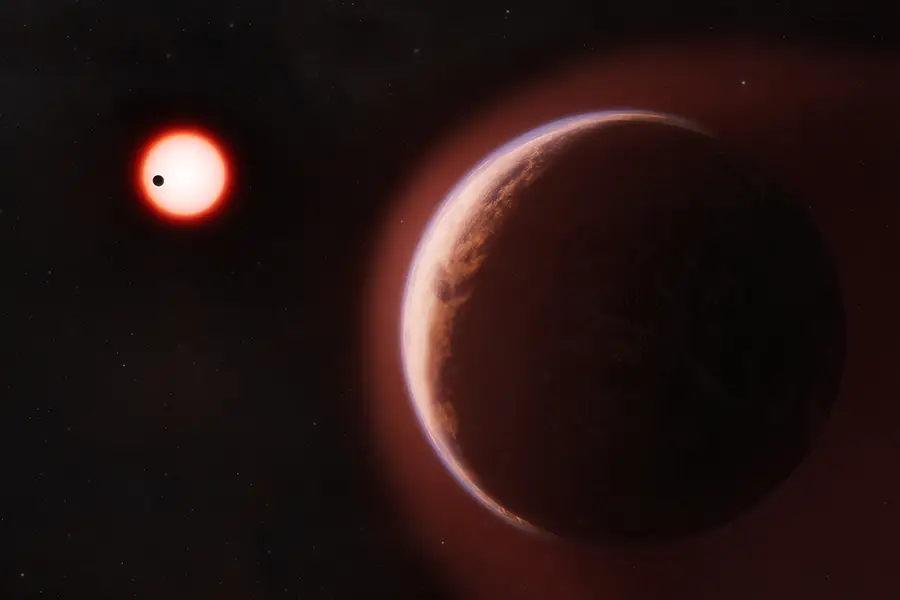
Melissa Weiss / Center for Astrophysics, Harvard & Smithsonian
Is there a planet out there that’s habitable? Astronomers just came one step closer to answering that question by directly observing an atmosphere on a rocky world like our own, for the very first time.
The team, led by Collin Cherubim (now at University of Chicago) while he was a Harvard graduate student, detected helium escaping from the upper atmosphere of LHS 1140b, a rocky world orbiting a mere 49 light-years away.
LHS 1140b has been “hotly studied,” Cherubim says, as it’s a rocky world with the potential to have a terrestrial atmosphere. It’s not exactly Earth-like — it’s 70% larger, and it orbits a dim, red-dwarf star every 25 days — but it resides in the habitable zone of its star, where liquid water might exist on a rocky planet.
The detected helium indicates an upper atmosphere rich in that element. Yet heavier compounds might be trapped below. Such an atmosphere could support liquid water and shield its planet from radiation, making it one of the best candidates so far for life.
“As the first discovery of an atmosphere on a terrestrial-type planet in the habitable zone, this is an important milestone in exoplanet science,” says Robin Wordsworth (Harvard University), one of Cherubim’s dissertation advisors. Not only that, but the team might’ve unveiled a new class of planet only theorized so far: helium worlds.
First Helium World?
While modeling the atmospheres around smaller worlds at Harvard, Cherubim noticed that certain planets initially gathered envelopes of hydrogen and helium. But while they eventually lost the lighter hydrogen, they held onto their helium. So Cherubim went looking among smaller worlds to see if they exhibited helium signatures.
Observing in September 2024 with the Magellan Clay telescope in Chile, Cherubim and his team measured the light of LHS 1140b as the planet passed in front of its star. During such transits, they could pick up on the make-up of its uppermost atmosphere. The helium signal — specifically, absorption from excited helium atoms — appeared loud and clear. (Neutral helium doesn’t absorb light.)
The team estimates that 220 tons of helium blow off of LHS 1140b every second — around the weight of an adult blue whale. High-energy radiation from the planet’s star blast’s off the helium vapor, which streams around and behind the planet in a long tail.
With its star clocking in at more than 3 billion years old, LHS 1140b is probably in its last stages of losing its primordial hydrogen and helium. In fact, the team noticed that the planet had barely any hydrogen left.
At first, the data didn’t tell a perfect story. When the team took more observations of the planet a year later, they were surprised to see no helium absorption at all. But it turns out, changing stellar winds and radiation affect how fast the helium escapes — or even just how much of the escaping helium becomes excited so that it absorbs light at all. After digging deeper into the original dataset, the team couldn’t find another explanation for the original helium detection — it must be coming from LHS 1140b’s atmosphere, the team concludes, most likely from a thick, helium-rich envelope around the planet.
“I’m very excited that [this result has] put a spotlight on the system, making many people interested,” says Charles Cadieux (University of Montreal, Canada). He was not involved in this result but led a previous study on LHS 1140b, finding inconclusive evidence of an ocean beneath the planet’s terrestrial atmosphere.
Cadieux urged caution regarding the variable helium detections, since helium can also be found in stars. “I was very surprised and very excited about this result,” Cadieux says, but he adds that it is still tentative: “I think we need more observations in the end to really know what is going on with this habitable-zone planet.”
What’s more, previous observations of LHS 1140b with the James Webb Space Telescope had ruled out a puffy atmosphere. They also hinted at the presence of heavier compounds, such as carbon dioxide, nitrogen, water, and oxygen. Those observations seem to conflict with the helium detection.
But it’s possible for both to be true, if LHS 1140b has an uppermost, helium-rich atmosphere, while heavier elements lie below. The planet’s colder temperature could help “trap” compounds like water as they rise, freeze into clouds, and rain back down again. The infrared observations from Webb may have accessed the deeper layers of the atmosphere.
Helium . . . And Life?
While the planet’s helium-rich atmosphere is distinctly un-Earth-like, it might still be conducive to life. LHS 1140b is a rocky planet, it’s at the right temperature, and it appears to have an atmosphere that could support liquid water on the surface.
Finding more helium-rich planets like LHS 1140b can help us learn more about our own past. The solar system’s rocky planets were once thought to have formed after hydrogen and helium gas had dispersed. However, a 2023Nature study suggested that Earth might’ve had (and later lost) a primordial envelope of hydrogen and helium, just like the one we see streaming off of LHS 1140b.
Astronomers are already searching for more atmospheres around rocky worlds: A 500-hour observing program kicked off last summer, using the Webb and Hubble space telescopes to look for atmospheres around dozens of planets orbiting red dwarf stars. And astronomers are already hot on the tail of LHS 1140b: Just a week ago, JWST took nine additional observations of LHS 1140b throughout its orbit, as part of this program.
Predicted by theories and now confirmed with an observation, helium-rich planets open a new window on rocky, potentially habitable worlds. “There is an incredible diversity of exoplanets compared to what we see in the solar system,” Wordsworth says. “The cosmos never ceases to surprise us.”