Orest Shvadchak
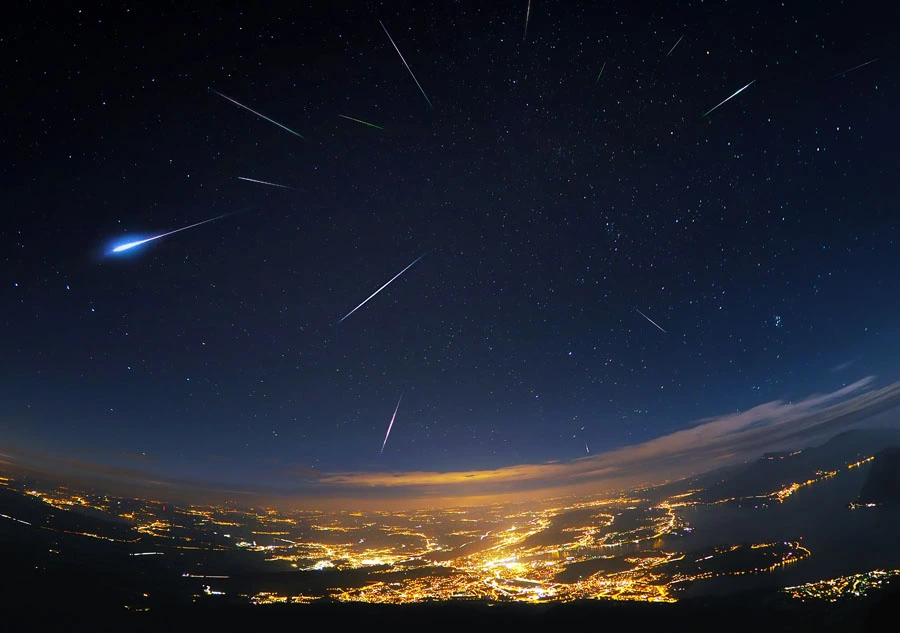
Circumstances couldn’t be better for this year’s Perseid meteor shower. After eclipsing the Sun on August 12th, the Moon hands over the keys and departs the scene. The night belongs to meteor-watchers. The Perseids routinely crank out one of the richest and most dependable displays year after year.
The shower first appears in records left by Chinese astronomers in 36 A.D. But it wasn’t until three European observers put two and two together in the late 1830s that modern astronomers recognized its yearly recurrence. More recently, a 1971 Perseid sighting by singer-songwriter John Denver inspired one of the best-known odes to nature’s knack for touching our hearts. One mid-August, Denver and friends had gone camping high in the Colorado Rockies, planning to watch the meteor shower. The night began hazy but gradually cleared. Around midnight, the famous singer got up to answer nature’s call and noticed the starlight was so intense it cast shadows. In his autobiography Take Me Home, Denver writes:
“The shadow of the starlight blew me away. Maybe it was the state I was in. I went back and lay down next to Annie in front of our tent, thinking everybody had gone to sleep, and thinking about how in nature all things, large and small, were interwoven, when swoosh, a meteor went smoking by. And from all over the campground came the awed responses “Do you see that?” It got bigger and bigger until the tail stretched out all the way across the sky and burned itself out. Everybody was awake, and it was raining fire in the sky.”
The experience led to writing Rocky Mountain High, one of Denver’s most iconic songs.
Sky & Telescope
2026 Perseid Meteor Shower
Now’s your chance: The shower is active from July 7th through August 24th, peaking the night of August 12-13. The broad maximum occurs between around 5 p.m. August 12th and 5 a.m. August 13th. Half-maximum, when half the maximum number may be seen, occurs 1-2 days on either side of the peak.
At its peak, up to 100 meteors per hour might be seen under the darkest of skies. But few of us have that option due to ubiquitous light-pollution. From outer-suburban locations, one-half to one-third that number is more realistic. The most I’ve seen in an hour from my borderline rural sky is around 40. Over time I’ve learned meteor showers are more about the experience than a number. That said, seeing a lot of Perseids never hurt anyone.
NASA / MSFC
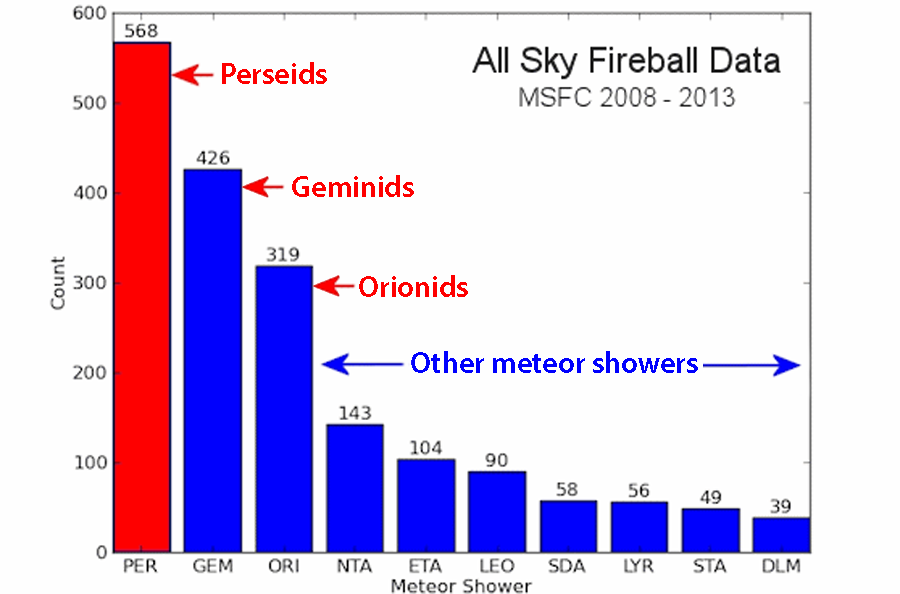
Perseids are also famed for their frequent fireballs. A study by the Meteoroid Environment Office at NASA’s Marshall Space Flight Center (MSFC) tallied 568 Perseid fireballs from 2008 to 2013, nearly 150 more than the second-place Geminids. In 2018, 2020, and 2021, observers reported unexpected upticks in meteor counts 0.7 to 1.5 days after maximum, according to the International Meteor Organization. I witnessed just such a bump on August 14, 2021, the day after the peak. Consider adding an extra morning of shower-watching in case it happens again this year.
Most Perseids are sand-grain-size cast-offs from Comet 109P/Swift-Tuttle, which American astronomers Lewis Swift and Horace Tuttle independently discovered only three days apart in July 1862. At 26 kilometers (16 miles) across, it’s one of the largest-known periodic comets. Being so large, it sheds more mass during each return, providing the Perseids with additional, larger chunks of fireball-producing material that other smaller comets can’t match.
Every year in July and August, Earth crosses 109P’s dusty-pebbly orbital trail. The debris crashes into our atmospheric windshield at 59 kilometers a second (132,000 mph), fast enough to compress and heat the air in its path to over 1,650°C (3,000°F). The encounter vaporizes the particle and ionizes the air in a flash of wonder-inducing light. In the interactive simulation above, courtesy of MeteorShowers.org, zoom in using your mouse’s scroller to visualize the planet’s yearly encounter with Comet Swift-Tuttle’s particle stream.

Copyright Radu M. Anghel
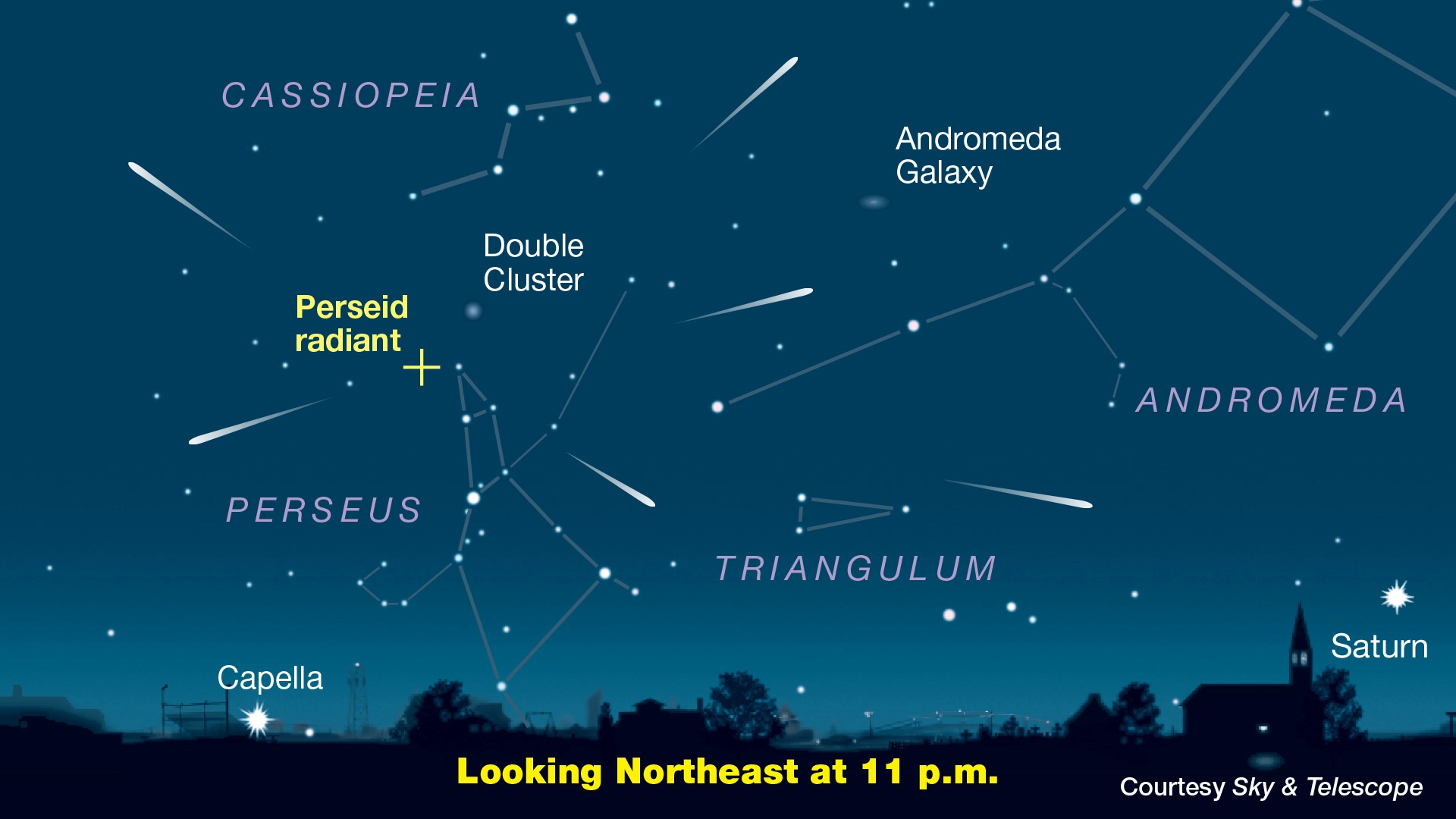
A good time to start watching is around 10 p.m. local time. Perseids will stream from the radiant in Perseus (hence the name), just below the W of Cassiopeia. The radiant will be low in the northeastern sky, so counts will be reduced because the horizon masks most downward-traveling meteors from view. However, this is a great time to see earthgrazers — slow, bright, long-trailed meteors that strike the atmosphere at a shallow angle and flare for many seconds.
As the night goes on, the radiant ascends into open sky, and the number of meteors we can see increases. After midnight, Earth turns into the direction of the stream, which further boosts activity. Instead of catching up to us, the planet plows head first into the blizzard. Best viewing will be from around 2 a.m. till dawn. Perseids can appear anywhere on the sky, but their paths always point back to the radiant. If you see one that doesn’t, it’s a sporadic meteor, not a shower member. There’s no one area of sky to view, but you’ll find the best direction to look is away from the worst light-pollution, so you’re facing the darkest sky.
Bob King
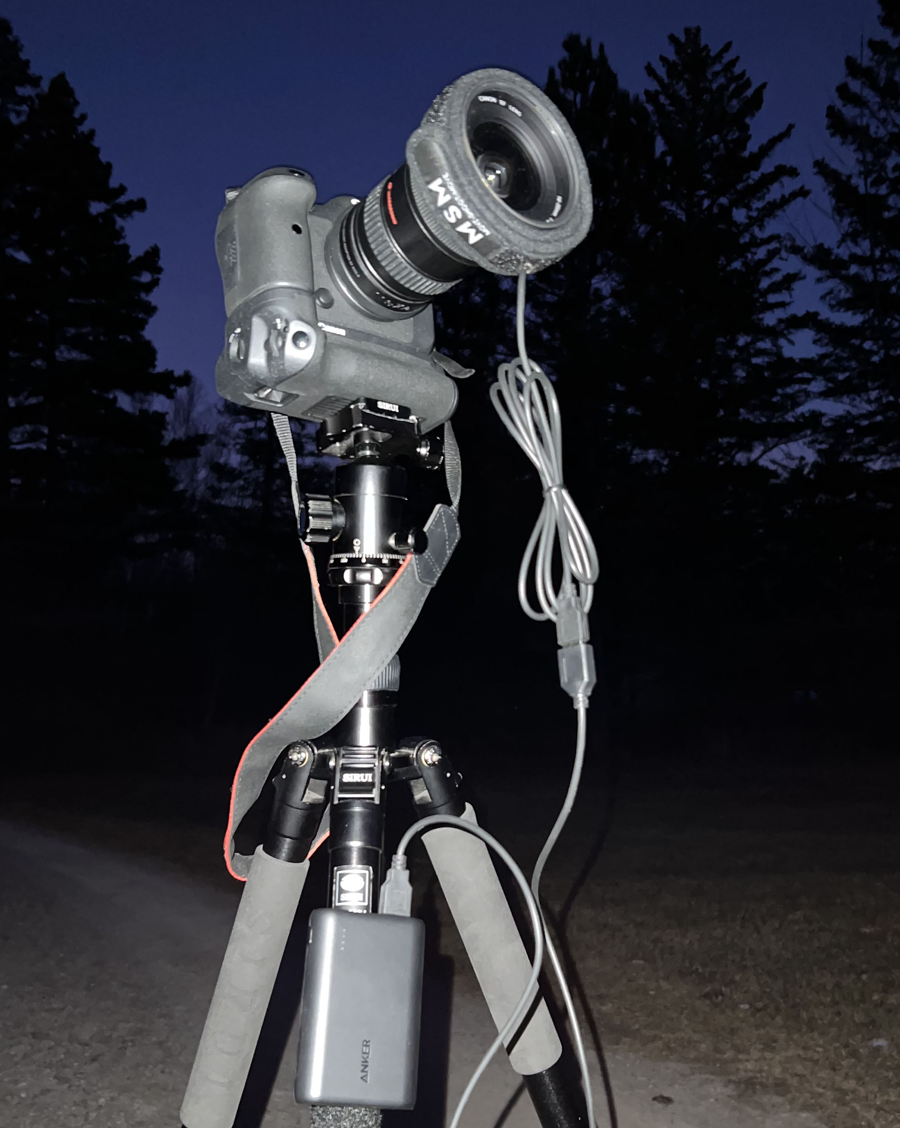
Other than that, you might want a comfortable lounging chair (or sleeping bag spread on the ground), and you’ll need to decide what time works best for you. I watch for a half-hour to hour as soon as it gets dark. Then it’s off to sleep before rising again at 1 or 2 a.m. for the juiciest part.
The Perseids provide the opportunity to tune into the nocturnal landscape, feel the Earth turn under the steady stars, and watch meteor after meteor with anticipation and surprise. Even after two or more hours, it’s never easy to fold up the chair and head back to bed. Have a pleasant sojourn, and don’t forget to wish upon a shooting star.