Bob King
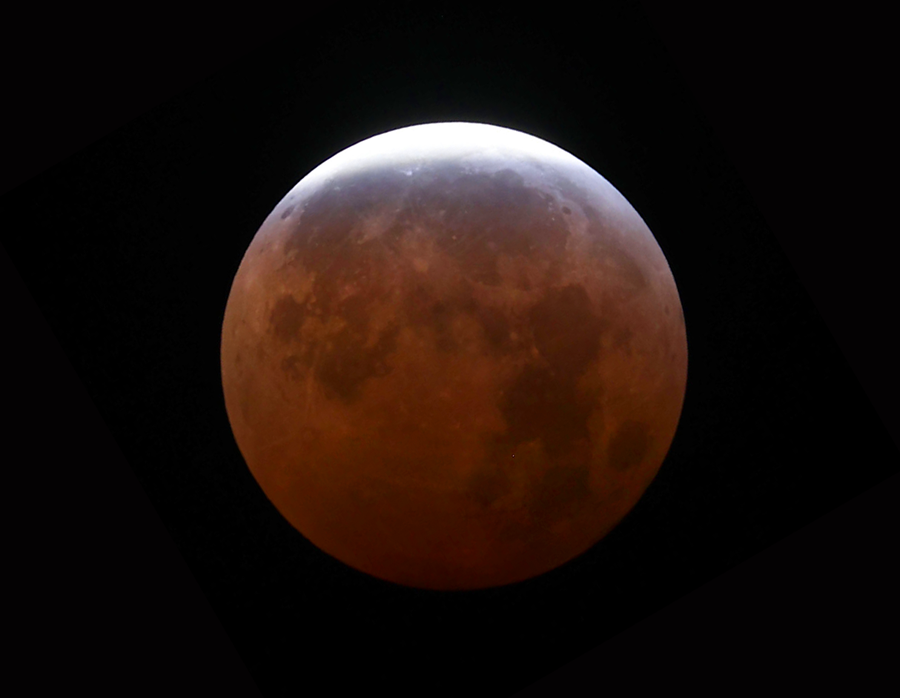
Good thing eclipses come in pairs. If you weren’t able to see the Aug. 12th total solar eclipse due to location or clouds, orbital mechanics has your back. The same near-perfect alignment of the solar system’s celestial trinity — Sun, Earth, and Moon — holds just long enough for the full Moon to slip into Earth’s dark, central shadow, or umbra, Thursday night, August 27–28. Greatest eclipse occurs at 12:13 a.m. EDT, when 96% of the Moon glows like a smoldering sunset. The remaining bright lunar sliver pokes out into Earth’s lighter, outer shadow, or penumbra, silvering the northern limb.
There are two different ways of describing how much of the Moon the Earth’s umbra covers. The first is magnitude, which is the fraction of the Moon’s diameter covered by the umbra. For this eclipse, it’s 0.93 or 93%. Then there’s obscuration, or the total amount of the Moon’s surface area obscured by the umbra, in this case 96%. Take your pick.
Leah Tiscione / Sky & Telescope
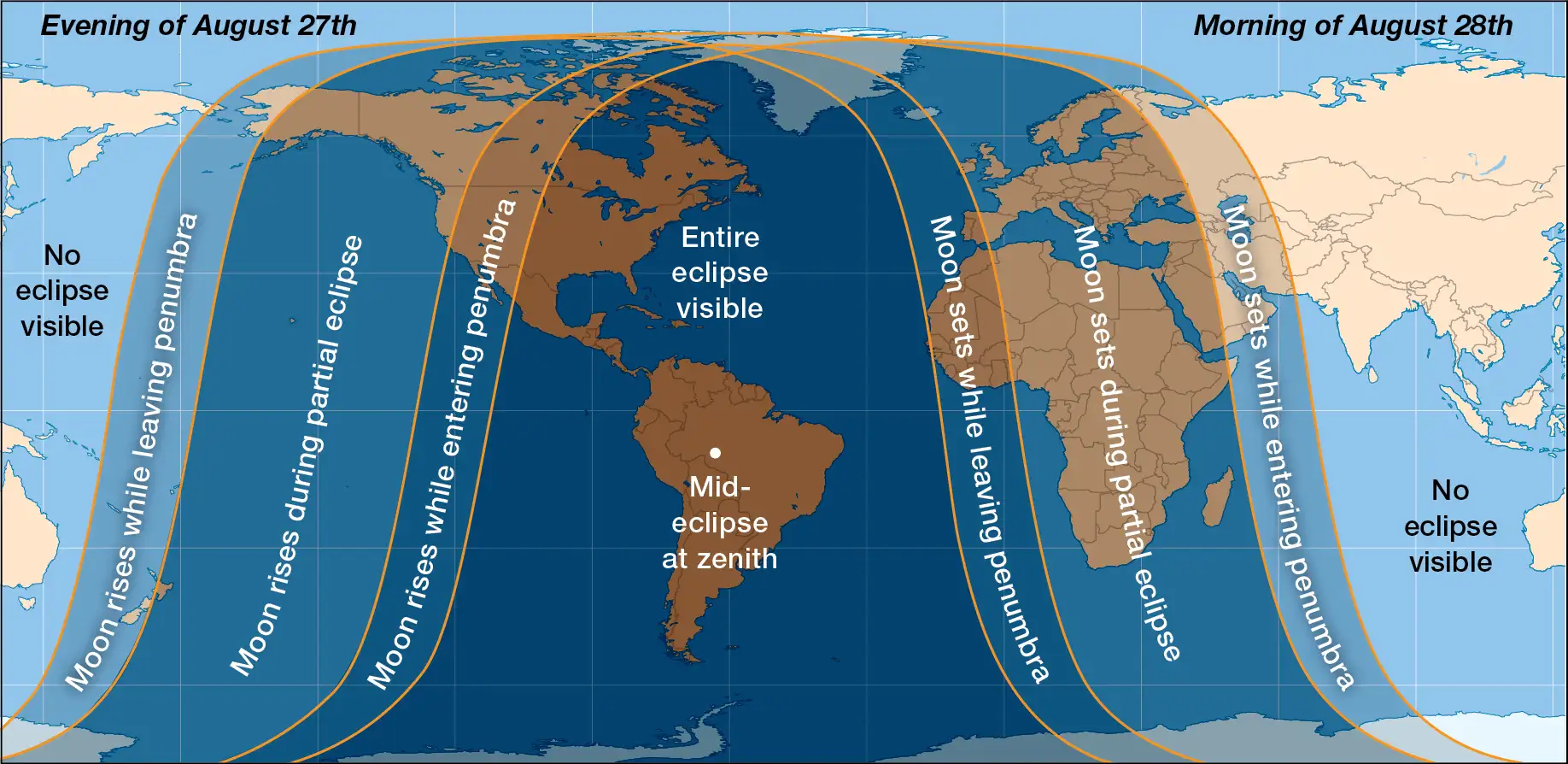
Maximum eclipse will be visible throughout the Americas except for Hawaiʻi and parts of Alaska. In Anchorage, the Moon rises 40% in shadow after greatest eclipse. From the West Coast, the Moon rises with the partial eclipse either underway or soon to begin. Astrophotographers with a wide-open horizon would want to take advantage of the chance to frame the Moon and a favorite landscape in a telephoto lens. In Africa and Europe, the lunar shadow-dance occurs during the wee hours up through dawn August 28th. The table below gives times for U.S. time zones. (Note: Times in bold type are for August 28th).
| Eclipse phases by time zone on August 27 and August 28, 2026 | |||||||
| Eclipse Event | UT | EDT | CDT | MDT | PDT | AKDT | HAST |
| Penumbra first visible | ~2:00 | ~10:00 p.m. | ~9:00 p.m. | ~8:00 p.m. | ~7:00 p.m. | ~6:00 p.m. | ~4:00 p.m. |
| Partial eclipse begins | 2:33 | 10:33 p.m. | 9:33 p.m. | 8:33 p.m. | 7:33 p.m. | 6:33 p.m. | 4:33 p.m. |
| Greatest eclipse | 4:13 | 12:13 a.m. | 11:13 p.m. | 10:13 p.m. | 9:13 p.m. | 8:13 p.m. | 6:13 p.m. |
| Partial eclipse ends | 5:52 | 1:52 a.m. | 12:52 a.m. | 11:52 p.m. | 10:52 p.m. | 9:52 p.m. | 7:52 p.m. |
| Penumbra last visible | ~6:15 | ~2:15 a.m. | ~1:15 a.m. | ~12:15 a.m. | ~11:15 p.m. | ~10:15 p.m. | ~8:15 p.m. |
| Note: Times in bold type are for August 28th. | |||||||
| Source: U.S. Naval Observatory | |||||||
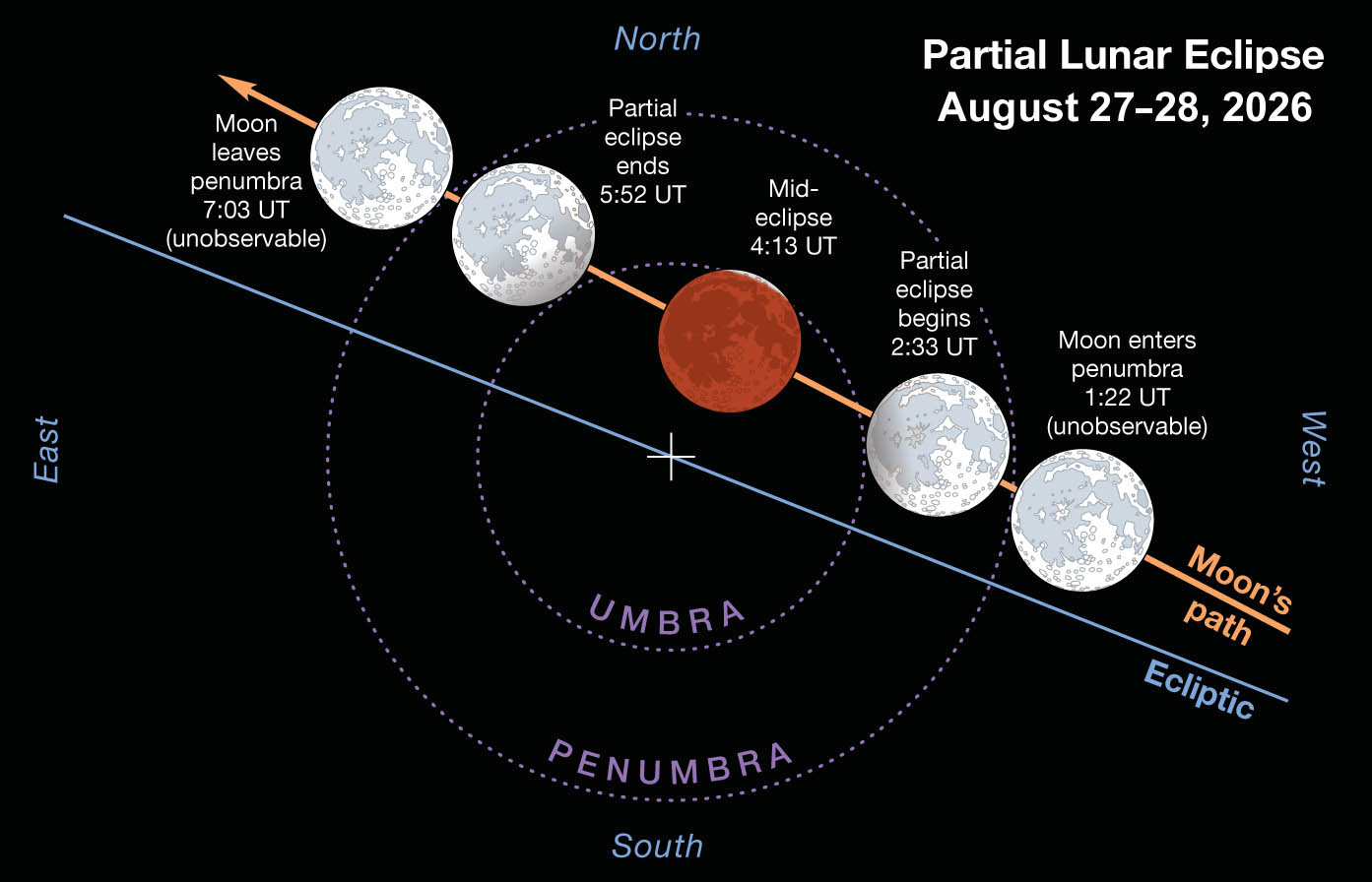
About a half hour prior to the start of partial eclipse, you’ll notice that the eastern third of the Moon looks duller, almost bruised. The odd sight becomes ever more obvious the deeper the Moon ventures into the outer penumbral shadow, a zone of partial sunlight and partial shadow. From the perspective of someone standing on the Moon, Earth partially covers the Sun and filters the light but doesn’t quench it. Penumbral shading deepens as the Moon races toward the umbra, sprinting along at more than a kilometer per second (2,260 mph).
Leah Tiscione / Sky & Telescope; Source: Fred Espenak
Partial eclipse begins when the lunar limb first contacts the umbra. Before too many minutes pass, you’ll see the darkened Moon glowing softly in hues of red and orange. Earth’s atmosphere refracts (bends) the combined light of every sunset and sunrise occurring around the globe’s edge and beams it into the umbral shadow. When the Moon arrives, it redirects the glory back to our eyes. For our distant ancestors the “blood-red” eclipsed Moon was often seen as a bad omen, a sign that an angry god was devouring the orb to punish us for our wayward ways. Nowadays, the only anger directed at eclipses is at the clouds that prevent us from seeing them.
Jona Lendering, CC BY-SA 3.0
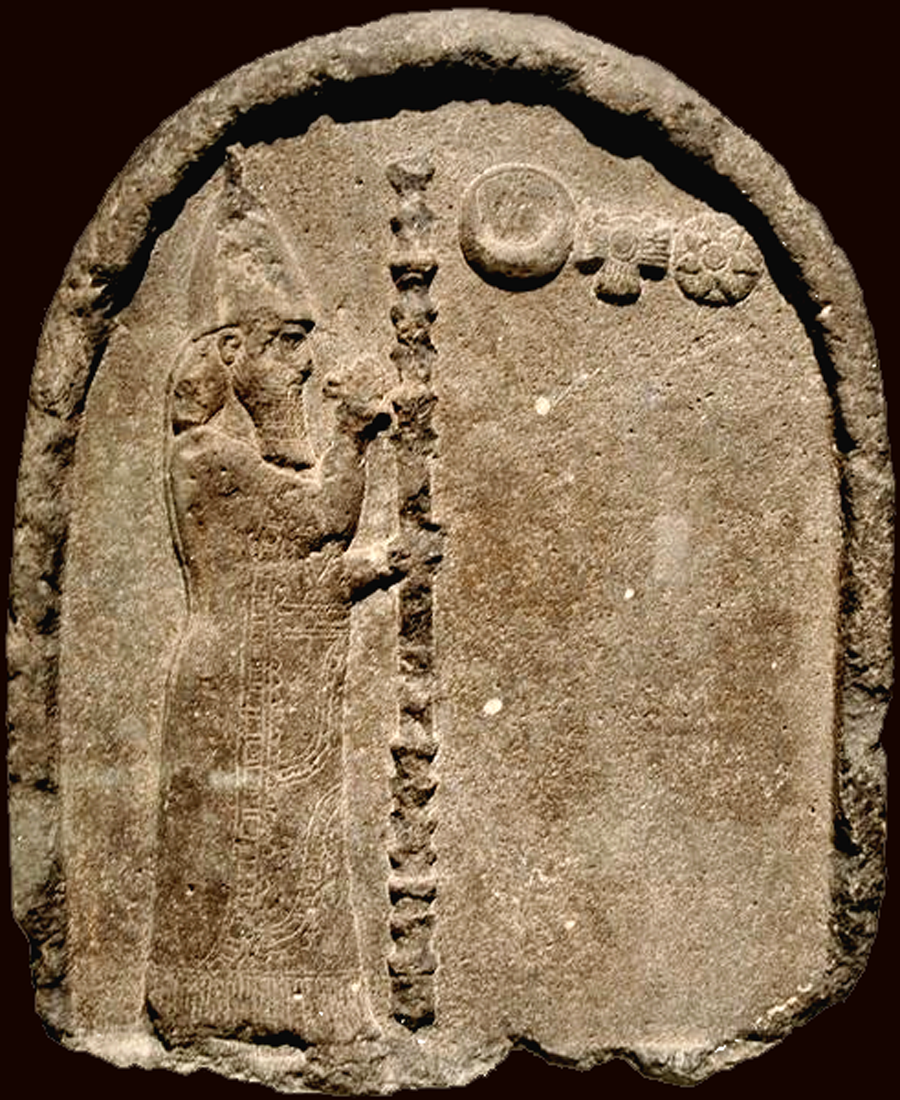
The ancient Babylonians, who were the first to successfully predict eclipses, also believed they foretold the death of the king. To avert this outcome, they tricked the bad omen by installing a “substitute king“. He would be dressed in regal clothing and temporarily assume the throne while the real king would go into hiding. Once the danger had passed, the substitute would remain king for 100 days before being ritually executed. I’ll willingly sacrifice sleep and comfort to see a lunar eclipse but draw the line at death.
Bob King
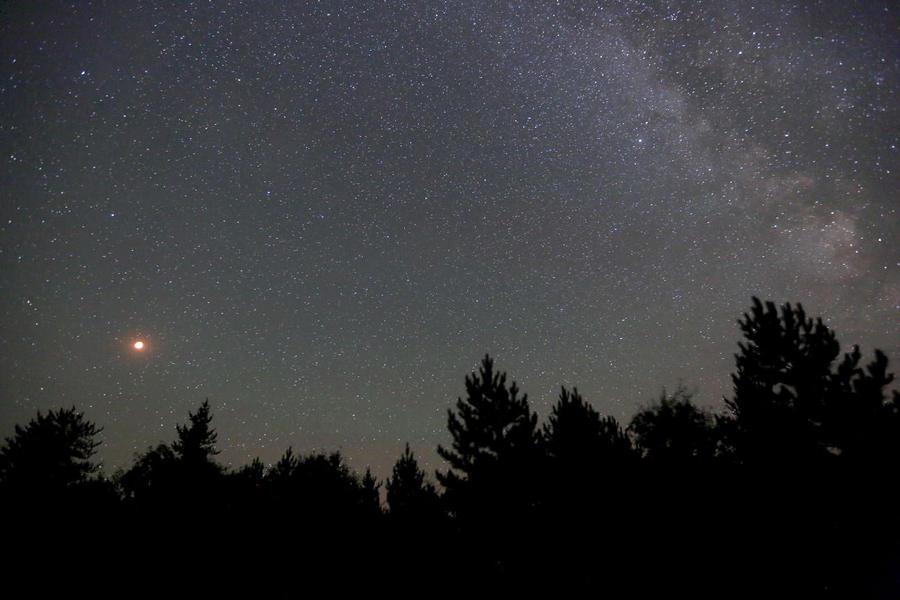
Despite not being total, enough of the Moon will be hidden in shadow for the stars and Milky Way to return to their full splendor. At least for a short time around greatest eclipse. A bonus peek at a dark sky has always been one of my favorite aspects of lunar eclipses. It feels end-of-world. Sometimes I’ll observe a faint comet or variable star that otherwise would be dashed by moonlight. The slow return to a fulsome Moon and star-poor sky mimics the end of totality during a solar eclipse but at a far-more relaxed pace.
Invite your spouse, family, or friends to join you for this colorful, casual celestial alignment. The next eclipse anywhere near this deep for the Americas won’t occur until the total lunar eclipse of June 26, 2029.