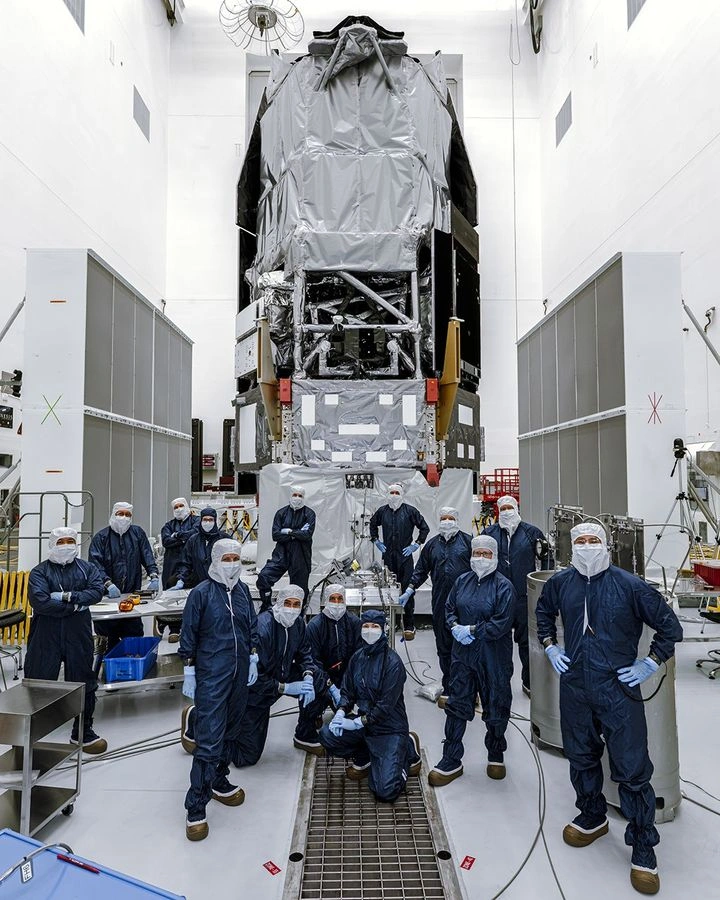
NASA has a new telescope headed into space. A SpaceX Falcon Heavy rocket roared to life at launch pad LC-39A at the Kennedy Space Center shortly after sunrise early Sunday morning August 30th, sending the Nancy Grace Roman Space Telescope spaceward. Liftoff occurred at 7:26 a.m. EDT / 11:26 UT.
The Roman telescope will offer astronomers an unprecedented view of planets across the Milky Way. With Roman, astronomers will also probe the nature of dark matter and dark energy across the cosmos. The mission’s objectives will go a long way towards filling in our understanding of these questions on the modern forefront of astronomy and cosmology.
The mission launched early, ahead of a lift-off originally set for the spring of 2027. The telescope separated and deployed from the upper stage booster at T+31 minutes, and NASA is now tracking the telescope in good health, via the Deep Space Network (check and update).
NASA / Sydney Rohde (Rocz)
The Telescope
The telescope started its journey as the Joint Dark Energy Mission (JDEM); it was later designated the Wide-Field Infrared Survey Telescope (WFIRST) when it was approved for development in 2016. The National Reconnaissance Office donated the telescope’s 2.4-meter mirror (the same size as Hubble’s) to NASA in 2012. (Another surplus mirror just like it has yet to be assigned a mission.) JDEM originally called for a 1.5-meter mirror, and the fortuitous gift of a larger mirror allowed for the inclusion of the mission’s coronagraph, an instrument designed to block the light of a bright star in order to reveal fainter objects, such as planets, around it.
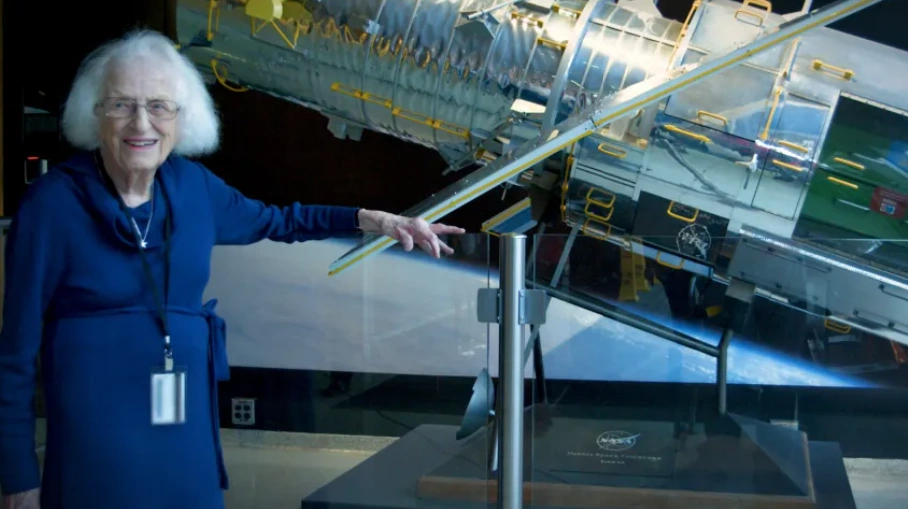
In 2020, the space telescope was named after Nancy Grace Roman, NASA’s first Chief of Astronomy, who is often referred to as the “Mother of Hubble.”
NASA
The mission’s development really came together after the COVID pandemic. NASA Roman Payload Systems Engineer Bear Witherspoon attributes the team’s timeliness to “open honest communication from both project management, our subcontractors, and all of the people on the technical side of the team.” Roman includes international collaboration as well, with the space agencies of Japan, Europe, and France, as well as Germany’s Max Planck Institute, all contributing to the coronagraph.
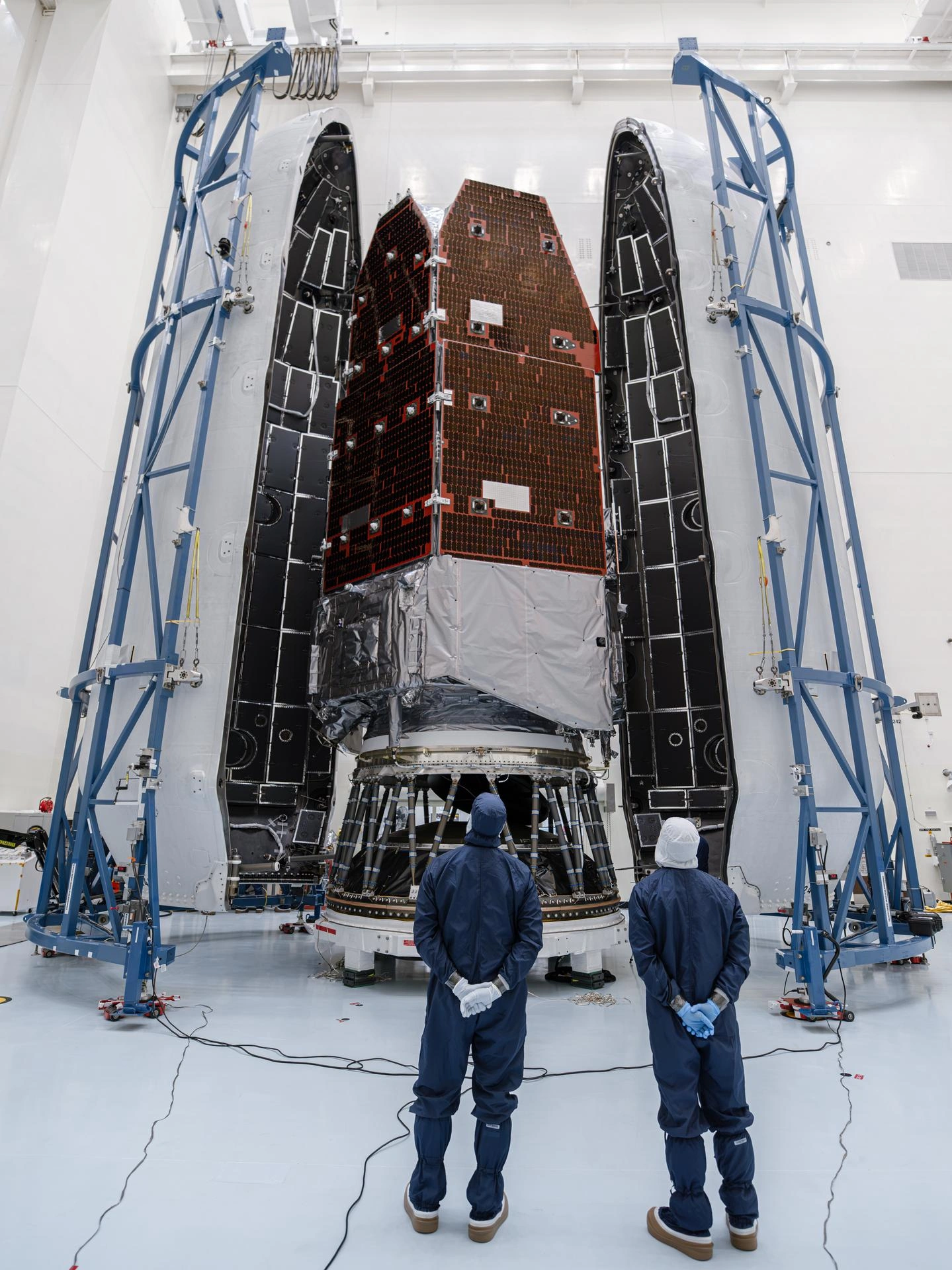
Now, the mission will head toward a looping Lissajous orbit around the L2 Lagrange point, a stable region about 1.5 million kilometers (about 1 million miles) beyond Earth in the anti-Sunward direction. This location will keep the telescope at a cold, thermally stable region of space; station-keeping with Earth requires minimal power. Earth, meanwhile, remains nearby for communication. Other scopes at L2 include the James Webb Space Telescope and ESA’s retired Gaia mission.
NASA / Sydney Rohde (Rocz)
Roman is also the first space telescope launched with a grapple fixture onboard, which could one day be used for capture and repair to extend the telescope’s operational lifespan. Roman has a 5 year nominal mission.
The Instruments
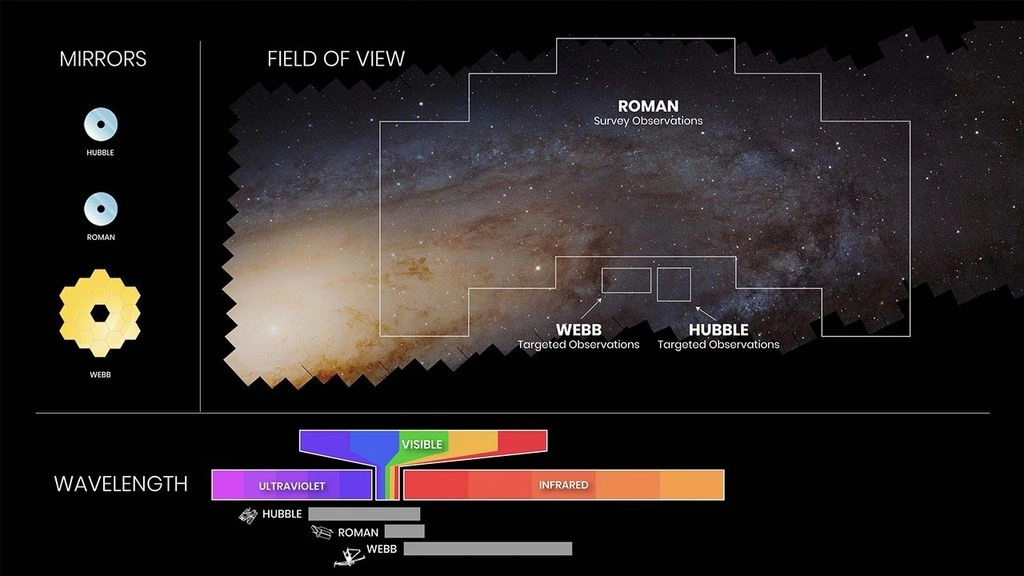
The Nancy Grace Roman Space Telescope has two instruments onboard: the Wide Field Instrument (WFI) and the coronagraph. Every 300-megapixel WFI image covers 0.28 square degrees of sky, a field of view bigger than the Moon. That field of view sets the telescope apart from other NASA flagships, and far outstrips that of Hubble or Webb. It’s 100 times that of Hubble’s Wide Field Camera 3 (WFC3) view, yet offers the same Hubble-quality resolution.
WFI is the telescope’s primary work horse, using 18 detectors to take images through a set of eight different wavelength filters that span from visible light through near-infrared. The images, which have an unusual “space invader” shape that follows the mirror’s form, will be pieced together to generate enormous surveys of the night sky.
NASA
Like many modern astronomical projects, Nancy Grace Roman will generate a copious amount of data. To handle the expected 20 petabytes of data that the mission will generate over its five-year nominal mission, NASA has established the Roman Research Nexus. Nexus is a cloud-based science community that will be available to the public, students, and researchers.
“There’s going to be 1.4 terabytes of data coming down every day,” says Witherspoon, likening the deluge to “listening to a million songs a day.”
The coronagraph instrument onboard the mission is a technology demonstrator, designed to block light from the star to see fainter exoplanets nestled close in. Roman’s coronagraph uses an innovative combination of baffles, deformable mirrors, and software to essentially cancel out the host star’s light using a method known as destructive interference. Roman’s coronagraph will resolve exoplanets and faint bits of protoplanetary disks that are several orders of magnitude fainter compared to what previous missions.
The Science
The mission is expected to address key questions within the study of exoplanets. In addition to exploration of individual systems using the corongraph, Roman’s wide-field survey capabilities enable it to chronicle gravitational microlensing on a massive scale, in which the the gravity of smaller objects such as stars or planets briefly magnify the light of background stars.
“We’re going to do a demographic census of exoplanets in the Milky Way,” says Witherspoon. While Roman isn’t expected to image terrestrial exoplanets directly, the coronagraph demonstrator will pave the way for missions such as the Habitable Worlds Observatory. Microlensing, on the other hand, will offer a view of planets across large swaths of the Milky Way.
At the same time, gravitational lensing offers cosmologists something completely different: The chance to map dark matter as well as dark energy across cosmic time. In doing so, astronomers will better understand the cohesive effects of dark matter as well as the repulsive force of dark energy.
A crucial observation that Roman is expected to make is a measurement of dark energy’s impact on the early universe. If the strength of the repulsive force has changed over time, Roman will measure that by observing so-called baryon acoustic oscillations. These ripples in the distribution of galaxies in the early universe serve as a kind of ruler, measuring changes between the early formation of the universe and how it differs from what we’re seeing today.
Roman will also test the role and nature of dark matter on large scales. This, too, involves the mission’s vast survey capabilities. Roman will map galaxies and galaxy clusters on an unprecedented scale. Astronomers can then use the most minute effects of gravitational lensing to chart unseen dark matter, illuminating its role in the cosmic past and present.
Beyond exoplanets and cosmology, Roman will also pursue fast-changing objects. The telescope can slew to a new patch of sky quickly, which will make it flexible for going after gamma-ray bursts, supernovae, and other celestial transients.
Read more about Roman science in Govert Schilling’s September 2026 feature article: “The Start of the Roman Empire”
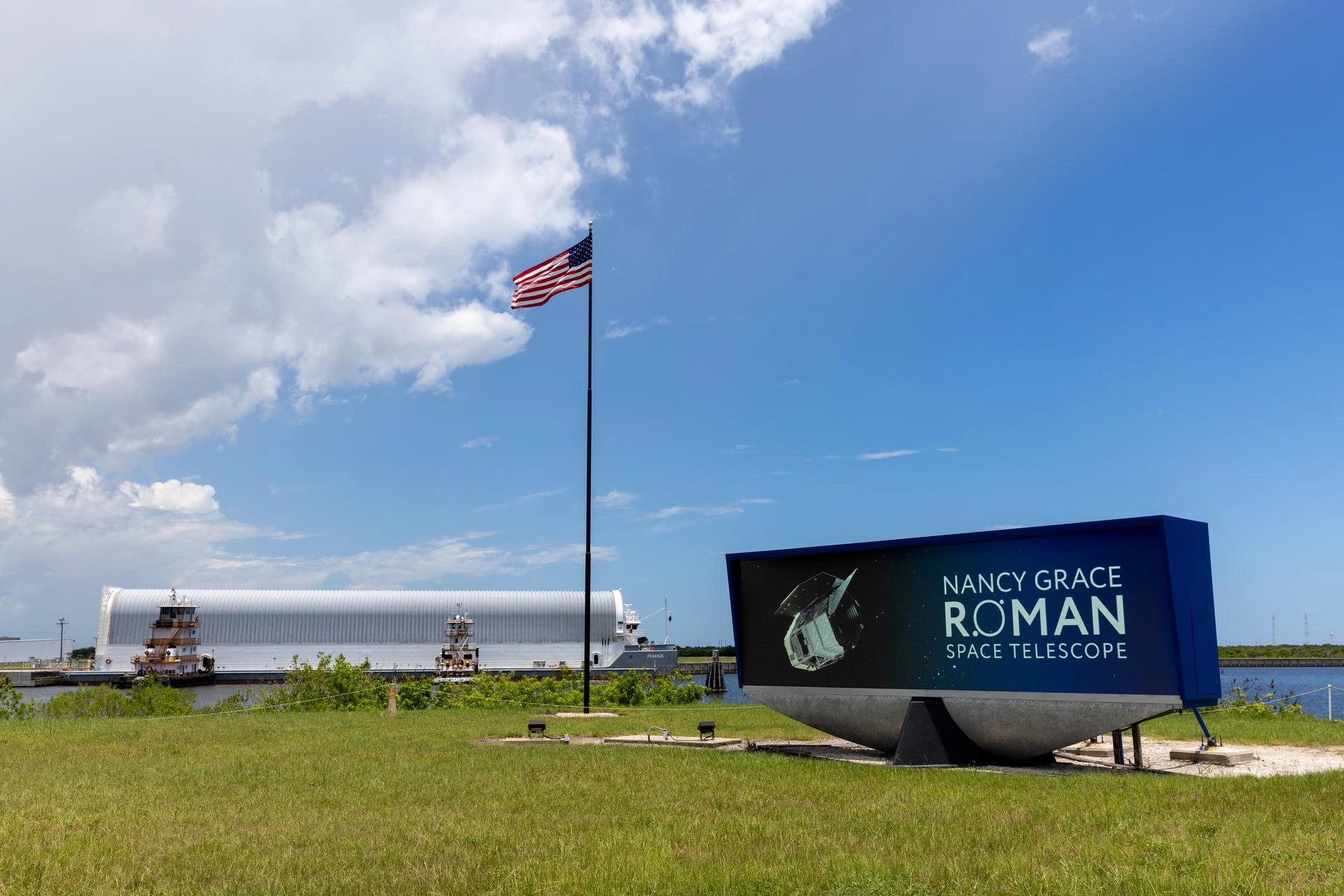
NASA / Amber Jean Notvest
Roman will begin to loop around its L2 destination in late September, and begin its 90-day commissioning phase enroute. We’re looking forward to seeing the first science images by early 2027!