On Earth, most of us rarely have to think about the signals that keep our internal clocks aligned. The sun rises, daylight changes, darkness arrives and morning comes again.
Our bodies have evolved alongside this roughly 24-hour cycle. Light is one of the strongest signals our bodies use to synchronize the circadian clock. But what happens when the sun no longer provides a reliable schedule?
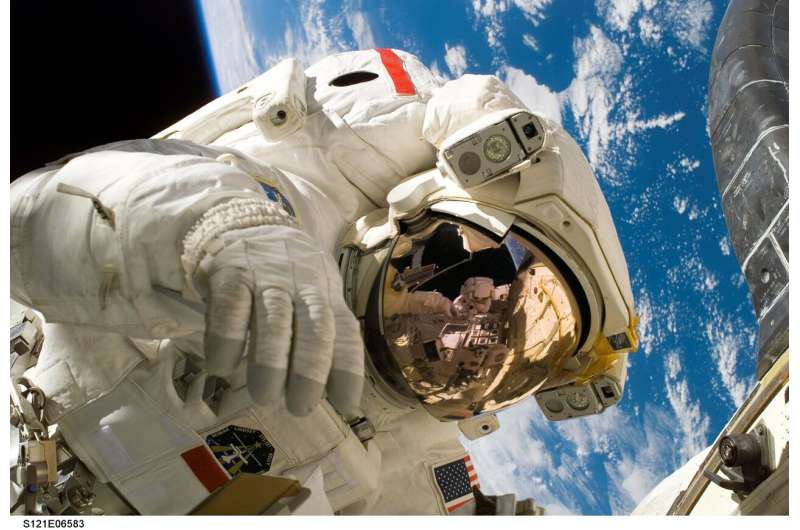
A spacecraft orbits Earth roughly every 90 minutes, so astronauts experience about 16 sunrises and sunsets every 24 hours. They cannot go to sleep every time the sun disappears—but their bodies still need to know when it is time to sleep, wake, eat, exercise and work.
This makes spaceflight more than just an engineering challenge. It is an extraordinary experiment in human biology—one that can reveal what happens when the environmental cues that normally regulate our sleep disappear.
Sleep is thought to be controlled by two interacting biological systems. One is the circadian clock, which helps determine when the brain expects sleep and wakefulness. The other is sleep pressure, which gradually builds the longer we remain awake and dissipates while we sleep. Usually, these systems work together. But jet lag, shift work and spaceflight can pull them apart.
An astronaut may be exhausted after many hours awake but still struggle to sleep because their circadian system is signaling it is daytime. Feeling tired and being biologically ready to sleep are not always the same thing. This distinction is one of the most important lessons spaceflight can teach us about sleep.
Research in chronobiology and sleep science has demonstrated that carefully guiding astronaut schedules around exercise, meals, tailored lighting and work scheduling can help offset some of the negative effects of sleep loss and circadian disruption. Artificial lighting can also be controlled to provide more appropriate environmental cues.
But there is a catch: Giving astronauts time to sleep does not necessarily mean they will sleep. Astronauts have traditionally been given around 8 1/2 hours of sleep opportunity on each day of spaceflight. But research across different types of missions suggests they often obtain only about 6 to 6 1/2 hours.
Repeated night after night, that gap becomes chronic sleep restriction. Research aboard the International Space Station has linked daily sleep patterns of six hours or less with measurable reductions in vigilant attention—the ability to notice and respond reliably to important information. In an environment where a missed signal could have serious consequences, sleep is not simply a matter of comfort—it is part of mission safety.
How much does sleep depend on timing?
My favorite part of NASA’s Artemis II lunar flyby mission in April 2026 was when crew members were woken each day by music chosen by the astronauts and their families. One morning, American astronaut Christina Hammock Koch called out NASA for cutting off “Pink Pony Club” by Chappell Roan before the chorus.
The music was a morale-boosting tradition rather than a circadian treatment. But the astronauts also wore wrist-mounted movement and sleep monitors as part of NASA’s Artemis Research for Crew Health and Readiness study before, during and after the mission. These allowed researchers to examine how sleep and activity changed across training, deep-space flight and recovery on Earth—alongside measurements of cognition, behavior and team performance.
Missions such as Artemis II, together with NASA’s ongoing Mars simulations, offer scientists an unusual window into human sleep. Rather than treating it as something that simply happens when we are tired, space research highlights how much sleep depends on timing.
NASA is not only observing sleep disruption. It is also testing ways to prevent it—such as whether playing pink noise (an audio signal containing all frequencies humans can hear, but with lower frequencies sounding louder and higher frequencies softer) through a headband during a four-hour daytime sleep opportunity can improve subsequent alertness.
The preliminary study, involving 14 healthy adults, found no difference in sleep inertia or vigilant attention between the pink-noise and control conditions during the first 40 minutes after waking.
Space sleep trade-offs
In spacecraft, light is treated as part of the biological life-support system. Blue-enriched white light can support alertness and help synchronize the circadian clock during scheduled waking hours, while dimmer, blue-depleted light can help prepare the brain for sleep.
But this creates an unexpected engineering trade-off. Recent NASA-supported testing found that presleep lighting allowed greater melatonin production but impaired color discrimination. A light setting that benefits the circadian system may therefore be unsuitable when astronauts need to identify color-coded controls, equipment or warning signals.
Caffeine can protect some aspects of performance when sleep-deprived astronauts must remain alert, but it has also been found to interfere with the sleep they need to perform well the next day.
In space as on Earth, caffeine can temporarily solve one problem while quietly helping to create the next one.
Beyond Earth days
The next challenge is even more fundamental: What happens when humans stop living according to an Earth day altogether? A Martian “sol” lasts approximately 24 hours, 40 minutes. That extra 40 minutes may sound trivial, but for the human circadian system, it presents a persistent scheduling problem.
In late September 2026, the four-person crew of NASA’s latest yearlong CHAPEA Mars simulation was scheduled to move from an Earth-based 24-hour schedule to this longer Martian day. The crew is now expected to remain on Martian time until the mission, based at Johnson Space Center in Houston, Texas, ends on Oct. 31.
Forty minutes may sound trivial, but repeatedly delaying sleep and wake times means continually asking the circadian system to adjust. Future Mars explorers may experience the most literal form of jet lag imaginable—not simply traveling across time zones, but traveling between planetary days.
Key concepts
Provided by
The Conversation


This article is republished from The Conversation under a Creative Commons license. Read the original article.
Citation:
What space travel teaches us about sleep and circadian rhythms (2026, October 2)
retrieved 2 October 2026
from https://phys.org/news/2026-10-space-circadian-rhythms.html
This document is subject to copyright. Apart from any fair dealing for the purpose of private study or research, no
part may be reproduced without the written permission. The content is provided for information purposes only.