If you have ever lifted the lid of a trash bin on a hot day, you know the smell I am talking about. One of the culprits behind that sour, vinegary stench is acetic acid, which builds up as food waste starts to rot. Now, a team of researchers from several Chinese institutions, including Central China Normal University and the Beijing Academy of Science and Technology, has found a way to tackle it using sunlight.
How does sunlight get rid of the smell?
The team started with manganese oxide, an affordable material that can already break down acetic acid. To give it a boost, they added a small amount of lithium, which makes the oxygen inside the material far more active and better at tearing apart acetic acid molecules.
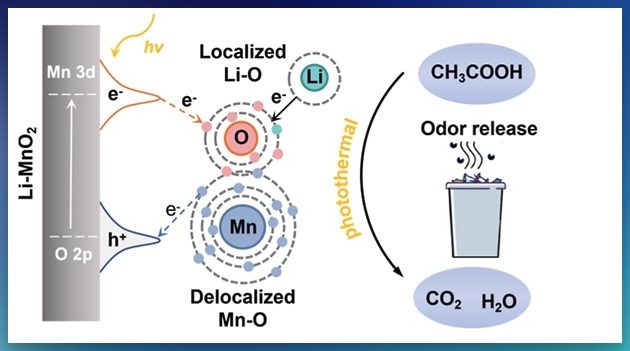
The clever part is the power source. Odor-fighting catalysts usually depend on electric heating to get going, but here the sun handles that job. According to the team’s calculations, lithium helps the catalyst turn light into heat more efficiently and hold that heat on its surface where the action happens.
The team designed an add-on that slots into the lid of an everyday wheeled bin. Its see-through, breathable top lets in both sunlight and bin air, and a built-in lens aims that light right at the catalyst. Under simulated sunlight, the lithium version outperformed plain manganese oxide and activated carbon, the stuff inside many odor filters.
Does it actually work outside the lab?
To find out, the researchers filled waste bins with nearly 3 kilograms of bananas, apples, oranges, pears, tangerines, bread, and even red wine. They then tracked the smell for around 1,000 hours, and the bin with the catalyst generally had lower acetic acid levels than the one without it.
The catalyst also held up in humid conditions, removing over 90% of the acetic acid for most of a 50-hour test. That is good news, since trash bins are rarely dry places.
This is still lab research, so don’t expect a sun-powered trash can at your local store just yet. That said, if this tech makes it into real products, taking out the trash might finally become a little less painful.