The new MCUs integrate two dedicated hardware accelerators alongside a 520-MHz Cortex-M7 core to boost performance in mission-critical industrial applications.
STMicroelectronics recently announced the new STM32H7P series MCUs. The microcontrollers are powered by an Arm Cortex-M7 with up to 2 MB of flash running at 520 MHz. ST estimates a 1.7x performance improvement over similar devices on the market. The MCU includes a hardware signal processor (HSP), ST’s “Neural-ART” neural processing unit (NPU), and digital signal processing (DSP) functionality. ST says the hardware units cut fast Fourier transform (FFT) time by 5x over software implementations on a comparable Cortex-M7.
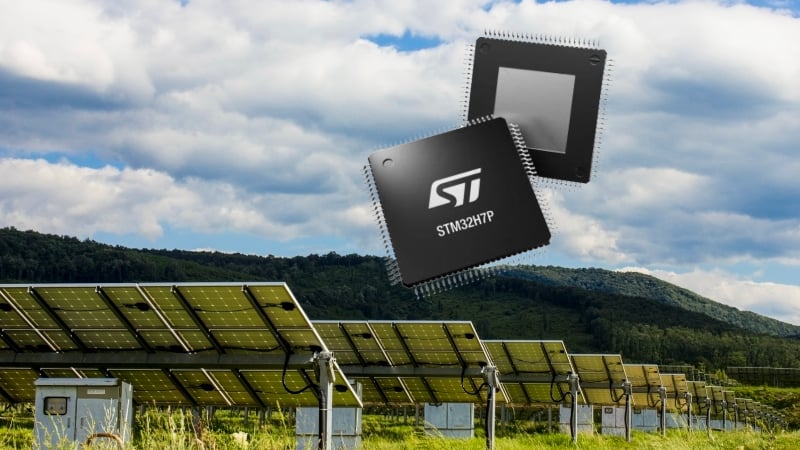
The STM32H7P is designed for high-powered motors, solar equipment, DC power equipment, and other industrial systems.
The STM32H7P series starts with the same MCU base and peripheral set as the STM32H7 series. The devices add hardware accelerators (the NPU and HSP), additional analog peripherals and timers for better motor control, industrial temperature capability, and more memory. The P series also omits Ethernet and graphics functionality to make room for industrial, AI, and real-time improvements.
While the MCU includes a broad and flexible set of peripherals as you would expect in a high-end MCU, it focuses on real-time and edge-AI needs in industrial settings. Deriving extremely high efficiency from high-powered motors, solar equipment, DC power equipment, and other industrial systems requires on-chip AI, real-time responses, and extensive math capability. ST focused on all three areas with the processor series.
NPUs and DSPs for Real-Time Operations and Edge AI
Neural processing hardware in an MCU consists of dedicated matrix multiplication units tightly coupled to memory, so data doesn’t need to pause in cache, FIFOs, or registers. While DSP and NPU processing share similarities, neural/AI processing in an NPU uses highly parallel, low-precision operations. DSPs, on the other hand, require high-precision math, often extended-precision floating-point. DSPs tend to operate on data streams in real time, while NPUs repeat parallel multiply-accumulate (MAC) operations until they find a viable result.
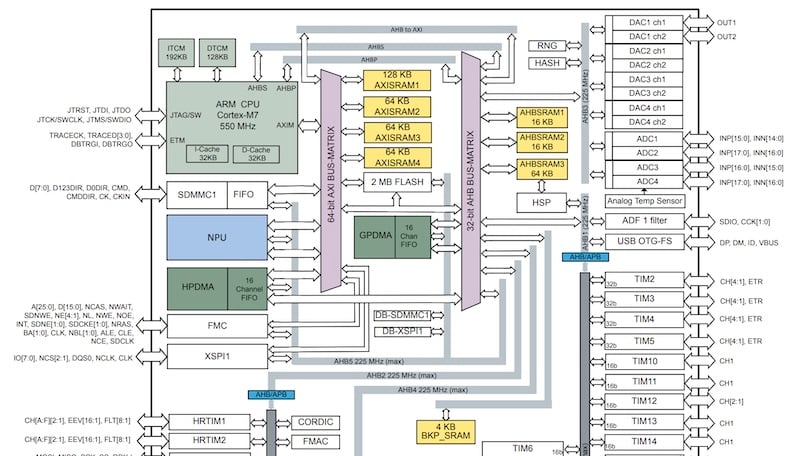
A segment of the STM32H7Pxxx block diagram. To view full image, see page 9 of the datasheet (Link downloads as PDF).
In the STM32H7P series, the NPU consists of dedicated MAC hardware operating at up to 520 MHz, delivering up to 85 Giga-operations per second (Gops). The STM32H7P’s NPU can be configured as 16- or 8-bit MAC units. STM32H7P5xx devices in this family include the NPU, while the STM32H7P4xx devices do not.
The STM32H7P series provides digital signal processing capability through dedicated signal-processing instructions, augmented with single- and double-precision floating-point support in the main Arm-7 processor core and the HSP coprocessor. The HSP includes a dedicated SRAM bank that the rest of the system can use when the HSP is not in use. The HSP can also assist with neural processing, thanks to several AI-oriented convolution functions.
Additional Real-Time Functionality
The STM32H7P series includes additional real-time functionality such as filter math accelerator (FMAC) hardware for MAC operations on 16-bit fixed-point vectors. This includes circular buffers, a 16 x 16-bit multiplier, a 24-bit accumulator with ADD and SUB functions, vector functions, DMA, and other acceleration functions.
The new devices also include a coordinate rotation digital computer (CORDIC) coprocessor for complex motor-control-specific math. The coprocessor accelerates complex math, such as trigonometric functions, utilized in precision motor control.
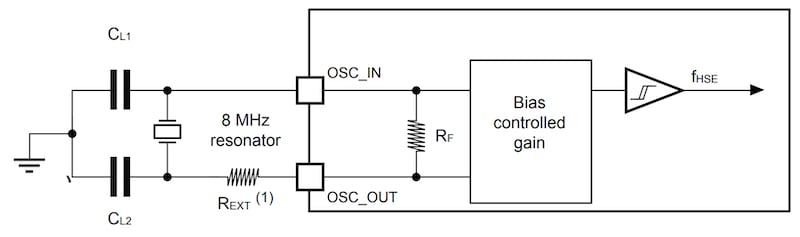
Typical application of the STM32H7P with an 8 MHz crystal.
In one real-time test, ST put the new MCUs into a solar inverter controller. The arc fault circuit interrupter (AFCI) module demonstrated 40x faster inference than MCUs that require software inference. Their AI battery management system (BMS) ran 15x faster, and the controller showed 20x faster anomaly detection.
Other Key Features
The STM32H7P series contains two DMA controllers and a hardware floating-point unit (FPU) to offload the CPU. A 64-bit, high-bandwidth Advanced eXtensible Interface (AXI) interconnect manages the internal pathways between the main CPU core, co-processors, memory, and peripherals. This interconnect includes programmable priority and a 32-bit Advanced High-Performance Bus (AHB) multi-layer crossbar matrix.
Memory starts with 32 KB of both data and instruction L1 cache. The MCUs include up to 2 MB of dual-bank flash and 1 KB of one-time programmable memory. Its 736 KB of SRAM is divided into 192 KB of instruction tightly coupled memory (ITCM), 128 KB of data TCM (DTCM), 416 KB of user SRAM, and 4 KB in the backup domain. It supports external memory and includes a hardware CRC unit.
It has up to 20 communication protocols, including I2C, SMB, I3C, UART/USART, SPI, SD/SDIO/MMC, CAN, and USB OTG. Analog comes in the form of four 12-bit ADCs with up to five MSPS and 44 channels, voltage reference, temperature sensors, DACs, comparators, and a decimation filter. It has up to 27 timers and two watchdog timers.
The chips operate with an industrial temperature ceiling of 125°C. They come in either a BGA form factor or an exposed-pad QFP package for better thermal management. A unique 96-bit ID supports security, maintenance, and inventory management. ST has put this series in their industrial longevity support program. Volume production is planned for January 2027.
All images used courtesy of STMicroelectronics.