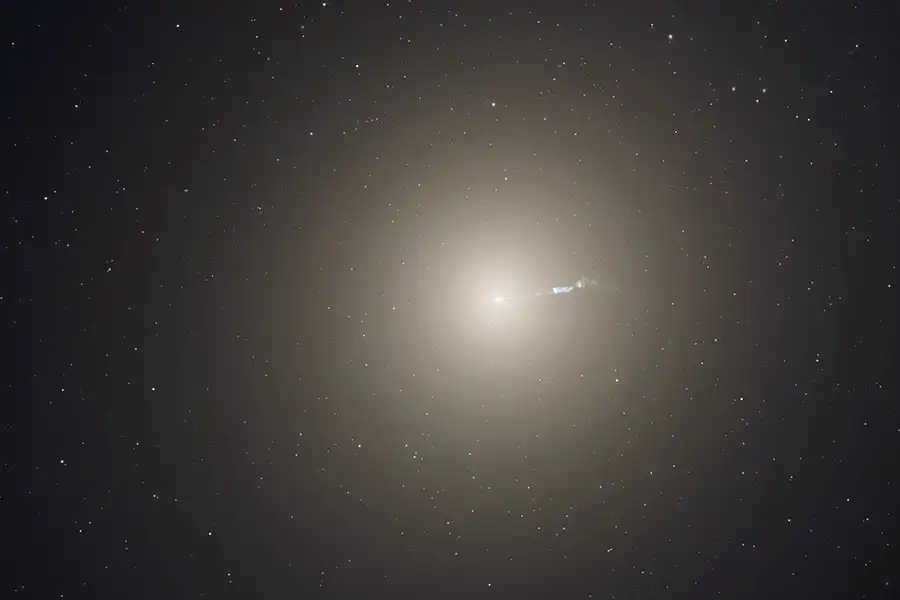
NASA, ESA and the Hubble Heritage Team (STScI/AURA); Acknowledgment: P. Cote (Herzberg Institute of Astrophysics) and E. Baltz (Stanford University)
Galaxies don’t form stars forever. Somehow, vibrant, young, star-filled systems turn into quiet, “dead” galaxies. Astronomers have long known that galaxies don’t all shut down the same way, yet identifying what makes a galaxy go quiet has been tricky.
Now, astronomers using a high-resolution computer simulation of the universe have come a step closer to understanding how galaxies die, by developing a method to map galaxies’ star formation (or lack thereof) using four simple measurements.
Stars form within clouds of cold gas. So if a galaxy’s gas heats up, or if it loses the gas altogether, then star formation will cease and the galaxy will die. Different processes leave distinct patterns in how star formation shuts down across a galaxy. But astronomers don’t usually get to watch that happen; instead, they have to identify these patterns using a single observation of a galaxy. New diagnostic tools can help astronomers recognize these patterns in single snapshots.
“Like a Time Machine”
Graduate student Cameron Lawler-Forsyth (University of Waterloo, Canada), lead author of the study published in the Astrophysical Journal, compares observing galaxies to walking into a mall: You see people of all ages, but you can’t watch them grow up. Likewise astronomers can observe millions of galaxies, but they’re only seeing snapshots of a single moment in time.
Simulations, however, act like a time machine, enabling researchers to track a single galaxy from its infancy through middle age and beyond. Using a zoomed-in cosmological simulation known as Illustris TNG50, the team first identified hundreds of large, dying galaxies. Then they looked for spatial patterns as the galaxies stopped forming stars.
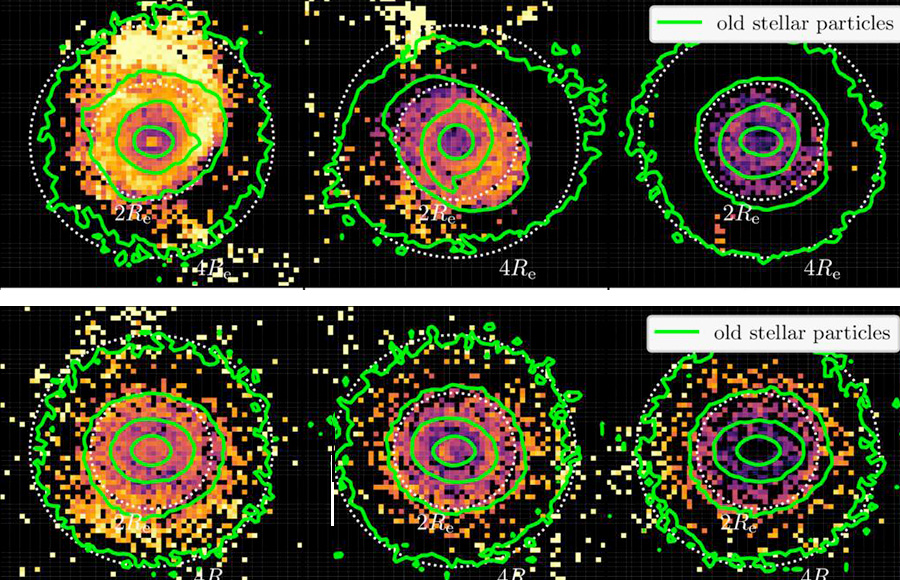
To do that, Lawler-Forsyth and colleagues divided each galaxy into a series of concentric circles, then measured the amount of star formation in each section. From this, they noticed patterns in how stars form across galaxies, choosing four parameters that could capture those patterns. The first measures how widely star formation extends compared to the size of the galaxy. The second describes how concentrated the star formation is. Finally, the remaining two note the radii at which star formation drops sharply in the inner and outer regions.
“There are many ways to quantify star formation,” Lawler-Forsyth says, “but these parameters seemed like a sensible way to capture the patterns we were seeing.”
The team studied 1,666 galaxies in the simulation, 361 of which were “quenched,” having ceased star formation by the end of the simulation. Of these, 78 ceased star formation first near the center, then in the outer regions. Another 185 galaxies quenched the opposite way, with star formation first suppressed in the outskirts. The remainder showed a more ambiguous pattern. The values of these four parameters change significantly in dying galaxies compared to star-forming ones. Therefore, by measuring them in observations, astronomers can identify whether a galaxy is dying, distinguish between inside-out and outside-in pathways, and estimate how far along the quenching process has come.
“This is a good approach,” says Kevin Bundy (University of California, Santa Cruz), who led a large galaxy survey known as Mapping Nearby Galaxies at Apache Point Observatory (MANGA). This survey maps the star formation in nearly 10,000 nearby galaxies with a goal to understand how they evolve from birth to death.
“Observations, including from MANGA, do indeed support these different pathways,” adds Bundy, who was not part of the current study. “For the most part, we see inside-out quenching, but that may be because outside-in is favored in rare, dense environments like galaxy clusters.” The TNG50 simulation is more likely to find such galaxies than surveys like MANGA.
Inside-Out vs. Outside-In
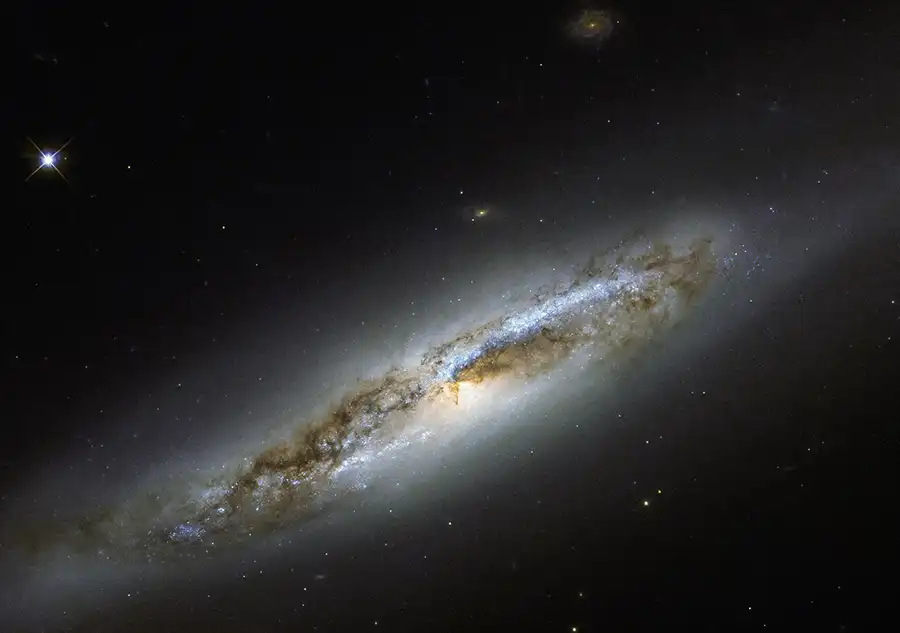
ESA / Hubble
While many processes can shut down these stellar factories, they are often grouped into two broad types.
If a galaxy ceases forming stars near the center first, it’s likely because there’s a heat source there: the central supermassive black hole that lurks in most large galaxies. When these black holes feed on surrounding gas, they release huge amounts of energy in the form of radiation as well as particle winds and jets. This energy heats gas in the galaxy’s center or drives it out completely. As a result, star formation shuts down first in the center and then in the galactic outskirts. Winds from massive, dying stars or their supernova explosions can also contribute to inside-out quenching.
In contrast, a galaxy’s surroundings can cause star formation to quiet from the outside-in. When a galaxy falls into a crowded region such as a galaxy cluster, the movement through the cluster’s gas strips gas out of the galaxy. (You can feel a similar effect when you ride your bike; even on a windless day, your own movement will blow your hair back as you ride.) “It all basically comes down to the gas,” Lawler-Forsyth said. “If you can heat it up, pull it out, or stop more gas from falling in, you shut down star formation.”
His team finds that galaxies undergoing outside-in quenching tend to be less massive and die quickly, in only 1.5 billion years. That aligns with scenarios where such galaxies are falling into clusters — less massive galaxies would be more susceptible to cluster effects. More massive galaxies, on the other hand, tend to stop forming stars in their centers first, probably because such galaxies come with active massive black holes. They take longer to die, up to 3.5 billion years for the most massive ones.
Lawlor-Forsyth et al. / Astrophysical Journal 2026
Simulations vs. Reality
Bundy says that, in principle, surveys like MANGA should identify inside-out and outside-in signatures in real galaxies. But he cautions that real data come with some observational effects that simulations may not incorporate.
The team designed their measurements to work beyond simulations, and Lawler-Forsyth says applying them to real data from telescopes is “very feasible”. Now, his team is working on applying new measurements to real galaxies observed by the Hubble Space Telescope.
You might be relieved to know that our own Milky Way is not expected to follow either one of these pathways anytime soon. Lawler-Forsyth explains that our central black hole, Sagittarius A*, is relatively quiet and currently not expelling the kind of energy needed for inside-out quenching. And since we don’t live in a dense galaxy cluster, our galaxy is not at risk of being stripped of its gas. Instead, our future likely involves a collision of some sort with the Andromeda Galaxy a few billion years from now, which could spark new star formation before the lights finally go out.