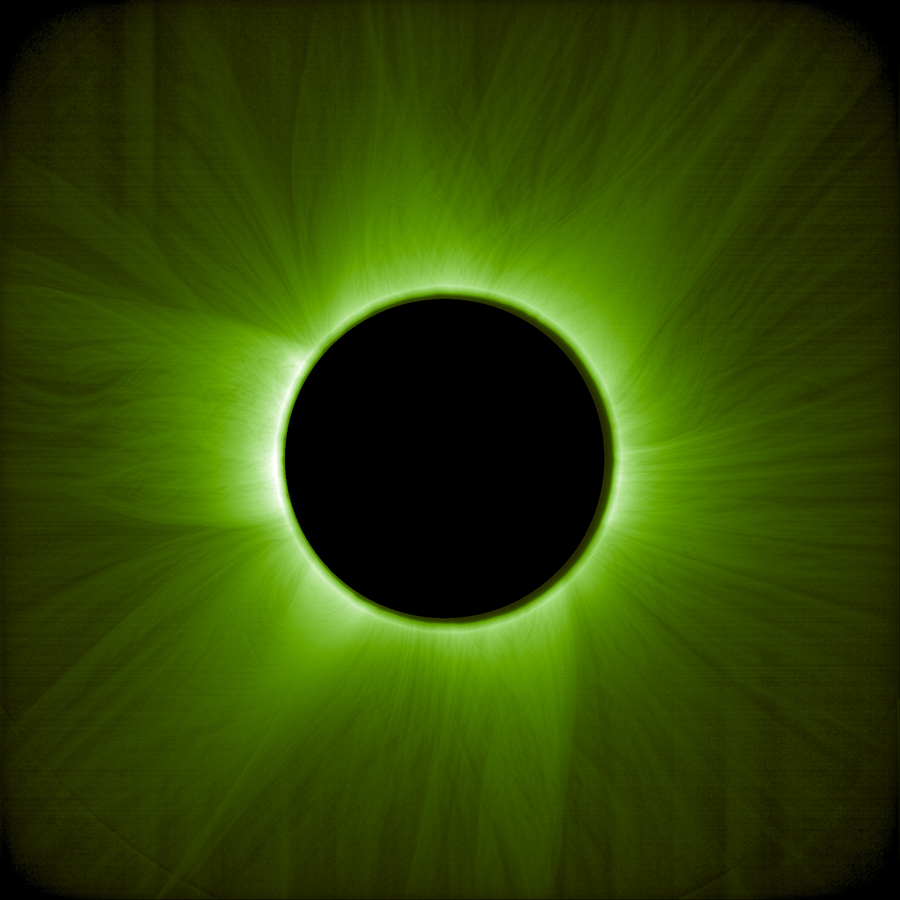
ESA
A total solar eclipse seen from Earth is one of the best ways to study the Sun’s extremely hot inner corona. This region cannot be studied under normal conditions as it’s very close to the Sun’s surface, which is so bright that it blinds normal telescopes. During total eclipses, however the Moon blocks the solar disk just right, so astronomers can observe the faint plasma structures that emerge from the solar limb.
This ideal setup has however one important drawback. Total solar eclipses occur about every 18 months somewhere on Earth, and they only last a few minutes. But what if scientists could create an artificial solar eclipse every time they wanted?
That’s the idea behind the European Space Agency’s Proba 3 mission. By flying two spacecraft in precise formation, Proba 3 creates artificial total solar eclipses. One spacecraft acts like the Moon, creating an artificial eclipse that blocks the solar circumference using a 1.4-meter (4.6-foot) disc that blocks the Sun. The other carries a coronagraph telescope and other instruments to observe the artificially eclipsed Sun.
Telescopes have long used an occulting disc to block the Sun’s light. But the problem is diffraction. Because light acts like a wave, it can bend around the edges of an object. If a telescope’s view of the Sun is covered with a small disc, light still leaks around the edges, blurring the faint corona.
But diffraction lessens when the occulter is far from the telescope, like the Moon is during a total solar eclipse, says Andrei Zhukov (Royal Observatory of Belgium), the principal investigator of Proba 3’s ASPIICS coronagraph. While placing spacecraft so far apart isn’t yet practical, the Proba 3 duo are now observing the Sun while 144 meters apart.
”The trick is to align precisely the two spacecraft with the Sun and with each other,” Zhukov adds. Their separation has to stay constant to within 1 millimeter. “If you are off by even a tiny bit, it doesn’t work,” he says. “We can already speak of a [technological] achievement, because it really works.”
After about one year of operations, Proba-3 is providing its first science results. In the March 10th Astrophysical Journal Letters, Zhukov and his colleagues describe the mission’s first observations. ASPIICS can see down to 70,000 km (43,000 miles) from the Sun’s surface, a region no other space-based coronagraph can observe.
Looking closer to the Sun allows the researchers to detect smaller features that aren’t usually observable from Earth, such as blobs, outflows, inflows, jets, and waves. These features point at the source of the slow solar wind, a stream of particles that’s constantly streaming out from the Sun.
“We know from measurements of the solar wind is very inhomogeneous; there’s a lot of structure in it,” Zhukov says. “Now, we have seen this structure with our coronagraph and we could measure its speed.”
Proba 3 also provided new looks at the quiescent corona, coronal mass ejections, and solar jets. While these phenomena are known to scientists, they are notoriously difficult to observe in the low region of the corona, Zhukov says. Proba 3’s telescope snaps a photo every 30 seconds, allowing researchers to detect fast-moving flows in these structures.
“The time resolution and the spatial resolution of the images they’re getting is really impressive,” says Matthew Owens (University of Reading), who was not involved in the research. “What they’re seeing there is lots of flows, which we expected, but there’s material moving about in the solar atmosphere all the time. I think it’s proving to be a lot more structured and messy than previous studies have shown.”
The next step will be to dig into the details of these processes, Owens says: “There’s a lot of interesting physics there.”
A better understanding of the solar wind can help improve space weather predictions, which are important to protect power grids, satellites, and astronauts. This knowledge also contributes to other fields, such as exoplanet research, by helping scientists determine if distant planets’ atmospheres are stable or if they are being stripped away by the violent winds of their own stars.
Proba 3 also has other goals. A radiometer located on the occulter spacecraft measures the total energy Earth receives from the Sun. These measurements are valuable for Earth science, such as in climate models.
The spacecraft also has an instrument to measure energetic electrons in Earth’s magnetosphere. This instrument exploits Proba 3 highly elliptical orbit; though designed to minimize gravitational interference with Earth during observations, the orbit takes the spacecraft right through Earth’s radiation belts, allowing scientists to study the high-energy particles interactions with our planet.
Overcoming Technical Difficulties
Despite all of the science already conducted, Proba 3 is first and foremost a technology demonstrator. As such, it has had some technical hiccups.
The mission was off to a good start: Following a launch in December 2024, Proba 3 acquired its first observations in March 2025, with the nominal science mission officially beginning on July 3, 2025. But a year into the mission, ESA lost contact with the main spacecraft for an entire month, between mid-February and mid-March, 2026. Then, suddenly, contact resumed.
Since then, ESA has been troubleshooting and patching software to make sure loss of contact doesn’t happen again. While ESA has not yet certified that the spacecraft is back at full operation, Zhukov expects that normal science operations will start soon. “The poor spacecraft spent a month in the cold,” he says.
If everything turns out all right, the mission has an approved budget until late 2026. Zhukov says they should have fuel to keep working until the summer of 2028, so he is counting on getting an extension, a decision he says will be reached in June.