NASA / Jolearra Tshiteya
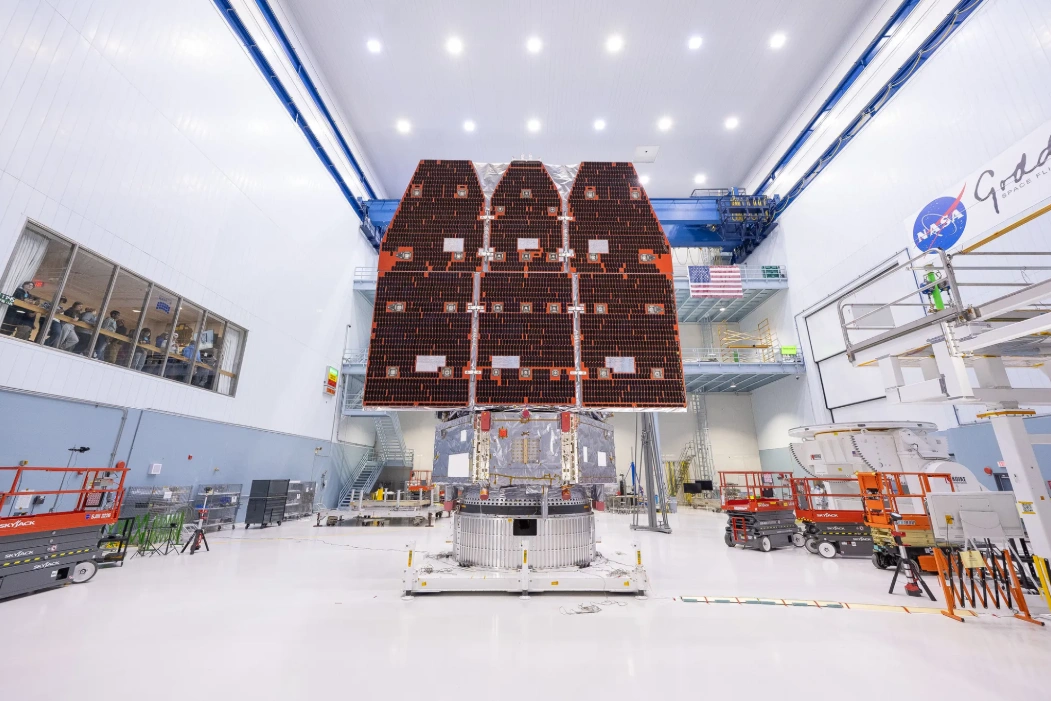
NASA’s newest space telescope mission is headed to its final destination ahead of launch. The agency has given us a first look at the fully assembled Nancy Grace Roman Space Telescope and a preview of the exciting mission ahead.
The mission started life as the Wide Field Infrared Survey Telescope (WFIRST), which itself incorporated design elements from the previously proposed Joint Dark Energy Mission. To give you an idea of just how long the pipeline from selection to launch is, WFIRST was named a high priority in NASA’s Astrophysics Decadal Survey way back in 2010.
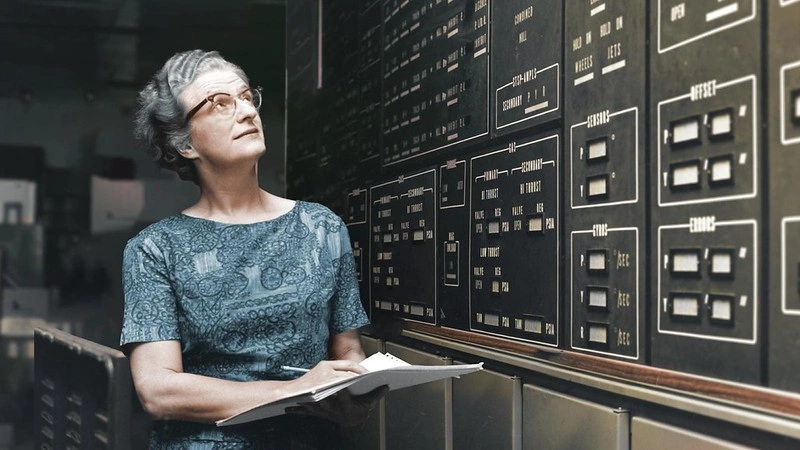
The telescope is named after Nancy Grace Roman, an American astronomer who pioneered research into stellar motion and stellar classification. She joined NASA in 1959, six months after the agency was formed, and became the first Chief of Astronomy there. She was known as the “Mother of Hubble” for her work in getting the Hubble Space Telescope to the launchpad. Roman passed away in 2018, two years before the telescope was named after her in 2020.
NASA / ESA
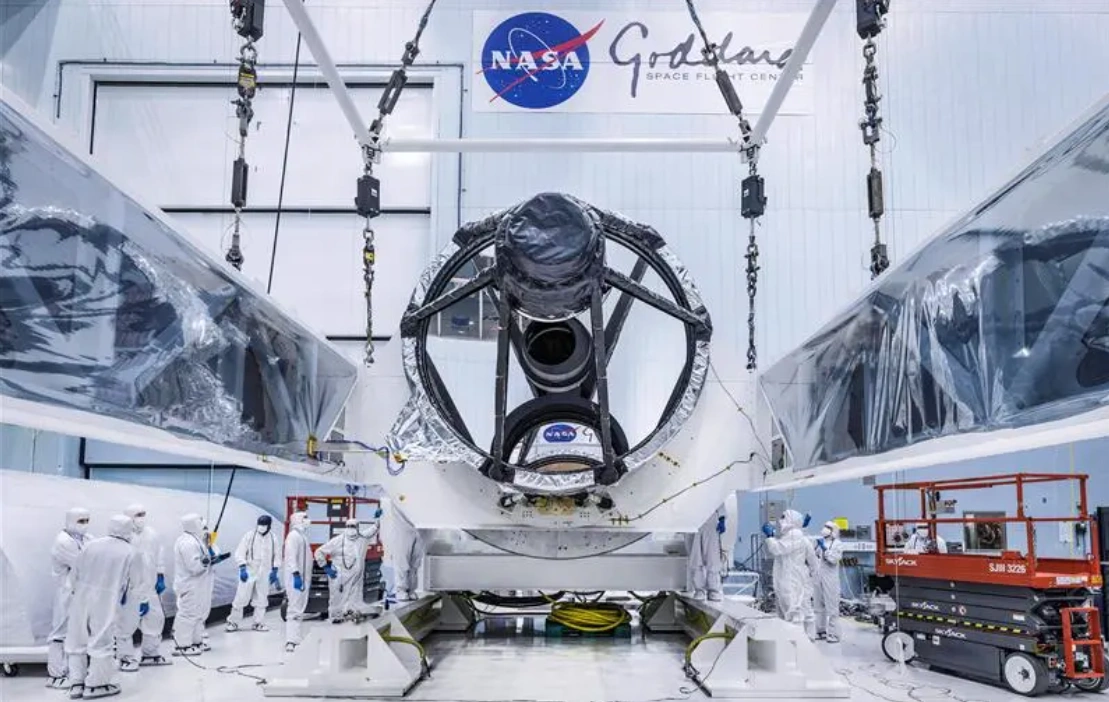
Once the telescope had been approved for development, there came a surprise offer from the U.S. National Reconnaissance Office of two 2.4-meter diameter mirror assemblies, donated to NASA in 2012. Even then, the mission had to navigate changing administrations and budgetary challenges on its road to the launch pad.
As of late 2025, the telescope has a $4.3 billion dollar price tag, which covers design, construction, and five years of operations, as well as the launch aboard a SpaceX Falcon Heavy rocket. NASA Administrator Jared Isaacman stated in Tuesday’s press conference that the mission came in under budget.
NASA has now announced the space telescope ready for launch, as the team finishes final preparations at NASA’s Goddard Spaceflight Center in Greenbelt, Maryland. Next up, the telescope will complete pre-launch testing ahead of shipment to the Kennedy Space Center for launch. The mission is set to lift off this September at the beginning of its launch window, eight months ahead of its Congressionally mandated schedule.
The space telescope is headed to a Lissajous orbit around the Sun-Earth L2 Lagrange point, which is also home to the James Webb Space Telescope and the European Space Agency’s Gaia satellite. This distant point is ideal for observations, as it’s cold, stable, and far from Earth. It’s also far from repair operations, meaning it has to work right the first time.
NASA/Chris Gunn
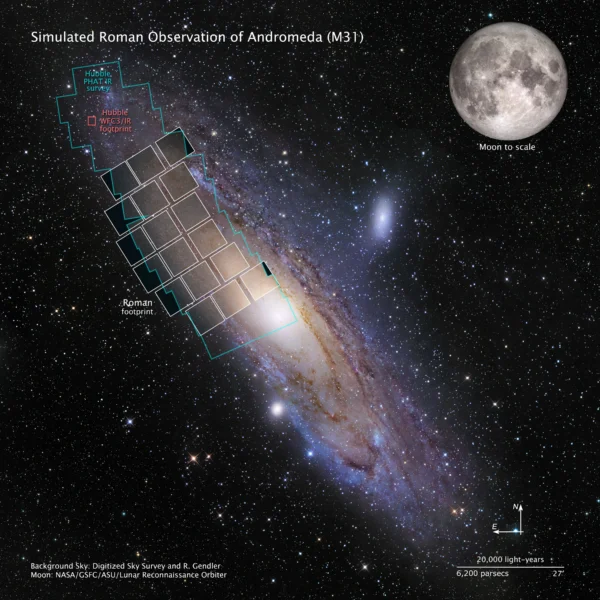
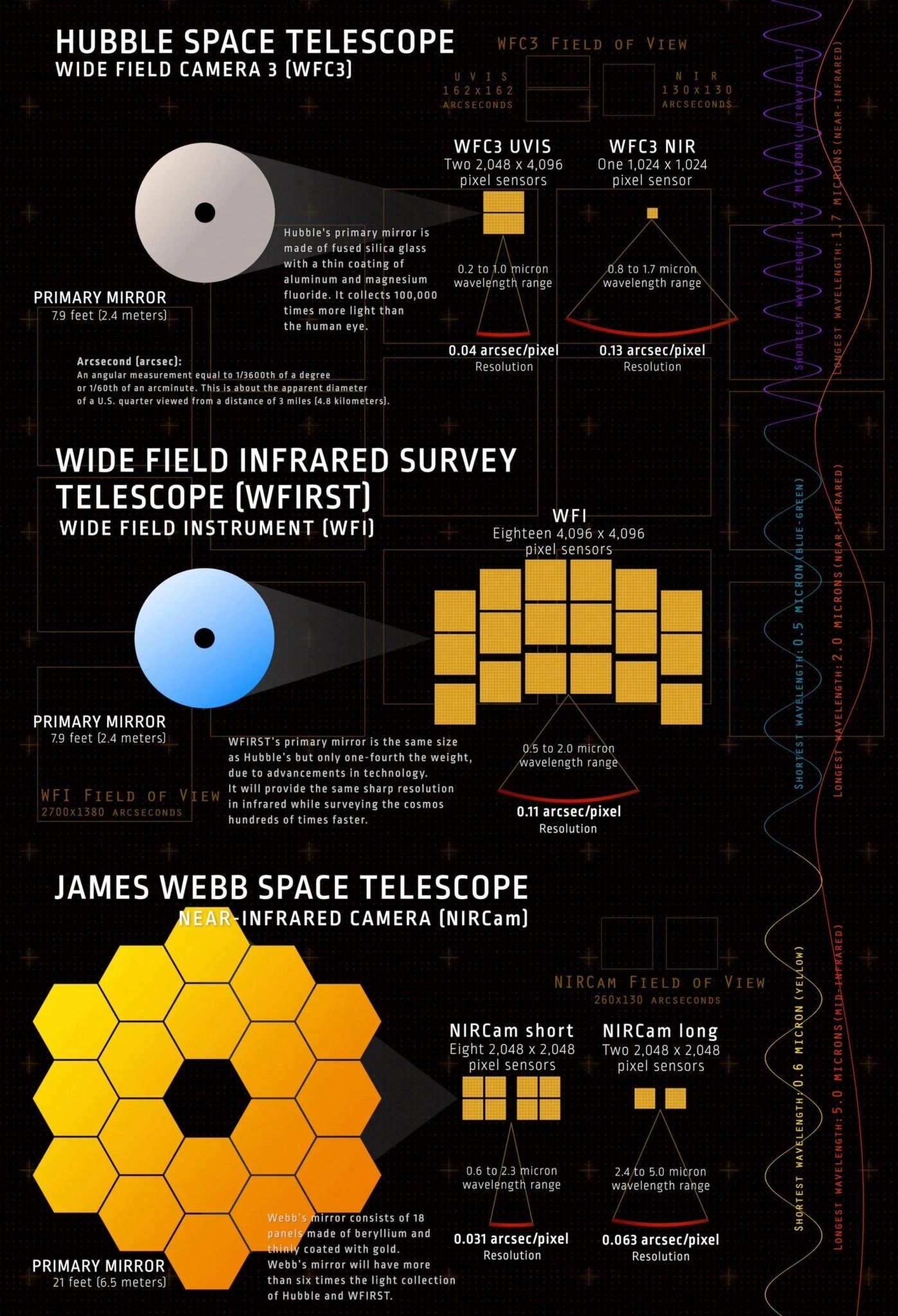
At NASA’s unveiling of the asssembled telescope, we also saw a preview of the science we can expect from this telescope. Equipped with a 2.4-meter (7.9-foot) diameter primary mirror, the same aperture as the mirror at the heart of Hubble, Roman will work in the visible to near-infrared regime. But unlike Hubble, Roman’s Wide Field Instrument has a field of view of 45′ by 23′, about 100 times Hubble’s field of view, thanks to its shorter focal length (f/7.9, compared to Hubble’s longer f/24 focal ratio). The Wide Field Instrument is also equipped with a 300-megapixel infrared camera.
NASA/SVS/Scott Wiessinger Background: DSS/R. Gendler Moon: NASA/GSFC/ASU/LRO
With its wider field of view, Julie McEnery (NASA Goddard) stated in Tuesday’s press conference that “one month of observation time on Nancy Grace Roman will be equivalent to a century on Hubble.” To handle the 20 petabytes of data generated over the observatory’s five-year nominal mission, NASA launched a cloud-based platform called the Roman Research Nexus earlier this year, on which the science community can organize and analyze the flood of incoming data.
NASA / GSFC
As part of the mission’s overall goal, it will carry out a survey that will look along the plane of the Milky Way toward our galaxy’s core. The survey is expected to find more than 2,600 new exoplanets using gravitational microlensing, by planets and their stars pass in front and briefly magnify background stars.
The mission will also chart the unvierse’s structure, help resolve the tension between different estimates of our universe’s growth, and probe the nature of dark energy.
The telescope’s Coronagraph Instrument (CGI) will demonstrate an innovative starlight suppression technology, allowing it to block out light and image exoplanets only 0.15″ from their primaries. CGI will also serve as a proof of concept for the coronagraph that’s expected to fly on NASA’s Habitable Worlds Observatory, set to launch in the 2040s. CGI will be the most sophisticated coronagraph flown on a mission to date.
Despite recent challenges, NASA Goddard has kept busy. In addition to turning out the Roman telescope, NASA Goddard is also working on the Dragonfly mission to Titan as well as autonomous helicopters to be deployed on the Moon and Mars, dubbed Moonfall and Skyfall, respectively. The helicopters will be similar to Ingenuity, which tested the technology on Mars. Whether and how those missions proceed will depend on the agency’s funding, which the current administration has again proposed be slashed in half in 2027. That’s not to mention Goddard’s workforce, which dropped by a fifth last year.
The Nancy Grace Roman Space Telescope will bridge the gap between the more focused Hubble and James Webb space telescopes and next-generation space telescopes that will cover the sky at scale. It will be exciting to see the mission head to space and get to work probing the cosmos later this year.