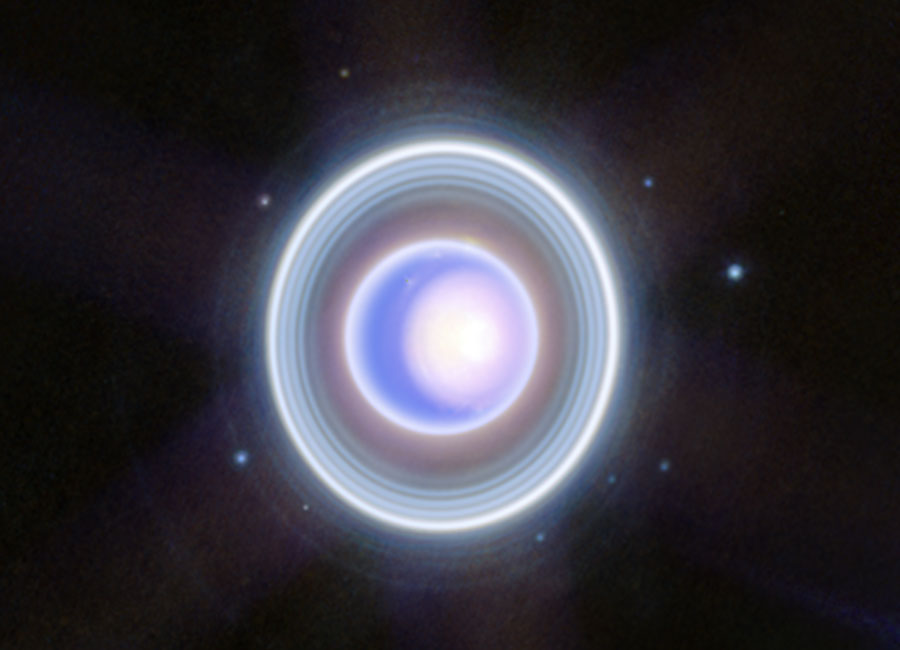
NASA / ESA / CSA / STScI
James Webb Space Telescope’s sharp color vision has found water and carbon compounds in Uranus’s outer rings — but not in the same place. Astronomers have known that the two rings were different colors since their discovery. But the finding of ice in one ring and dust in the other creates a new mystery: What’s going on with the tiny ice-moon Mab?
Saturn-like Rings
Uranus’s ring system is less familiar to us than Saturn’s, but the two are similar. Just like Saturn’s, Uranus’ main ring system is about twice the planet’s width. Within this distance, moons can’t coalesce, because tidal forces exerted by the planet’s gravity would tear them apart. Instead, orbiting particles of dust, ice, and rock spread out into planet-encircling rings.
Farther out, material orbiting the planet assembles by self-gravity into a set of moonlets in tightly packed orbits. These tiny “ringmoons” are an integral part of a planet’s dynamic ring system. Their gravity shapes ring edges and creates spiraling waves within the rings themselves. Ringmoons can gather up ring particles, sweeping out a clear lane, taking away from the ring’s mass in the process. But an impact on a ringmoon can throw off particles to add to the ring’s supply.
Also just like Saturn, Uranus has more rings beyond the densest main ring system. The outer rings are far fainter and harder to spot. The two outermost rings weren’t discovered until 2003, when Mark Showalter (now at SETI) and Jack Lissauer (NASA Ames) spotted them in long Hubble Space Telescope exposures.
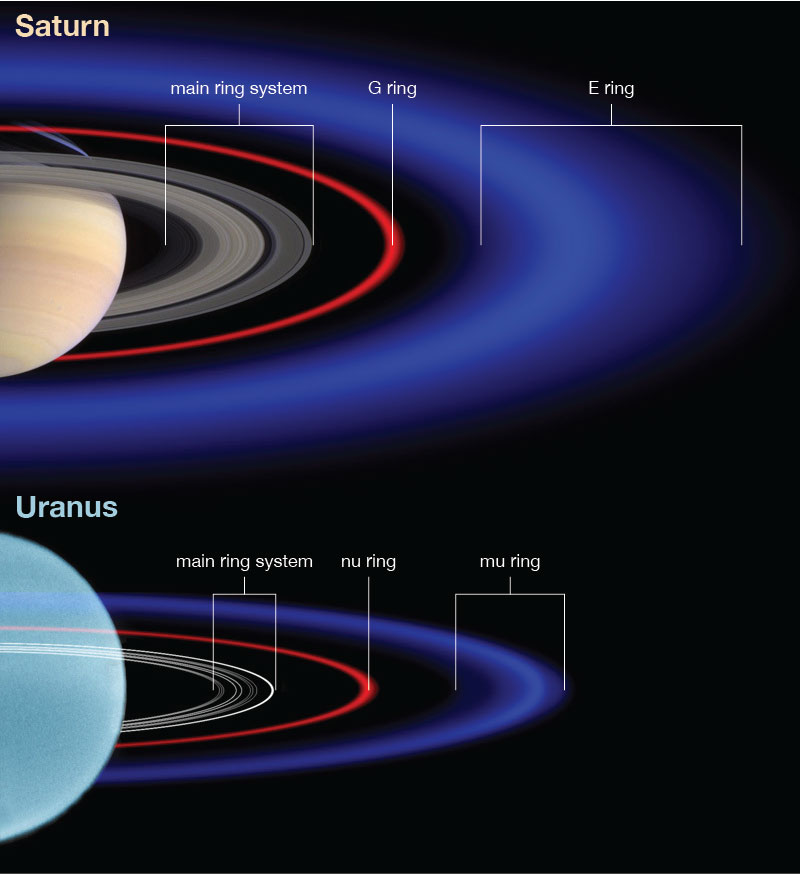
The ν (nu) ring is a narrow one at about 67,000 kilometers (42,000 miles, or about 2.5 times the planet’s radius), sandwiched between the orbits of ringmoons Portia and Rosalind. The outer μ (mu) ring is a broader one at about 90,000 to 100,000 kilometers (out to about 4 times the planet’s radius). It contains the orbit of a previously unknown ringmoon that they named Mab. Again, this is a similar situation to Saturn, where a little moon named Aegeon orbits within the faint, dusty G ring outside the main ring system.
Imke de Pater / Heidi Hammel / Seran Gibbard / Mark Showalter, courtesy Science
While Showalter and Lissauer were performing their Hubble work, astronomer Imke de Pater led an international team in observing Uranus using the adaptive optics-equipped Keck Observatory and the Very Large Telescope (VLT) in a campaign that lasted from 2003 to 2008. De Pater and her collaborators were able to locate the inner nu ring in archival data and determine that it was red, meaning that it was brighter in Keck and VLT wavelengths, around 2 microns, than in Hubble’s visible wavelengths under 1 micron. However, the outer mu ring did not show up. Given its detection by Hubble, this was a surprise. The non-detection suggested that the mu ring is unexpectedly dark at longer wavelengths — in other words, it is blue.
The reddish color of the nu ring as seen by Hubble, Keck, and VLT was a good match for the color of Saturn’s G ring, so it’s likely that the nu ring gets its particles from micrometeorite bombardment of Portia and/or Rosalind, just as the G ring gets its particles from Aegeon.
What did the possibly blue color of the mu ring mean? In outer planet spectroscopy, blue usually implies the presence of water ice, but there wasn’t enough information to be sure. De Pater and her collaborators (including Showalter) published results from the Keck observations of Uranus’ main ring system in 2013, but the team reserved analysis on the nu and mu rings for a future paper, pending the acquisition of more information about the color of the mu ring.
Webb Answers One question, Raises Another
It was a long wait, but the data has finally arrived. The James Webb Space Telescope observed Uranus several times over three years, from 2023 to 2025. JWST observes longer wavelengths than Hubble or Keck, between 2 and 5 microns, and that band contains many spectral features that can diagnose the presence of water and carbon-rich compounds.
The team has just published the JWST findings, along with Keck observations of the nu and mu rings going back to 2007, in JGR Planets. The new JWST data demonstrate that the red nu ring is made of what we’d expect of particles knocked off ringmoons: a mixture of rocky and carbon-rich material with a wide range of grain sizes.
The mu ring is blue, as the team suspected it would be, and the JWST spectral measurements confirm that it is made primarily of tiny, sub-micron grains of water ice. The mu ring has its own embedded ringmoon, but how could Mab be producing a ring full of sub-micron-size grains of water ice? Saturn’s E ring is likewise blue, thanks to contributions from the moon Enceladus’ south polar geysers. Could Mab be another geyser moon?
Sadly, no. Mab is much too small for geologic activity. It’s a tiny fleck of a moon between 10 and 25 kilometers in diameter, not much larger than the nucleus of Halley’s comet. (Enceladus is about 500 kilometers across and still considered small for a geologically active moon.) Therefore, Uranus’s mu ring likely has the same origin as its nu ring — a moon’s micrometeorite bombardment — but for some reason, Mab is icy where the other ringmoons are not.
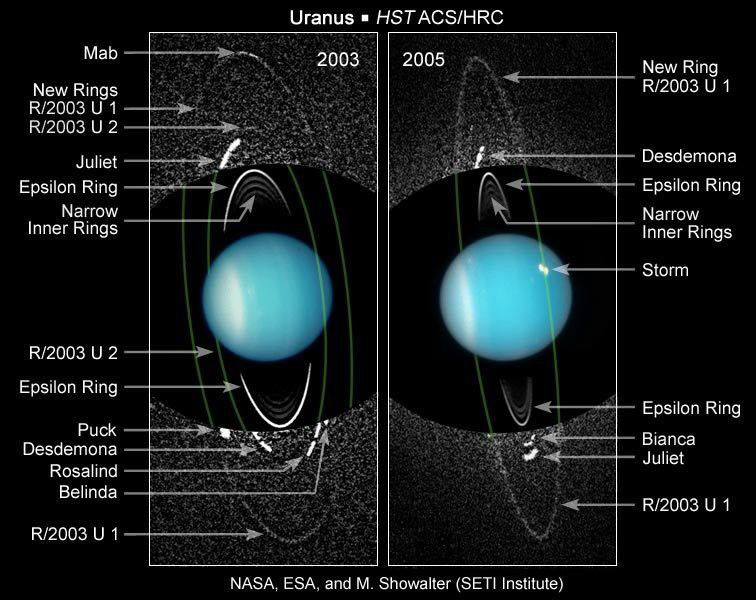
NASA / ESA / M. Showalter (SETI)
So the mystery has shifted: Why is Mab so icy?
Unfortunately, while Webb can achieve unprecedented spectral detail in its color measurements of large features like rings and planets, it can’t tell us anything about Mab’s geology. Mab is just too small. Each Webb pixel spans 400 to 900 kilometers at the distance of the Uranian system.
To learn more about what Mab is made of, why it’s different from Uranus’ other ringmoons, and how it colors one Uranian ring blue, we’ll need a spacecraft in orbit at Uranus. International teams have repeatedly proposed Uranus orbiter missions to NASA and ESA, but none has been started yet (see the July 2023 issue of Sky & Telescope). Clearly, we should go to Uranus!