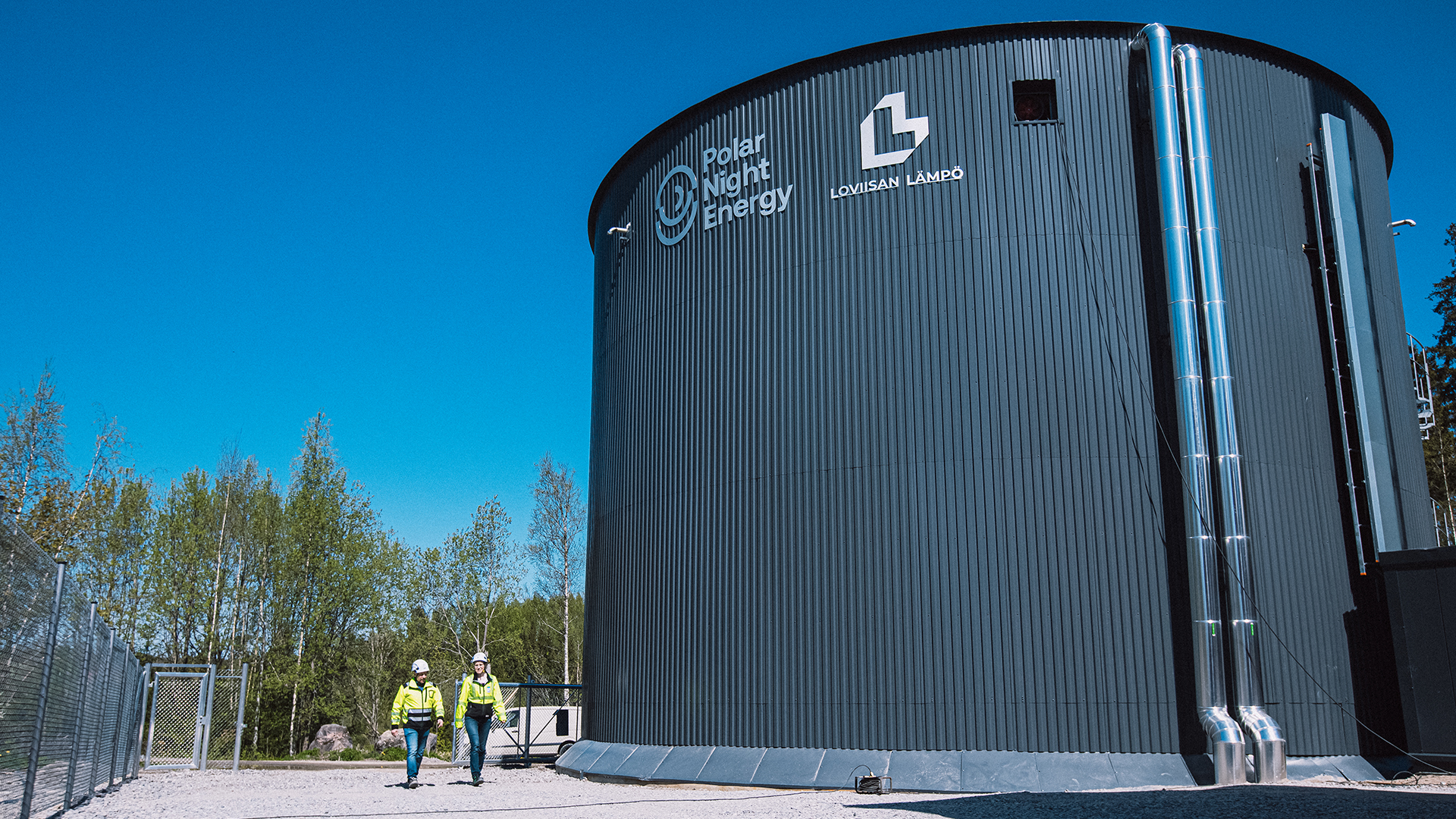
In late March, I visited Pornainen, a village of around 5,000 in Finland, as part of a press tour. To get to the world’s largest sand battery, you climb a spiral staircase bolted to the exterior of a dark corrugated steel silo set surrounded by forest, next to a red-brick building with a tall chimney. At the top, through a hatch, is something that doesn’t look like any heating system I’ve seen.
The space inside is low and crowded with massive pipes wrapped in crinkled foil insulation pressing upward. The silo holds 2,000 tonnes of sand, recycled waste from a fireplace manufacturer, threaded through with those pipes – enough thermal energy to cover the majority of the municipality’s heating needs throughout the year. At full charge, it reaches 500-600°C.
This is Polar Night Energy’s sand battery, commissioned in June 2025 for the district heating company Loviisan Lämpö, owned by CapMan Infra.
Put to the test by Finland’s harshest winter in years
Finland’s winter of 2025–2026 was brutal, unusually cold even by local standards, and electricity prices hit levels that laid bare just how volatile the Nordic market can be. Polar Night Energy’s own data shows Finnish spot prices swinging within a single week from 3 €/MWh to 373 €/MWh.
For a technology whose entire commercial logic depends on buying cheap electricity and storing it as heat, this was the worst-case scenario.
“We had a very challenging winter,” Tommi Eronen, CEO and co-founder of Polar Night Energy, tells Interesting Engineering. “It was super cold, even compared to our standards, and electricity prices were very, very high. But still, thanks to the peak energy capacity, and the combination of the wood chip boiler and this system, we were able to produce very low-priced district heating and very low emissions.”
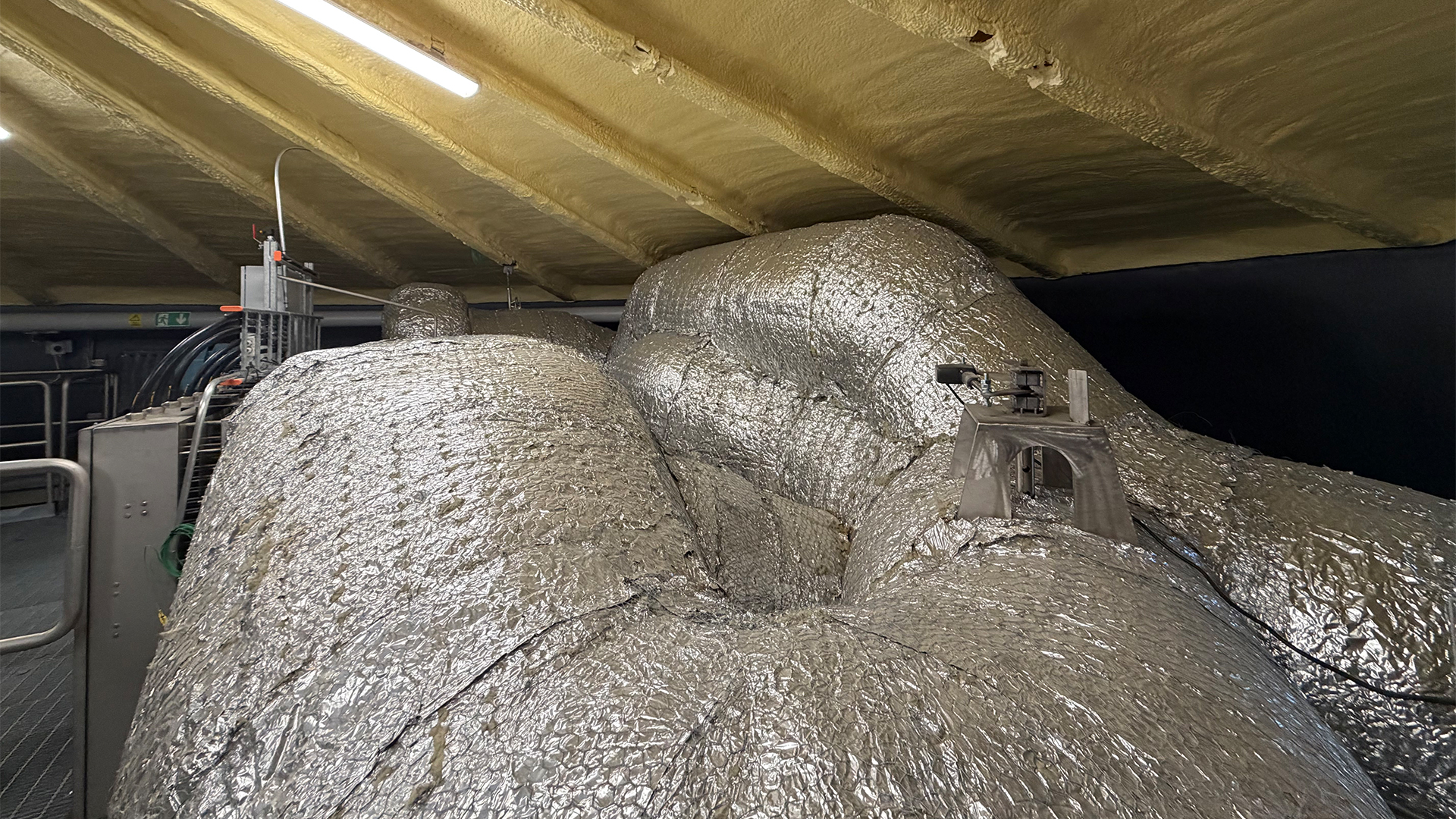
Sauli Antila, investment director at CapMan Infra, explains how the system handled the price swings. “During summer, we can store roughly one month’s worth of heating needs in one go. During winter, it’s a bit less than a week. But we have much greater resilience against energy price spikes.”
During the coldest, most expensive stretch, the wood chip boiler became the primary unit, and the sand battery supplemented it. The rest of the time, roles reversed.
The net result: Pornainen fulfilled all of its municipal climate targets with a single installation. Oil use dropped 100 percent, emissions fell 70 percent, and woodchip combustion was cut by 60 percent. According to the Mayor of the Municipality of Pornainen, Antti Kuusela, the municipality now heats all its public buildings, including a new sports arena opening in September 2026, entirely through this district heating network.
The system is deliberately simple
The operating principle is simple. Electricity heats air. That air circulates through a closed loop of pipes embedded in stationary sand, transferring heat into the material. When heat is needed, air flows in the reverse direction, extracting it and delivering it to the district heating network via a heat exchanger. Connecting the system to the existing network required only a few pipes and minor automation adjustments.
“There are not that many moving parts,” Antila tells me. “It’s a very static, robust, and simple system.”
Sand works because it doesn’t undergo phase change. Water tops out at around 100°C at atmospheric pressure, or roughly 120°C under pressure, before boiling. Sand doesn’t boil. It can be heated far higher without degrading. The Pornainen installation operates at 500°C; Polar Night Energy’s systems are designed up to 650°C. That ceiling means substantially more energy can be stored per unit of volume.
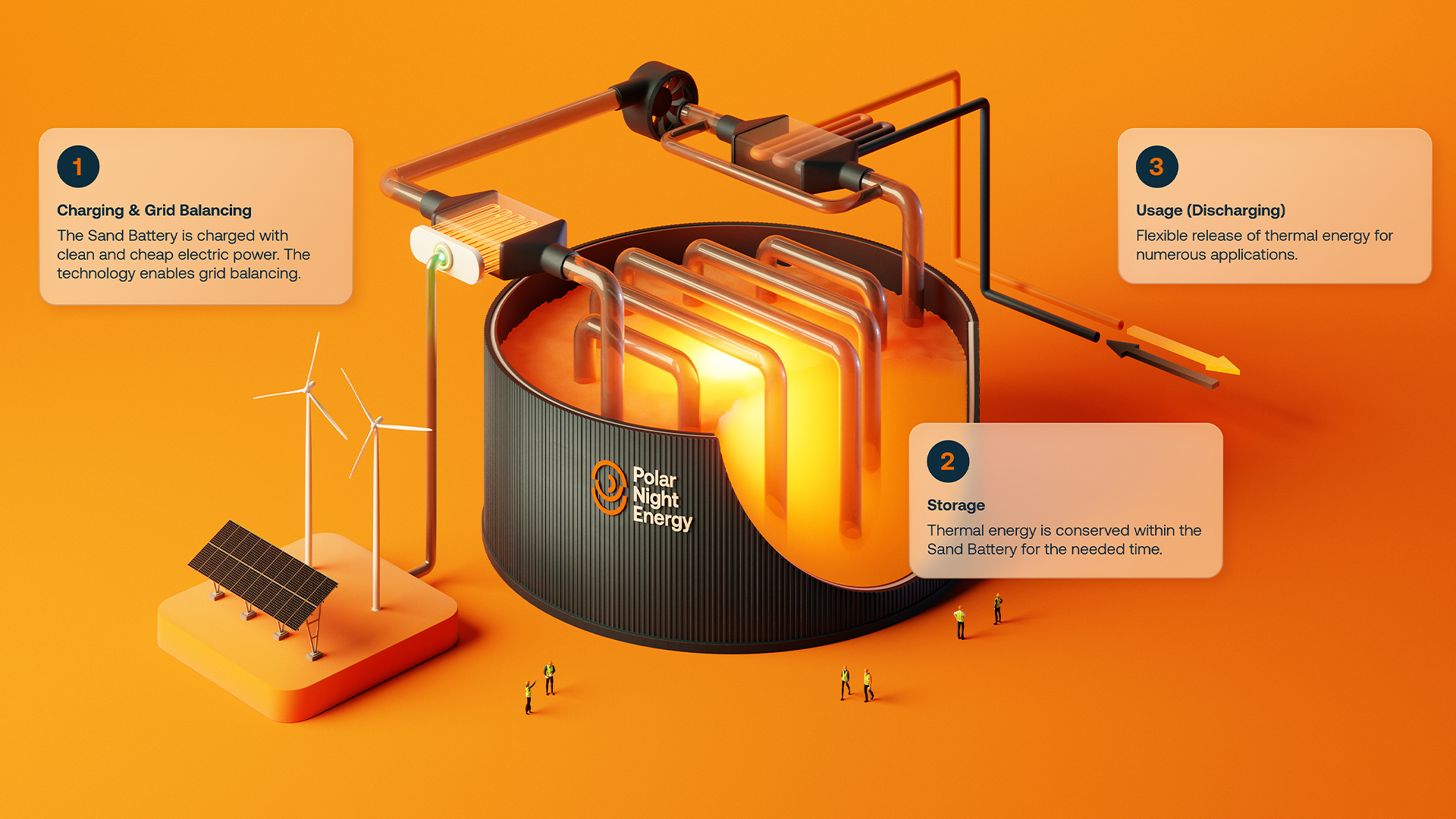
The outermost layers remain relatively cool even as the core reaches its maximum temperature, keeping insulation loads manageable and minimizing heat loss to the environment. Polar Night Energy models this distribution using multi-physics simulations, and its closed-loop heat transfer mechanism is patented.
Round-trip efficiency at Pornainen (charge, store, extract) is 80-90 percent. Antila confirms thermal recovery holds around 85 percent even after weeks of storage.
The sand at Pornainen isn’t construction-grade aggregate. It’s a processing byproduct from a fireplace manufacturer, material that would otherwise be disposed of. Polar Night Energy is also in conversation with mining operations that generate granular waste at scale.
The metric most storage systems ignore
The charging window rarely features in how thermal storage gets evaluated. Discharge rate and round-trip efficiency dominate. It’s where this system diverges most sharply from competitors. Most competing systems operate on charging windows measured in hours. The Pornainen sand battery charges over approximately 100 hours.
That matters because cheap electricity in the Nordic market doesn’t arrive on a fixed schedule. A system that can absorb only a few hours of low-priced power misses most of what’s available. One that can charge over 100 hours can capture far more of it.
“Compared to anyone in the market, we have orders of magnitude longer charging windows than anyone else,” Eronen tells me. “That’s one of the key features.”
There’s more. Because the storage medium (sand and sand-like industrial waste) is cheaper, the cost per unit of stored capacity is substantially lower. Eronen tells me the Pornainen system has already proven it can undercut the economics of water accumulators, something he describes as mind-blowing.
Building something 20 times larger than anything you’ve built before
Pornainen is 20 times larger than Polar Night Energy’s previous installation, a 200 kW/8 MWh system commissioned for Vatajankoski in Kankaanpää in 2022. Construction began in May 2024, and commissioning started a year later.
Liisa Naskali, COO of Polar Night Energy and the project’s construction lead, is candid about what that meant. This, she says, was 20 times larger than anything they’d built before, and therefore, the challenges were real. But the system has proven to work very well, “even better than we expected.”
Polar Night Energy served as the main contractor, coordinating specialist subcontractors while handling all design in-house. According to Naskali, the challenges were almost entirely related to doing things for the first time. You can plan in detail, she says, but you have to stay alert to how things actually develop. The lessons learned, she adds, are directly applicable to scaling into new regions.
The next installation is already underway: a 2 MW / 250 MWh system for Lahti Energia in Vääksy, Asikkala. It’ll be the largest sand battery built to date.
District heating is the niche. Industry is the market
Ask anyone at Polar Night Energy about the long-term picture, and the answer is consistent.
“District heating is a niche,” Antila tells me. It is relevant in Nordic countries and places with proper winters. The real opportunity is industrial. Industries that currently generate steam using gas or oil need temperatures in the several hundreds of degrees, and that market is global.
The sand battery can deliver heat at temperatures ranging from district heating levels (80–100°C) up to saturated steam at 200°C or above. Eronen identifies food and beverage, chemicals, pharma, and general manufacturing as near-term industrial targets. These sectors run on process heat, burn enormous quantities of fossil fuel to generate it, and have limited clean alternatives at the required temperatures. Eronen puts the sweet spot at around 200°C steam.
“To make steam with high temperatures, you have fewer and fewer options,” Antila says. “And you can’t have a gigawatt-hour steam accumulator — it would be far too dangerous.”
Annette Höglund-Dönnes, CCO of Polar Night Energy, says awareness remains a significant barrier. At an energy industry event in Berlin, her impression was that potential industrial customers simply didn’t know solutions like this existed – that it was already possible to stop using gas or oil to produce steam for industrial use.
Beyond heat, Polar Night Energy is developing Sand to Power, a product line combining turbine technology with the sand battery to enable a Power-to-Heat-to-Power (P2H2P) cycle. A pilot is underway in Valkeakoski, targeting 30–35 percent electrical efficiency and combined heat-and-power efficiency approaching 90 percent. The pilot concludes in 2027, after which the company intends to move to commercial-scale deployment.
A small village, and the larger argument
For the residents of Pornainen, the story is more direct. Their heating bills are more stable, and their municipality has met its climate targets. The old oil boiler that once backed up the network hasn’t run once.
“We are extremely happy to have this technology here,” Mayor Antti Kuusela says. “The stability of the district heating price is one of the biggest benefits for our local economy. It is simply better not to use wood for heating when there are innovations like this available.”
And for Polar Night Energy, Pornainen is the beginning of a much larger argument. “In the future, we’d like to focus on the heat as a service part,” Eronen tells me, “so that it will be easier for our end customers to implement these.” The example he reaches for is straightforward. “If they are producing beans, they want to focus on producing beans, not worrying about energy. That’s our worry.”