The discovery of an X-ray signal coinciding with the location of one of the mysterious ‘little red dots’ found by the James Webb Space Telescope (JWST) has strengthened the theory that the dots are ‘black hole stars’ — huge, dense clumps of gas energized by the presence of a growing supermassive black hole within them.
The little red dots may be the biggest cosmological discovery made so far by the JWST, and possibly the most important since the discovery of dark energy in 1998. If they are what astronomers think they are, then they would act as a crucial missing link in the formation of not only supermassive black holes but also the galaxies that grow around them.
Article continues below
“The X-ray dot has been sitting in our Chandra survey data for over ten years, but we had no idea how remarkable it was before Webb came along to observe the field,” said Princeton University astronomer Andy Goulding in a statement.
Chandra has identified millions of X-ray sources across the sky, but the importance of this one, catalogued as 3DHST-AEGIS-12014 (AEGIS refers to the All-wavelength Extended Groth Strip International Survey), only became apparent when it was noticed that it was in exactly the same location as a little red dot seen by the JWST. The X-ray source carries an energy not dissimilar to the X-ray energy of quasars, which are galaxies that host an extremely active black hole, often as the result of a galaxy merger stirring up gas and prompting that material to fall towards the black hole.
Little red dots are compact, being at most just a few hundred light-years across. They are also very red, meaning they are rather cool — a recent study led by Harvard’s Anna de Graaf identified water vapor in them, the existence of which tells us how cool the little red dots must be, in the range of 3,092 to 6,692 degrees Fahrenheit (1,700 to 3,700 degrees Celsius). This sounds hot to us, but it is cooler than our sun and indeed most stars except for the least massive red dwarfs.
Furthermore, little red dots are very distant objects, measured to have existed 12 billion years ago, or even older still. Photometric measurements of 3DHST-AEGIS-12014 by the Hubble Space Telescope tell us that we see this puzzling object as it existed 11.8 billion years ago.
The discovery of little red dots potentially also fulfills one of the JWST’s primary science goals, which is to try and trace the origins of supermassive black holes and the galaxies that assemble around them.
How supermassive black holes are born has been a mystery that has confounded astronomers. Do they form from the bottom up, as smaller stellar-mass black holes produced in supernova explosions combine with each other? Or, do they form from the top down, via the collapse of a vast gas cloud containing hundreds of thousands or even millions of times the mass of our sun?
Little red dots are thought to be huge gas clouds hiding a burgeoning supermassive black hole within them that is feeding off the cloud, eating it from the inside-out. The gas cloud glows from the heat and energy radiated from the material swirling around the black hole, and via magnetically collimated jets of charged particles that can escape the black hole’s maw.
Although little red dots are not yet definitive proof that supermassive black holes form through the top-down process, they do strongly indicate that. Chandra’s new discovery strengthens that hypothesis even further.
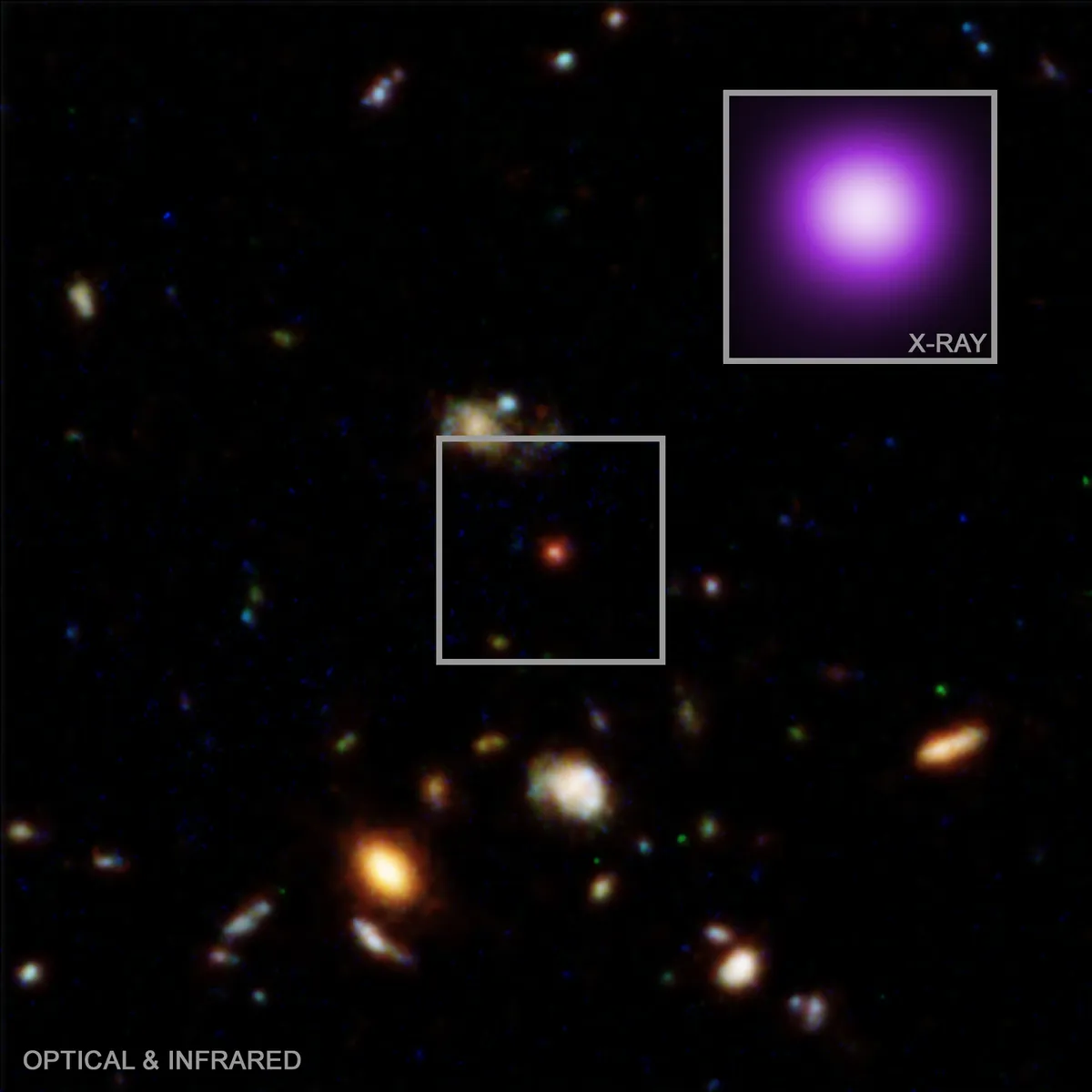
“Astronomers have been trying to figure out what little red dots are for several years,” said Raphael Hviding of Germany’s Max Planck Institute for Astronomy, who is the lead author of the scientific paper describing the discovery. “This single X-ray object may be — to use a phrase — what lets us connect all the dots.”
If Hviding’s team is correct, then this is the first little red dot to be found to shine in X-rays. Ordinary growing supermassive black holes, such as those at the heart of quasars, do shine in X-rays from matter being heated up to millions of degrees as it falls towards the black hole. However, in a little red dot the surrounding gas would absorb the X-rays before they can escape into space, so ordinarily we would not see a little red dot shining in X-rays. This marks 3DHST-AEGIS-12014 as something different.
“Finding a little red dot that looks different from the others gives us important new insight into what could power them,” said de Graaf.
So why can we suddenly see X-rays coming from 3DHST-AEGIS-12014? The hypothesis is that it is a transitional object between the birth of a supermassive black hole in a little red dot, and the “naked” supermassive black holes that we see growing even larger in the center of active galaxies. Inside a little red dot, the black hole is growing by consuming the cloud from the inside out, which eventually leads to holes in the cloud that act as windows into the heart of the little red dot and the supermassive black hole that astronomers think lurks there. The X-rays are escaping through these windows.
Furthermore, although the X-ray signal is weak at such great distances, the Chandra observations suggest that 3DHST-AEGIS-12014’s X-ray brightness could possibly be changing. This would happen as the huge cloud of gas rotates and different windows, some large and some smaller in size, spin into view.
The true identity of Chandra’s X-ray counterpart to one of the JWST’s little red dots is not yet nailed on; one outside possibility is that it could be a supermassive black hole surrounded by an exotic form of hot dust. However, such dust has never been seen before, making this scenario unlikely.
“If we confirm the X-ray dot as a little red dot in transition, not only would it be the first of its kind, but we may be seeing into the heart of a little red dot for the first time,” said Hanpu Liu of Princeton University. “We would also have the strongest piece of evidence yet that the growth of supermassive black holes is at the center of some, if not all, of the little red dot population.”
If this hypothesis is confirmed, then little red dots would become a crucial piece in the jigsaw of how galaxies and their supermassive black holes form, allowing astronomers to figure out the early history of galaxies such as our own Milky Way — a dream of astronomers ever since Edwin Hubble recognized that other galaxies existed beyond our own.
The research was published in March in The Astrophysical Journal Letters.