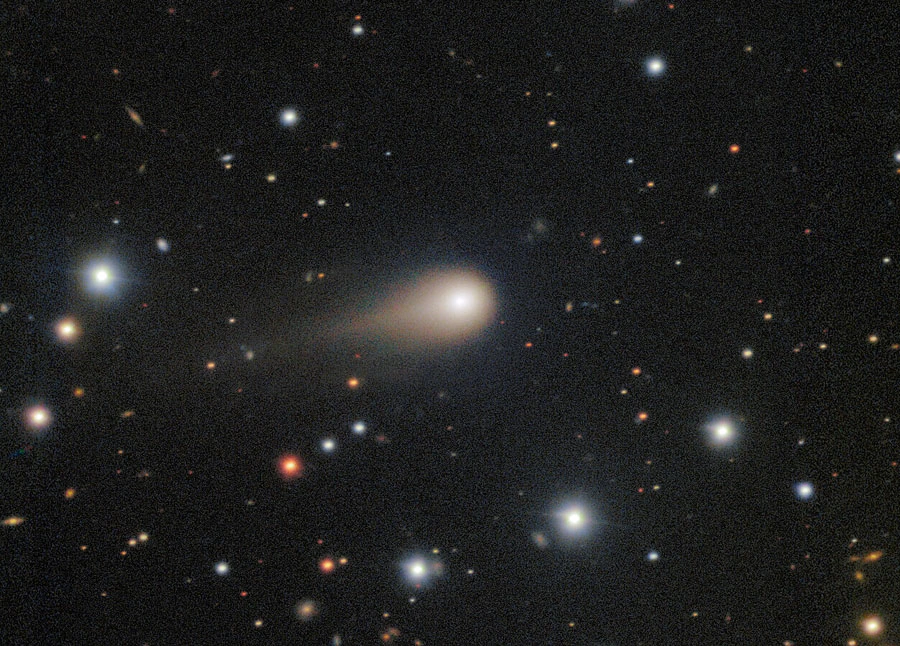
International Gemini Observatory / NOIRLab / NSF / AURA et. al
The visitors we know of from far beyond the solar system are rare. We’ve only found three so far: First, there was the oddly non-cometary 1I/’Oumuamua, discovered in 2017, followed closely by the more ordinary 2I/Borisov. Then, in the last year, astronomers caught wind of Comet 3I/ATLAS. With only a few months to observe the comet before it retreated beyond view, they raced to collect data on this little world both before and after its encounter with our baking-hot Sun.
Now, those data are telling a story: This comet came from far away — not only from us, but also from its parent star. And it started its journey a very long time ago.
Ready and Waiting
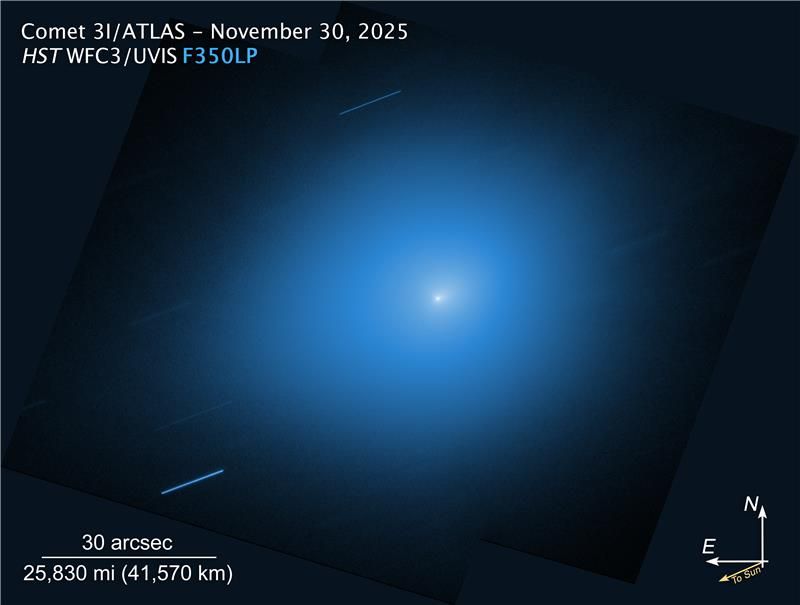
NASA / ESA / Hubble
The most recent interstellar comet zoomed into our solar system, popping into our view near Jupiter’s orbit, when it was traveling at 58 kilometers per second (130,000 mph). Its speedy and unbound, hyperbolic orbit placed its origin far beyond the Oort Cloud, the reservoir of small, icy rocks that surrounds our Sun and from which most long-period comets originate. Just by its speed alone, astronomers figured it must have traveled our galaxy a long time — at least 3 billion years — before reaching us, since various gravitational interactions with different stars would have accelerated it over time.
Ordinary comets originate in the cold outer solar system, where not much chemistry happens, so they retain a fossil-like record of our 4.5-billion-year-old solar system’s earliest years, noted Martin Cordiner (Catholic University of America) at a recent colloquium with scientists at the Harvard-Smithsonian Center for Astrophysics.
NASA
“Interstellar comets, coming from different stars,” he added, “give us the opportunity to reach out across space and time through the galaxy, to study close-up . . . the planet-forming regions of other star systems.” Cordiner has led a team in examining the comet using the James Webb Space Telescope, with preliminary results posted on the astronomy arXiv preprint server.
Cordiner was already studying cometary ices in 2017, when 1I/‘Oumuamua visited the inner solar system and captured his attention. After Webb’s launch, Cordiner and colleagues asked the Webb team to take a look at any newly discovered interstellar comets.
Their moment came in July 2025. “I came back from a canoeing trip in Maine to a lot of emails,” Cordiner said, laughing. “I couldn’t believe the day had come.”
Webb wasn’t really designed to track fast-moving objects — and 3I/ATLAS was moving really fast. Nevertheless, by August 2025, JWST had captured the comet’s spectrum.
Thanks to its larger size (about 1.3 kilometers, or 0.8 miles, across), 3I/ATLAS became far brighter than the first two interstellar visitors. It reached 9th magnitude at perihelion, on October 29, 2025, when it came nearest the Sun (though it never came closer than 1.36 au, outside Earth’s orbit). Even though 3I/ATLAS wasn’t well-positioned for observing from Earth at this time — it was behind the Sun from our point of view — interplanetary spacecraft captured data during that time. But thanks to the early heads up, Hubble, Webb, and myriad ground-based telescopes managed to view it before perihelion.
“When I loaded up the [Webb] spectrum, I was just blown away,” Cordiner said. “Look at that CO2 feature at 4.3 microns — just through the roof. And so little water.”
Comet 3I/ATLAS was turning out to be quite different from almost all solar system comets; water vapor usually dominates their comas. The object was still far from the Sun when Webb first observed it, at 3.3 astronomical units (roughly twice the distance of Mars from the Sun). But even out there, where carbon dioxide might be turning to vapor faster than water ice, the comet was clearly unusual compared to its solar system cousins.
After the vaporization of gases that occurred around the time, on October 29, 2025, Webb observed the comet again in late December. (So did Hubble and other observatories.) As expected, the Webb observations showed more water vapor.
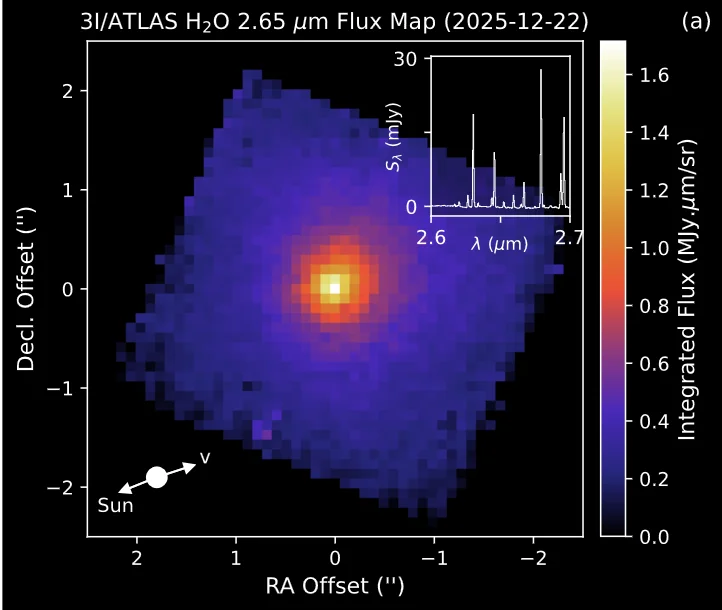
M. Cordiner et al. / arXiv/2603.06911
Post-perihelion observations from the Subaru Telescope in Hawai‘i, conducted by Yoshiharu Shinnaka (Koyama Space Science Institute, Japan) and collaborators, confirmed the change. In results published in the Astronomical Journal, Shinnaka’s team notes that even with the increased water, vaporized during the close approach to the Sun, the comet is still odd compared to other solar system comets, but it’s also more akin to 2I/Borisov.
The post-perihelion JWST data also showed clear fingerprints of methane, methanol, and ethane, so-called organic molecules. (There was nickel vapor, too, which Cordiner couldn’t explain: “That doesn’t make sense, but that’s a question for another day.”)
Cold, Ancient Origins
Most intriguingly, the team detected “heavy water,” that is, water with a heavy hydrogen atom known as deuterium. Deuterium has one more neutron than regular hydrogen (which has just a proton and an electron), and it joins molecules under distinct chemical conditions. The team only detected the deuterium because there was so much of it — entirely unexpected were this a solar system comet.
A team led Luis E. Salazar Manzano likewise found excessive deuterium in data collected by the Atacama Large Millimeter/submillimeter Array (ALMA) on November 4th, just after perihelion. The researchers found distinct spectroscopic fingerprints of both regular water and heavy water, enabling them to compare the two. They found 10 times more heavy water in the interstellar comet compared to the typical solar system comet — and more than 40 times the heavy water found in Earth’s oceans. Salazar Manzano and colleagues have published these findings in Nature Astronomy.
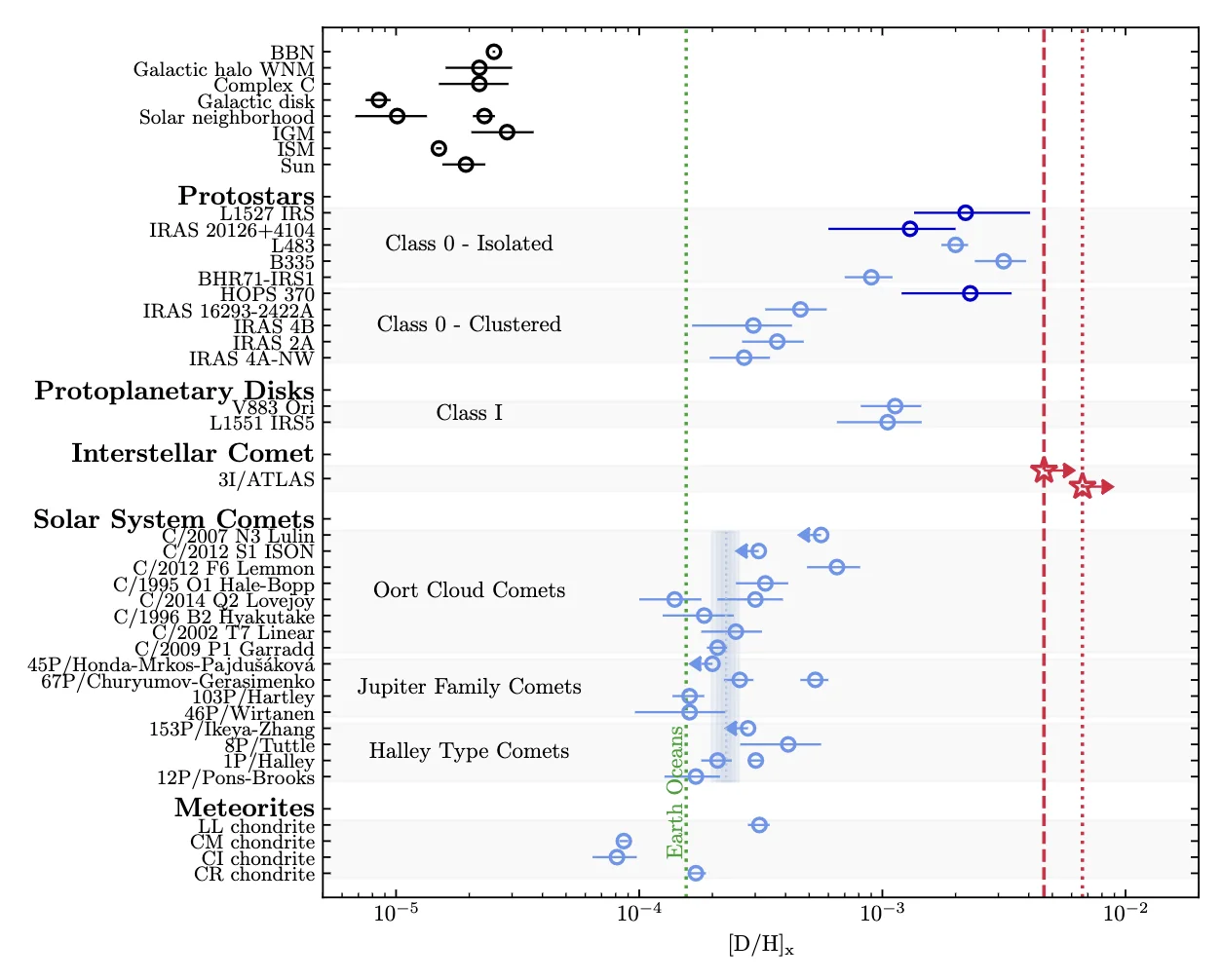
L. Salazar Manzano et al. / Nature Astronomy 2026
Such heavy water abundance sheds light on the formation of the comet’s nucleus, since there’s little reason for the ratio to have changed much since then.
“What we’re seeing here is an object that doesn’t seem to match our own solar system, our own comets,” Cordiner says. “It doesn’t match nearby protostars either. So this is something new and different.”
Turns out, the kind of chemistry that makes lots of deuterium requires two conditions: First, it must have been intensely cold wherever this icy rock formed, because reactions at those temperatures tend to make more heavy hydrogen. “The chemical processes that lead to the enhancement of deuterated water . . . usually require environments colder than about 30K, or about –406°F,” explains Salazar Manzano.
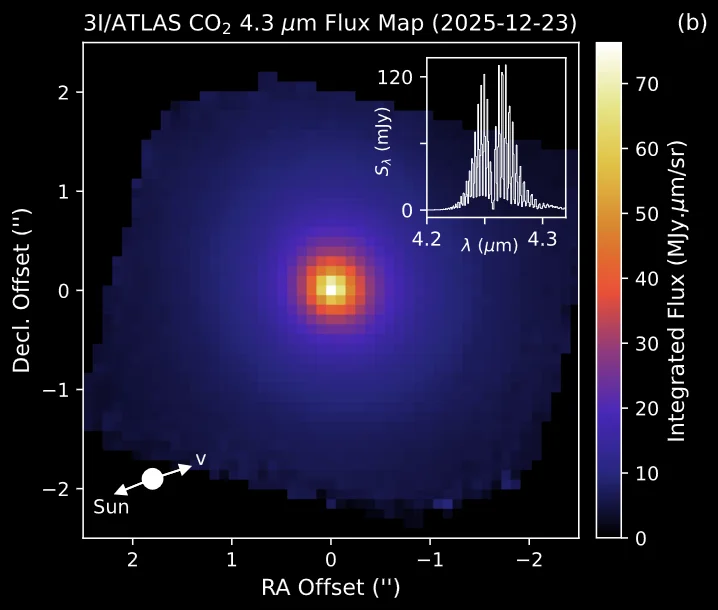
M. Cordiner et al. / arXiv/2603.06911
Cordiner’s team argues that a second condition is also required: environments low in elements heavier than hydrogen. That conclusion comes from unexpectedly low trace amounts of heavy carbon (13C) in the comet’s carbon monoxide–dominated coma. Moderate-mass stars sweep their heavy carbon into interstellar space, so the low amounts of that element in the comet suggest it formed before those stars had a chance to exist. Cordiner suggests the comet formed around a star in the Milky Way’s initial burst of star formation, back when there were few heavier elements to go around.
Cordiner cautioned that there are still many uncertainties in our understanding of the chemical models that lead to this conclusion. Nevertheless, the pieces of evidence seem to be converging on a story about the interstellar comet’s origins: 3I/ATLAS might have formed in the outskirts of a star system in the young Milky Way. At some point, a gravitational nudge, perhaps from a giant planet, ejected it from its home. It’s been ping-ponging through our galaxy ever since — for some 10 billion to 12 billion years.
Analysis of this interstellar object isn’t finished yet. Astronomers are still looking at the mounds of data they managed to collect during its brief visit, and that work will continue to test the comet’s origin story.