A Chinese creator has built a walk-in PC that turns desktop cooling into a human-scale spectacle. The fish-tank-style tower has enough room for a person, a compact desk, and a gaming setup, making the creator look like one of the tiny figures builders sometimes place inside flashy cases.
The build comes from TechTuber Soda Baka, who shared the project on Bilibili. It scales up familiar PC modding cues, including wall-sized fan housings, a huge graphics card prop, chunky cooler parts, and plenty of RGB lighting.
The size gets attention first, but the sealed enclosure soon becomes a heat trap.
The giant parts are mostly props
Soda Baka’s build starts like a serious PC project, with sketching, modeling, and fabrication before the frame comes together. The finished tower looks like an extreme version of the glass-heavy desktop cases that put every component on display.

Most of the human-scale hardware is built for show. The oversized fans, GPU, RAM sticks, and liquid cooler pieces appear to be nonfunctional, while working PC gear gives the creator something to use once he sits down at the desk.
The absurdity is carefully staged. Its size sells the illusion without pretending this is a practical computer anyone should recreate at home.
Why the AC matters
The air conditioner becomes the key component once the sealed enclosure starts heating up. To mimic a PC’s thermal problem at room scale, the creator uses hot-coal sauna gear and water to push the interior above 100 degrees Fahrenheit, or 38 degrees Celsius.
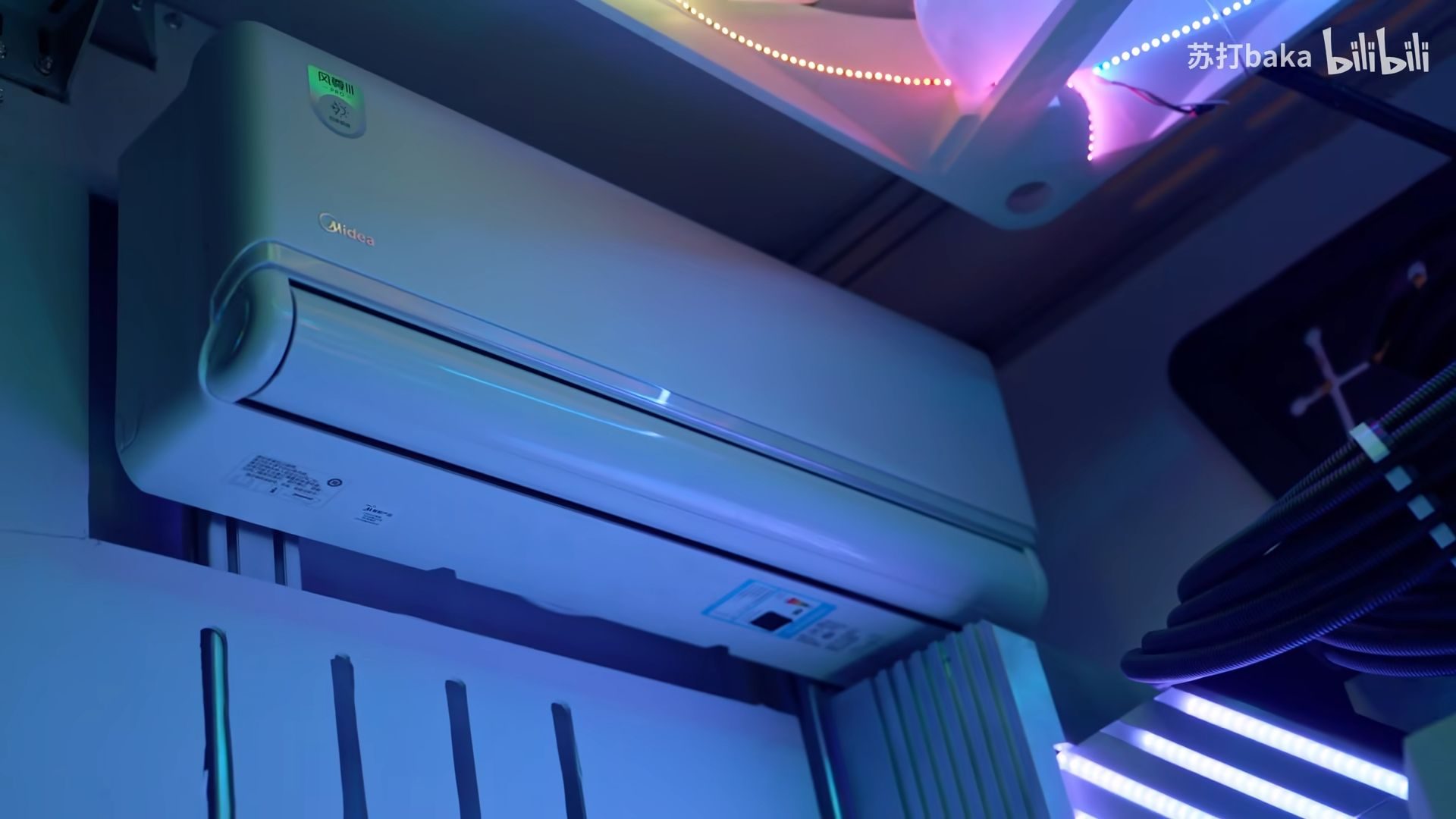
With the huge fans and coolers serving as set dressing, the build relies on a 12kW AC unit with claimed 820 cubic meters per hour of air circulation. The joke only works because the AC does the job the fake cooling hardware can’t.
What to watch next
The build looks more like a promo stunt than a mod worth copying. It may also be tied to an air conditioner sponsorship, though it isn’t fully confirmed.
For actual PC builders, the useful lesson is narrower and more practical. Glass-heavy cases, dense layouts, and sealed spaces all need a real airflow plan before heat becomes the limiting factor. Start with intake, exhaust, and component clearance before chasing the look.