NASA / ESA / CSA / Dani Player (STScI)
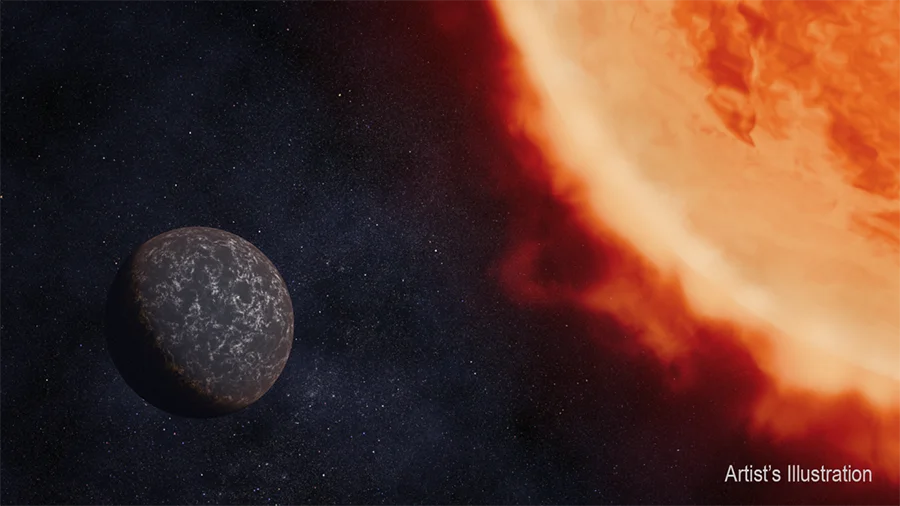
Astronomers have used the James Webb Space Telescope to study the surface of a “super-Earth,” a so-called rocky world slightly larger than our own planet. But contrary to the name, the planet’s not like our Earth at all; it is bare and lifeless, covered in cooled volcanic rock like basalt.
The world in question is LHS 3844b — a planet 30% larger than Earth that whips around its red dwarf star every 11 hours. Astronomers had already ruled out the possibility of a thick atmosphere around the planet back in 2019, with data from the Spitzer Space Telescope.
That meant that the JWST observations of the planet’s light provided a direct look onto its surface, with no thick atmosphere blocking it. The team found no wisps of volcanic gases, such as sulfur dioxide, which could have indicated recent geological activity. They were able to rule out even a thin, Mars-like atmosphere.
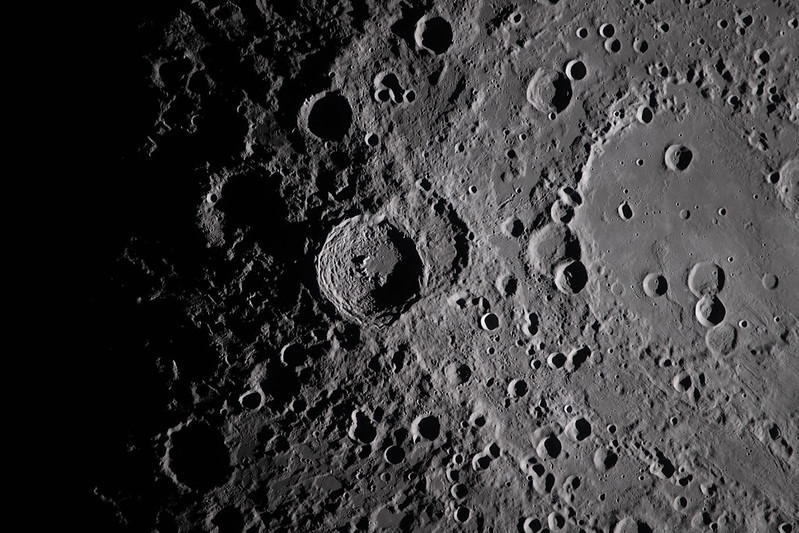
With the new JWST data, a picture emerges of this alien world: a surface as dark and desolate as our Moon, with old rock likely battered by space weather for billions of years. The findings, published in Nature Astronomy, are one of the first of a burgeoning field of “exoplanet geology.”
“This is a beautiful measurement, using JWST’s exquisite precision to measure the thermal glow emanating from a rocky exoplanet’s surface,” says Zach Berta-Thompson (University of Colorado-Boulder), who wasn’t involved in the study. The results give astronomers a new window into understanding the environments of rocky worlds beyond our solar system.
NASA
Observing a Faraway Surface
LHS 3844b is tidally locked, meaning that the same side of the planet always faces its star. Because it doesn’t have an atmosphere, its dayside is constantly heated to a sizzling 1,000 kelvin (1340°F ), while its nightside is only just above absolute zero, the coldest it can get.
LHS 3844b is more than 48 light-years from Earth, so astronomers observed it by looking at the tiny dip in light that occurs when the planet passes behind its star. By comparing the light from this eclipse to the combined light of the planet and star, the astronomers can isolate the emission that’s coming from the planet’s dayside.
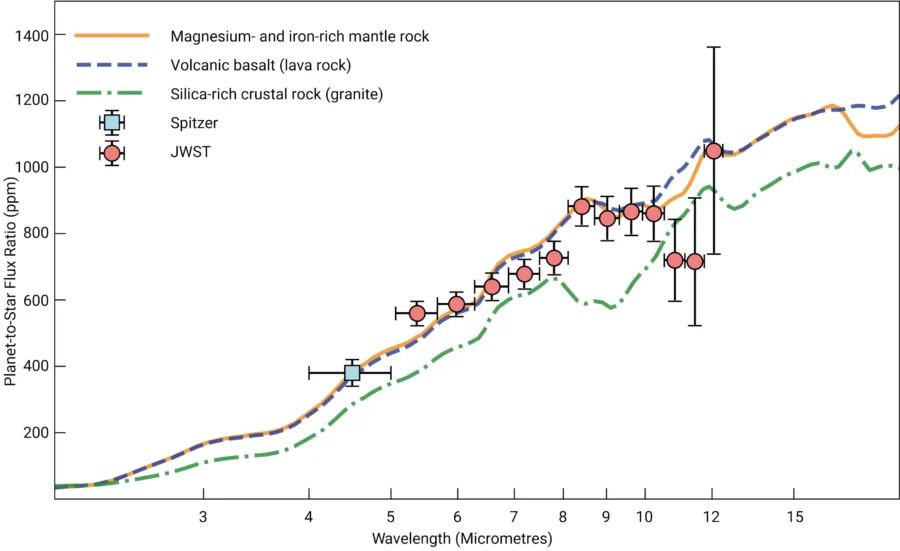
Astronomers looked at the thermal emission from the planet’s dayside across different wavelengths by observing three of these eclipses with JWST’s Mid-Infrared Instrument’s Low-Resolution Spectrometer, combining it with the previous Spitzer data to construct a spectrum of the planet’s surface.
The astronomers figured out what the surface was made of by comparing the data to different rock surfaces. “People went into laboratories around the world [and] took different samples,” says lead author Sebastian Zieba (Center for Astrophysics, Harvard & Smithsonian), “and just measured the way they reflect light or emit light.”
S. Zieba et al. Nature Astronomy 2026 / MPIA
When the team compared their data to this catalog of rocky spectra, they discovered a surface that was dark, hardly reflecting any light at all. It’s also incredibly low in silicates, the type of minerals that make up most of Earth’s crust.
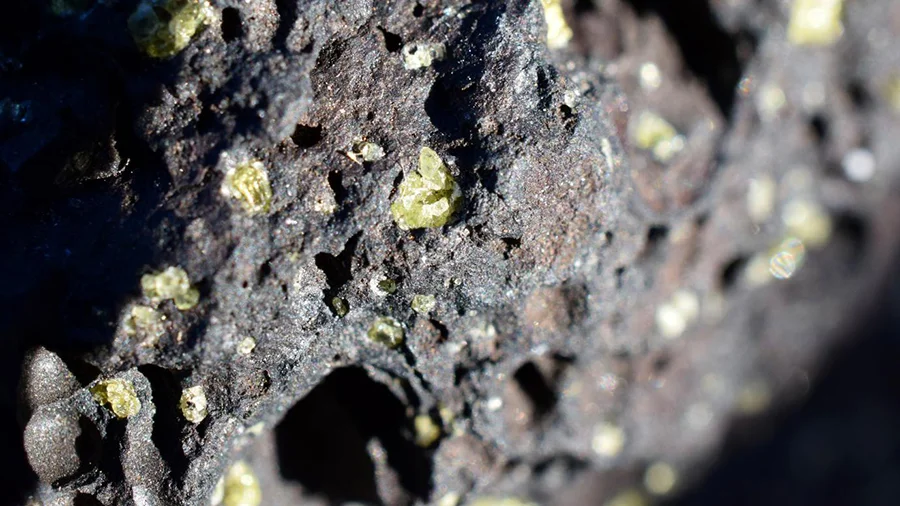
Instead, LHS 3844b’s surface appears to be made from basalt or igneous mantle rock — the remains of ancient volcanoes. It also appears rich in olivine, a dark-green mineral in Earth’s upper mantle that makes up low-silicate rocks.
On Earth, basalt appears on ocean floors and on volcanic islands, such as Iceland or Hawai‘i. In the solar system, we see it in the maria of the Moon as well as on Venus, Mars, and Mercury.
incidencematrix / CC-BY-2.0
The team’s findings mean that LHS 3844b is a far cry from Earth, whose continental crust is mostly made up of granite produced through geological processes, which are influenced by plate tectonics and the presence of water, Zieba says. Water can lower the melting point and viscosity of rock, playing a role in granite formation. “The Earth is unique in having this granite,” he adds.
The Beginnings of Exogeology
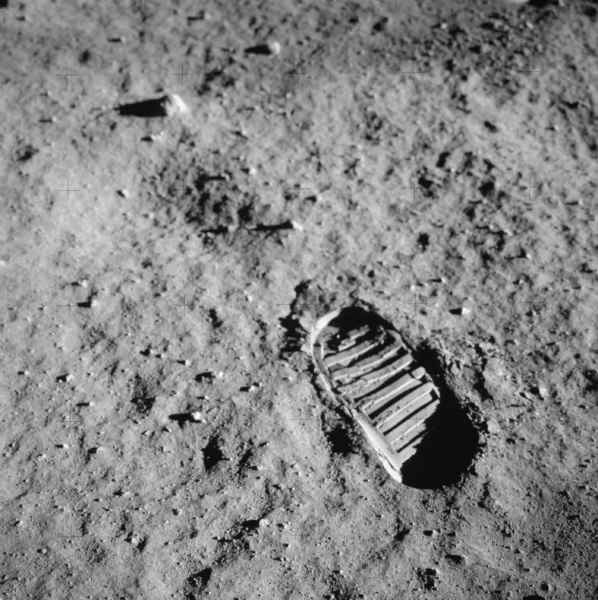
Without an atmosphere, LHS 3844b’s surface would be peppered with impacts from micrometeorites — tiny dust particles from comets and asteroids — and particles from stellar wind. This space weather would deposit nanometer-sized iron particles which reflect less light, darkening the surface and pulverizing rock into powder.
NASA
However, the team couldn’t distinguish in the data whether the planet’s surface was solid rock or fine powders darkened by space weathering. But to constantly churn out fresh slabs of solid rock, the planet would need active volcanic activity that it doesn’t have. Instead, the surface is likely weathered down into fine powders the size of dust, similar to the powdery surface of the Moon or Mercury.
The team has already observed nine additional eclipses of LHS 3844b with JWST. They’ve also measured the light from the planet throughout its entire orbit, which will help them determine whether the surface is solid or powdery.
“In the big, long-term quest to understand where else life might exist in the Milky Way, finding exoplanets that are able to support atmospheres is likely essential,” Berta-Thompson says. But the bare rock of LHS 3844b offers a different perspective. “While it might seem strange to be happy about something not being there,” he adds, “every measurement we make of planets having or not having atmospheres leads us closer to a more complete picture of how planetary atmospheres evolve and what makes planets habitable.”