ESO
What’s the source of gas feeding our galaxy’s supermassive black hole?
Astronomers have identified the likely source of gas that flows into the maw of the Milky Way’s central black hole, Sagittarius A*.
When it comes to black holes, what goes in never comes out. But to swallow stars, gas clouds, or planets, something must funnel the food into their gravitational grasp. The myth of black holes as “cosmic vacuum cleaners,” actively sucking matter out of their vicinity is just that — a myth. Now, astronomers claim they’ve found the source of dishes served to the supermassive black hole at the center of our Milky Way Galaxy.
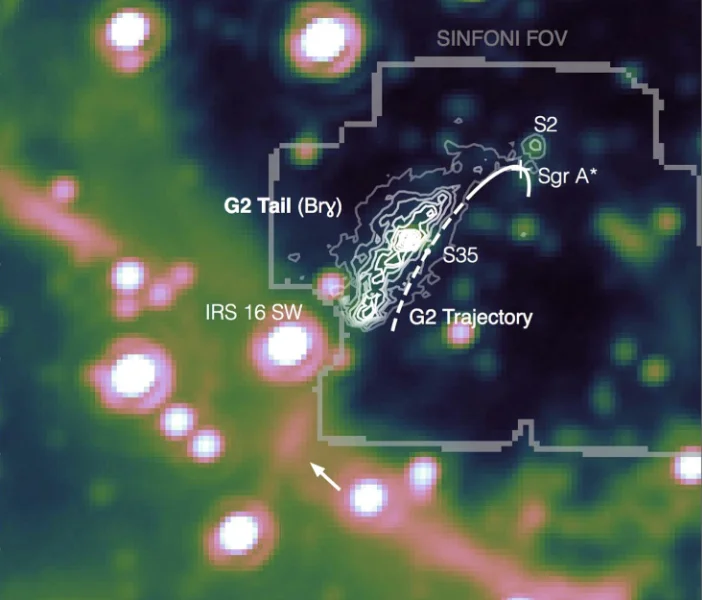
In a recent edition ofAstronomy & Astrophysics, a team led by Stefan Gillessen (Max-Plack Institute for Extraterrestrial Physics, Germany) reports the origin of a chain of gas clouds detected near Sagittarius A* (Sgr A*), the commonly used name of our galaxy’s central black hole. A binary star, IRS 16SW, orbits Sgr A* from just 19,000 astronomical units away, about the distance of the Oort Cloud of comets from the Sun. Gas and dust around that binary star is streaming toward the black hole. Gillessen and colleagues explore a possible mechanism by which these stars constantly creates new clouds, providing a steady supply of food heading towards Sgr A*.
S-stars and G-clouds
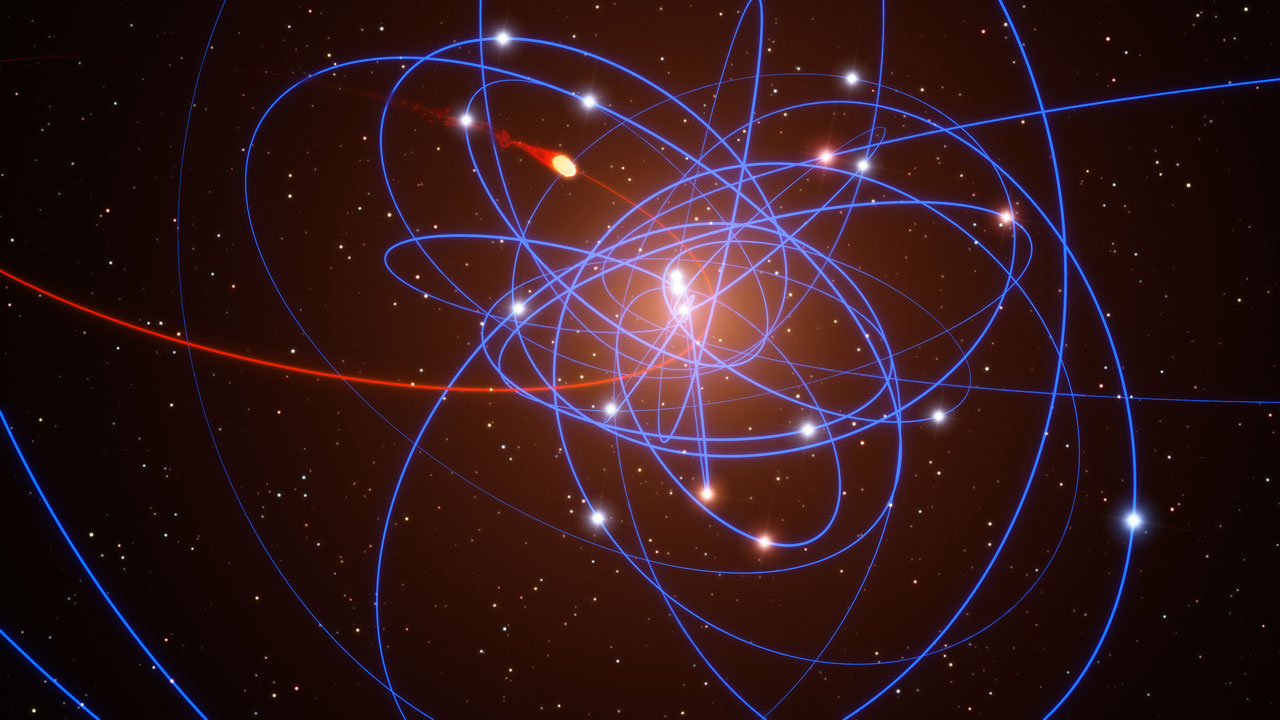
The central black hole of our galaxy has the mass of about 4.3 million Suns. Multiple teams derived this estimate after monitoring two dozen stars that orbit right around Sgr A*. These “S-stars” reside close to Sgr A*, at distances of less than 0.03 light-years.
Several teams, most notably one including Gillessen and Reinhard Genzel (MPE), and one led by Andrea Ghez (UCLA), also found several gas clouds that also appear to swirl around Sgr A*, (For their work on Sgr A* and its surroundings, Ghez and Genzel shared the 2020 Nobel Prize in Physics.) Three of those clouds, named G1, G2 and G3, travel on quite similar orbits . (Other G-clouds have also been observed, but those seem to be on other orbits.)
ESO / A. Eckart
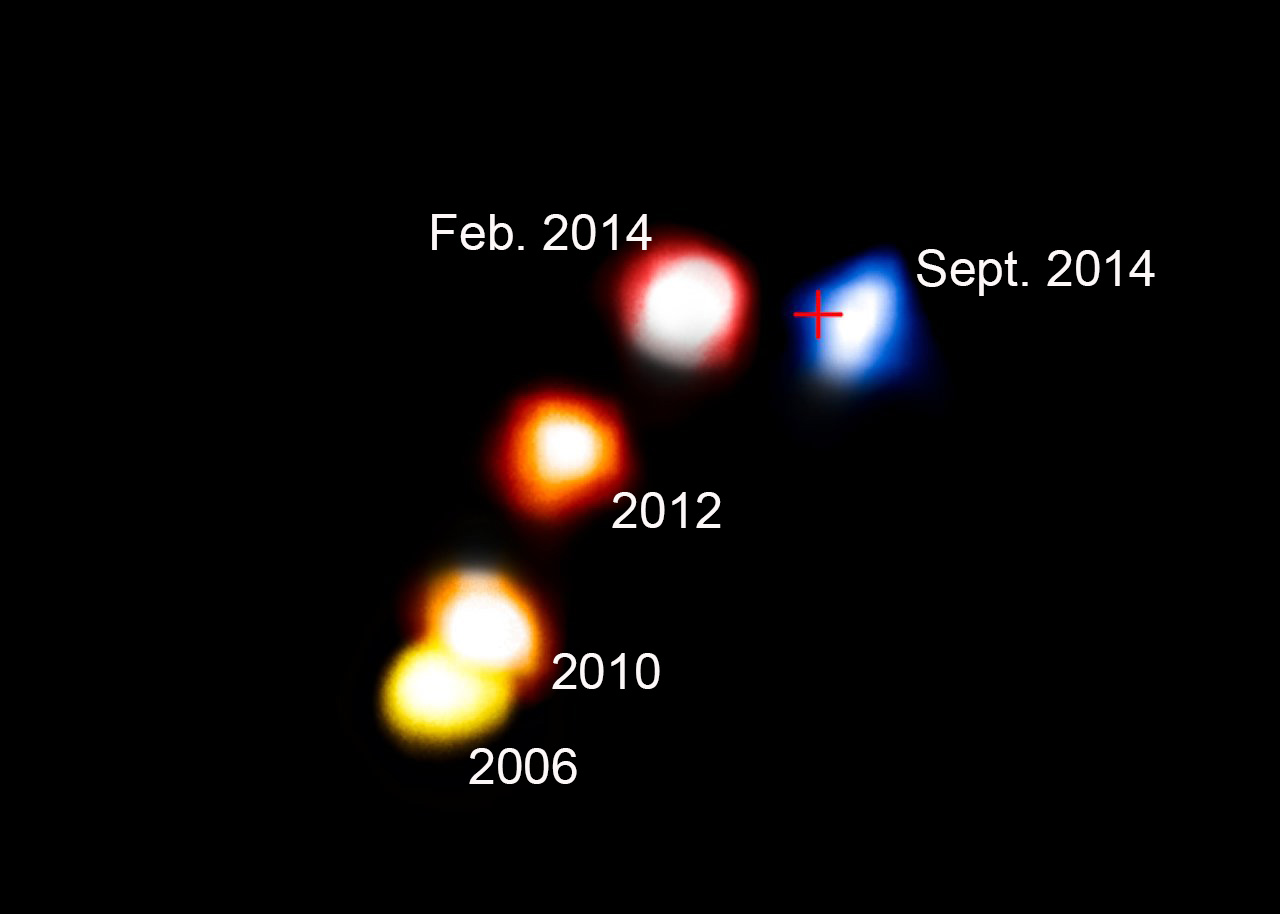
In 2014, G2 survived its closest encounter with the black hole, becoming somewhat “spaghettified” during its close pass due to Sgr A*’s strong gravitational field.

ESO / S. Gillessen
Gillessen’s team n considers this family of G clouds — G1, G2, and G3 — to be part of a coherent structure, part of a continuous stream of gas that connects the clouds as they orbit Sgr A*. But where did this gas come from?
A common source?
To find out, Gillessen and his team used adaptive-optics-assisted spectrographs at the VLT to track the G-clouds’ orbits. The researchers also analyzed the motions of stars orbiting the black hole at distances of less than 1 light-year, a bit farther away than the S-stars. They found that the clouds’ motions match the orbit of the close binary IRS 16SW.
Plewa et al. / Astrophysical Journal 2017
IRS 16SW is a pair of two hot stars, each about 50 times as massive as the Sun. They orbit each other in just 19 days, which means they’re so close to each other that their atmospheres partially overlap. They each emit strong winds of particles that shock the thin, surrounding gas. The researchers think that these shocks condense into clumps of gas every 10 to 20 years, each clump containing a few times Earth’s mass. Some of these clumps then end up in eccentric orbits around Sgr A*. IRS 16SW is thus the likely origin of the entire stream of G-clouds that’s the main food source for Sgr A*. Within a few centuries, that source will have dried up and our black hole will have to switch to a new food provider.
The groups’ computer simulations support the idea that the clouds — and indeed Sgr A*’s entire food supply — comes from this binary system. But the simulations have some significant simplifications, such as treating IRS 16SW as a single star. “It seems possible that the G-clouds originate from IRS 16SW,” the authors conclude, “[but] the exact formation mechanism requires more detailed study.”
Alternative scenarios
Other scenarios aren’t off the table just yet. In another scenario, the three G-clouds are the remains of stars or planets, torn apart in the immense gravity field of the black hole. Avi Loeb (Harvard University), who has studied this scenario over the years, isn’t convinced by Gillessen’s work: “The main challenge of the scenario proposed by the authors is in making compact dense clouds out of the interaction of a wind with an ambient medium,” he says. “Given the high velocities in the galactic center, I find [this] very challenging.” He still thinks that a tidally disrupted triple star system could have produced the clouds.
Jordi Miralda-Escudé (Barcelona University, Spain), who like Loeb wasn’t involved in Gillessen’s team, also favored tidal disruption in the past, but he is more willing to change his stance. “When I wrote my paper in 2012,” he says, “I was thinking that stellar winds creating clouds like G2 was rather unlikely, because no clear star was associated with the motion of G2.” That has changed now, he admits.
“The other reason I was skeptical,” he adds, “was that a cloud like G2 is pressure-confined by a very hot surrounding medium, with nothing else holding it together.” In the past decade, though, both observations and simulations have shown that such clouds can survive for some time. “[That’s why] I think I agree with the conclusion of the present paper,” he concludes. “It’s a very impressive new result!”