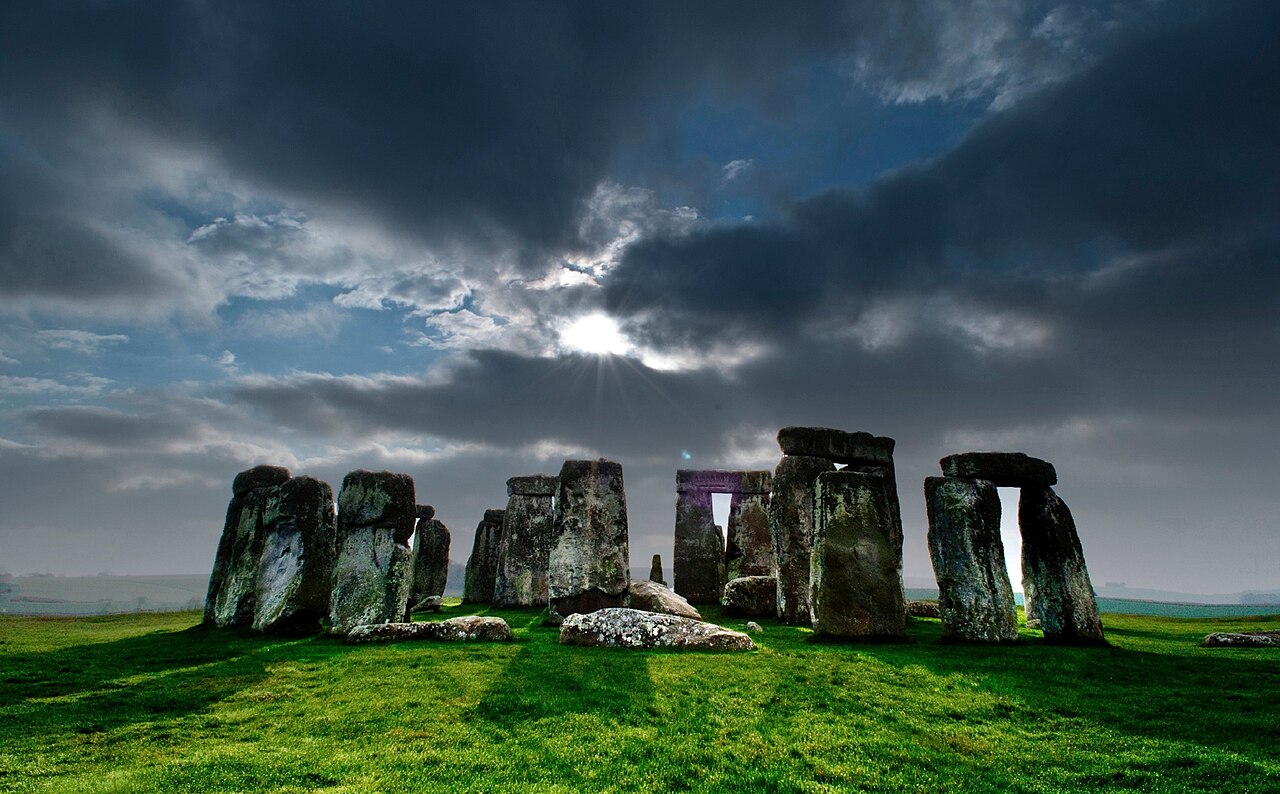
Sanjay Nair / Wikimedia Commons; CC BY-SA 3.0
Every year, on the June solstice, thousands gather at Stonehenge to watch the Sun rise in near-perfect alignment with the monument’s central axis. As the first light appears on the horizon, it passes beside the Heel Stone and into the heart of the circle — a moment that feels both ancient and immediate. This alignment is often described as Stonehenge’s defining feature. And in a sense, it is. But it is also part of a much larger story.
Stonehenge is not aligned to a single moment in the year. It is oriented to a system of repeating events in the sky. Opposite the summer solstice sunrise lies the winter solstice sunset, a direction that many archaeologists now argue may have been even more significant to its builders. And beyond just monitoring the Sun, Stonehenge is aligned with the Moon, which traces a far more complex path over the stones. It reaches extreme rising and setting points over a cycle that unfolds over nearly two decades.
Taken together, these patterns suggest that Stonehenge was not simply marking time. It was engaging with it; tracking cycles that repeat, diverge, and return.
For the past three years, I have taught a course at George Washington University called Ancient Skies, where students explore sites like Stonehenge using modern tools like Stellarium and Google Earth. Along the way, they ask the broader question of how different cultures, at different times in our shared history, have made sense of the sky. This new series for Sky & Telescope grows directly out of those conversations.
While the locations and themes presented in this series are a subset of what we examine in that course, they take on new urgency today. We are living at a time of extraordinary scientific understanding, yet also one in which many people feel increasingly disconnected from both the natural world and the institutions that study it. Revisiting these monuments is not an exercise in nostalgia; it is an opportunity to ask why, across thousands of years and vastly different cultures, humans invested so much effort in tracking the sky. What did they see that we may no longer notice? And what might we recover by looking up again?
A Monument Built Over Time
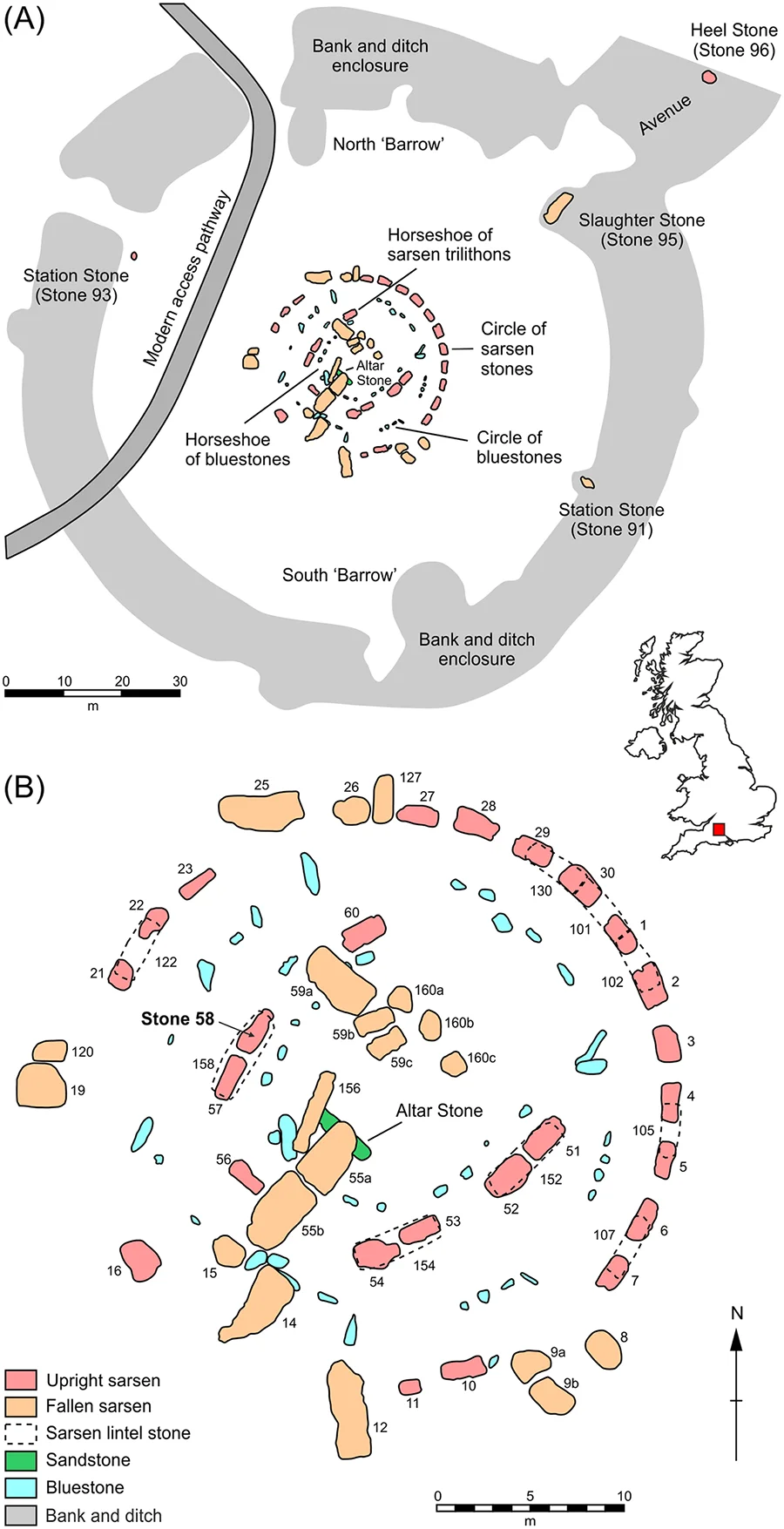
© 2021 Nash et al. / CC BY 4.0
Stonehenge did not appear fully formed. It was constructed in several stages spanning more than 1,000 years, beginning around 3000 BC with a circular ditch and bank. This was followed by the placement of massive sarsen stones — large blocks of hard sandstone — and smaller bluestones, a diverse group of igneous and metamorphic rocks transported from Wales, in carefully arranged configurations (Darvill, 2016; Parker Pearson, 2012; Parker Pearson et al., 2020).
This long construction history complicates any single interpretation. The monument we see today reflects not one moment of intention, but many of them layered across generations. Yet within that complexity, a consistent theme emerges: orientation.
The clearest expression of this intentionality is the monument’s central axis, oriented along the avenue toward the midsummer sunrise in one direction and the midwinter sunset in the other. This dual alignment is not accidental — it is correct to within a few degrees. Statistical analyses suggest that such precise orientation is highly unlikely to arise by chance alone. Surveys of megalithic sites in Britain indicate that orientations toward solstitial extremes occur far more frequently than expected by chance, with Stonehenge’s principal axis falling within only a few degrees of these celestial targets — a level of precision consistent with intentional design given local horizon variation.
But what mattered more: the longest day or the shortest?
The Winter Sun
For much of the 20th century, public attention focused on the summer solstice sunrise. It is visually dramatic, easy to observe, and still draws large crowds today. More recent archaeological work, however, has shifted emphasis toward the winter solstice.
Excavations at nearby Durrington Walls, a large settlement associated with Stonehenge, have revealed evidence of feasts timed to the midwinter period. The remains of pigs slaughtered at around nine months of age suggests winter gatherings. These findings point to a seasonal rhythm in which communities may have come together during the darkest time of year.
From within the circle, the winter solstice sunset aligns with the central axis in a way that frames the dying light between the stones. It is a quieter moment than the summer sunrise, but no less precise.
If the summer solstice marks a peak, the winter solstice marks an important turning point: the return of light after its longest absence.
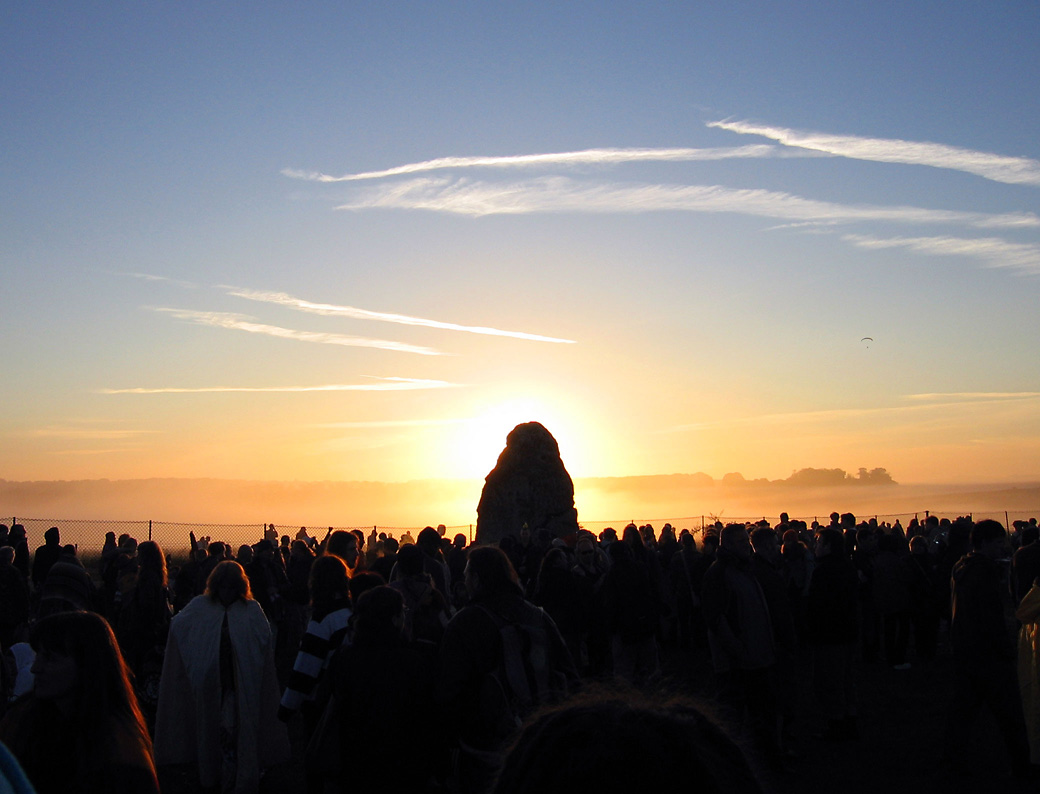
Andrew Dunn / CC BY-SA 2.0
Beyond the Sun
The Sun’s motion across our sky is regular and predictable, repeating every year. The Moon, by contrast, follows a more complex path. Over the course of 18.6 years, the Moon’s rising and setting points shift along the horizon, reaching extremes that extend beyond the range of sunrises and sunsets by several degrees in azimuth. These extremes are known as lunar standstills — moments when the Moon rises and sets at its most northerly and southerly limits. Some researchers have proposed that elements of Stonehenge may relate to these lunar extremes. In particular, the positions of the Aubrey Holes — a ring of pits surrounding the monument — have been interpreted as markers that could, in principle, track the Moon’s motion across its standstill cycle.
These claims remain debated. Critics note that the archaeological evidence does not conclusively demonstrate intentional lunar alignment, and that alternative explanations for the Aubrey Holes exist. Still, the possibility remains open and raises an important question: What kind of observation would be required to notice such a cycle?
Because the Moon’s standstill cycle unfolds across nearly two decades, to recognize it requires not just observations of several cycles to notice the pattern, but remarkable continuity for a culture that existed before the advent of writing. Knowledge would need to pass across generations through oral traditions such as folklore and storytelling.
Whether or not Stonehenge encodes this cycle directly, it stands within a broader landscape of prehistoric monuments in Britain that indicate an awareness of solar and possibly lunar patterns. It is part of a tradition of sky-watching that was both sustained and cumulative.
Over the past two decades, Stonehenge has remained at the center of both careful scholarship and more speculative claims. Some researchers have proposed that the monument encodes sophisticated astronomical knowledge, including eclipse prediction systems or precise geometric relationships between solar and lunar cycles. Others have suggested that its placement reflects an intentional selection of latitude that produces specific angular relationships between celestial events. These ideas remain intriguing but are not widely accepted within the archaeological community.
At the same time, advances in excavation and radiocarbon dating have strengthened more grounded interpretations, particularly those emphasizing Stonehenge’s role within a broader ritual landscape tied to seasonal gatherings and ancestral memory.
The current consensus is, therefore, both more cautious and more robust: The solstitial alignments are well-supported, the monument’s connection to seasonal ritual is increasingly clear, and while lunar and more complex astronomical interpretations remain possible, they are treated as hypotheses requiring further evidence rather than established conclusions.
A Landscape, Not a Point
Stonehenge is often treated as an isolated structure. In reality, it’s part of a much larger ceremonial landscape. Nearby sites such as Durrington Walls, Woodhenge, and the Stonehenge Avenue form a network of connected spaces, many of which are themselves aligned to solar events. Movement through this landscape — from river to monument, from wood to stone — may have carried symbolic meaning tied to cycles of life, death, and renewal.
Seen this way, Stonehenge is not simply a place to observe the sky. It is a place where sky, land, and human activity intersect. The alignments are not just lines on a map, they are directions embedded in human experience.
What Can Be Known — and What Cannot
It is tempting to look at Stonehenge and seek a definitive explanation, a single purpose that accounts for its design. But the evidence resists such simplicity.
We can measure alignments. We can date construction phases. We can analyze animal bones and artifacts. These provide a robust, empirical foundation for understanding the monument’s context.
But intention, that is, what the builders believed, felt, or intended, remains more elusive.
As a field, archaeoastronomy has matured significantly over the past half-century, moving away from speculative claims toward more rigorous standards of evidence. Today, most researchers agree on the importance of the solstitial alignments. Beyond that, interpretations become more tentative.
This is not a limitation to be overcome, but a reality to be acknowledged: Stonehenge is both known and unknown — measurable in its geometry and open in its meaning.
Stonehenge is only one expression of a much larger human story. In the articles that follow in this special series, we will move across landscapes and cultures: from the winter solstice light of Newgrange, to the horizon-marking architecture of Chaco Canyon, to traditions in which the constellations themselves are not fixed figures but living narratives shaped by culture and place.
Along the way, we will ask a consistent set of questions: What did people notice in the sky? How did they encode those observations in architecture, story, and ritual? And what does it mean that so many different cultures, separated by time and geography, turned to the sky as a source of structure and meaning? These are not just abstract academic questions about the past. They are questions about us as a species and how we’ve understood our place in the cosmos.
Participating in the Sky
What can be said with confidence is this: The builders of Stonehenge paid close attention to the sky. They oriented massive stones to the movements of the Sun. They constructed a monument that frames light at specific moments in the year. They participated in cycles that repeat with precision across generations.
They did not passively observe the sky; they engaged with it.
Today, the sky is often experienced differently. Artificial light obscures night skies such that we no longer see what our ancestors saw. The rhythms of our daily life are set by clocks and screens rather than celestial motion. The cycles that once structured human activity are still present, but less frequently noticed.
And yet, at Stonehenge, those cycles remain visible. Each solstice, the Sun rises and sets in alignment with the stones, just as it has for several thousands of years. The geometry holds. The pattern repeats.
The monument does not explain itself. It does not tell us exactly what its builders believed. But it shows us something else. It shows us that the sky was once something people lived with so intently that they built elaborate structures in its image.
References
Darvill, T. (2006). Stonehenge: The Biography of a Landscape. Tempus.
Hawkins, G. S., & White, J. B. (1965). Stonehenge Decoded. Doubleday.
North, J. (1996). Stonehenge: Neolithic Man and the Cosmos. HarperCollins.
Parker Pearson, M. (2012). Stonehenge: Exploring the Greatest Stone Age Mystery. Simon & Schuster.
Parker Pearson, M., et al. (2007). The age of Stonehenge. Antiquity, 81(313), 617–639. https://doi.org/10.1017/S0003598X00095624
Parker Pearson, M., et al. (2021). The original Stonehenge? A dismantled stone circle in the Preseli Hills of west Wales. Antiquity, 95(379), 85–103. https://doi.org/10.15184/aqy.2020.239
Ruggles, C. L. N. (1999). Astronomy in Prehistoric Britain and Ireland. Yale University Press.
Ruggles, C. L. N. (Ed.). (2015). Handbook of Archaeoastronomy and Ethnoastronomy. Springer.