NASA / JPL
The giant outer planets of the solar system host a ragtag bunch of moons, some large and round, some small and misshapen. Generally, round moons are the native satellites that formed alongside their planets, orbiting in the same direction the planet rotates. Others, called irregular moons, travel on wider, more elliptical paths, often in the opposite direction from their planet’s spin. Astronomers think these are captured objects formed elsewhere and were ensnared by the gravity of the gas and ice giants early in the solar system’s history.
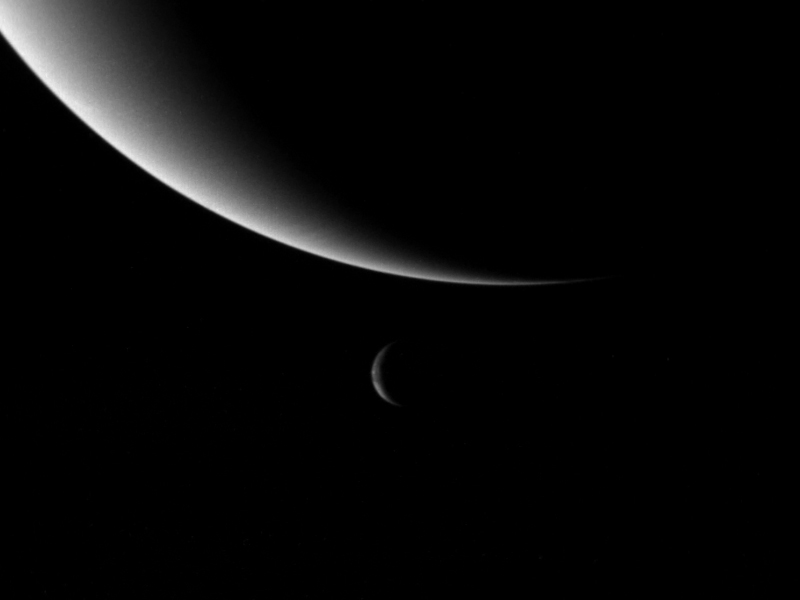
Neptune, however, doesn’t quite fit the pattern. Nearly half of its 16 known moons travel backwards around the planet. One of them is not like the others: Like a swan chick among ducklings, Triton is six times larger than the system’s next-largest moon. Nearly as big as Earth’s Moon, Triton has long been considered a Pluto-like world, captured in Neptune’s orbit when the planet was still young. Now, research suggests that Triton’s arrival — or perhaps even the arrival of some earlier, Triton-like object — destroyed whatever original population of moons Neptune had.
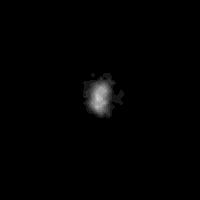
Triton isn’t the only puzzle: Nereid, Neptune’s third-largest moon, measures about 350 kilometers (220 miles) across and sits in an uncanny orbital valley. It’s too far away from Neptune to be considered a native moon, but it’s closer-in than most irregular satellites. Its orbit is both highly inclined and extremely elongated, hinting at an unusual past.
The Origin of Nereid
Matthew Belyakov (Caltech) and colleagues investigated Nereid’s history using the James Webb Space Telescope, finding that Nereid’s composition differs from Neptune’s other moons. It has more water ice and lacks volatile organic molecules. Crucially, it also looks different from Kuiper Belt objects, which are considered the reservoir from which most of the captured irregular moons come from.
“It is what we were expecting, but in a very gratifying way,” Belyakov says. “This does not look like it formed out past Neptune; it looks too much like it formed at Neptune, like a regular satellite would.”
NASA / JPL
Previous studies had already hinted at this, but the new study’s findings are more conclusive. Not only do JWST’s spectra have much higher resolution than previous observations, astronomers now also have a much larger library of spectra of other moons and Kuiper Belt objects, gathered during JWST’s first five years of operation. When comparing against these objects, the team found that Nereid doesn’t look like any of them. Likewise, Nereid’s spectrum differs from that of Saturn’s irregular moon Phoebe, which like Triton might also be a captured Kuiper Belt object. “You would almost be able to see the difference with the naked eye,” Belyakov says.
Nereid is also very different from Neptune’s inner, regular moons. Those moons circle close to the planet and are small, almost like rubble piles assembled in orbit. The researchers think these are not primordial moons but were reassembled from debris left over after Triton’s arrival destroyed the original system. Triton likely triggered collisions, hurling some original moons away while grinding the remaining population to pieces.
Nailing Nereid’s composition was only part of the story, though. Belyakov and colleagues also wanted to know how it arrived in its current far-out orbit, so they ran a series of computer simulations to replay what happened after Triton’s capture.
The team struggled to figure out what the Neptunian system looked like before Triton came in like a wrecking ball. The messy moons and Neptune’s own tilted rotation axis suggest a checkered past. “It looks something like a car accident,” says David Nesvorný (Southwest Research Institute, Boulder), who was not involved in the study. “Everything depends on how Triton was captured and how it evolved, and then Nereid is a consequence of that. You have to model the whole thing at the same time.”
The simulations produced intriguing results. In only about 40% of the runs was Triton successfully captured, and only half of those also produced an object in a Nereid-like orbit. That leaves roughly a 20% success rate. But that’s reasonable for this kind of capture scenario, says planetary scientist Matija Ćuk (SETI Institute), who also wasn’t involved in the new study.
Was There a Triton-like Object Before Triton?
But the simulations also suggested another possibility. In most of the runs where Triton is not captured, bodies were nevertheless thrown into Nereid-like orbits. The researchers propose that an earlier Triton-like object may have first disrupted Neptune’s moon system, placing Nereid into its present distant orbit. Then it either crashed into Neptune or escaped the planet’s gravity. In this picture, Triton arrived later, after Nereid had already been scattered to its safer, current orbit.
“It’s an interesting idea,” Ćuk says. “It’s more complicated; but actually, when something happens once, it can happen more than once if the conditions are right.”
There are additional reasons to consider the two-stage scenario, Ćuk says. Simulations suggest Triton is most easily captured if Neptune’s original moons were relatively low in mass, with only about one-third the mass of Uranus’s current satellite system. (Uranus is considered a blueprint of how Neptune might have looked like originally). But in simulations using modern, Uranus-like moons, the interactions often ended badly. Either one of the moons collided with Triton and destroyed it, or Triton and the moons ejected one another from the system. “So that two-stage process might actually work,” Ćuk adds.
“I kind of like their story,” Nesvorný says. “Of course, it’s not definitive work. There’s more observation to do. I think the capture of Triton and the effects on the regular satellites could be explored much more systematically.”
Definitive answers, however, remain distant. Belyakov points out that there are many uncertainties, from the original number and masses of Neptune’s moons, to basic data such as Nereid’s own mass, which he singles out as the most vexing unknown. A future spacecraft mission to Neptune could resolve many of these questions.