Bob King
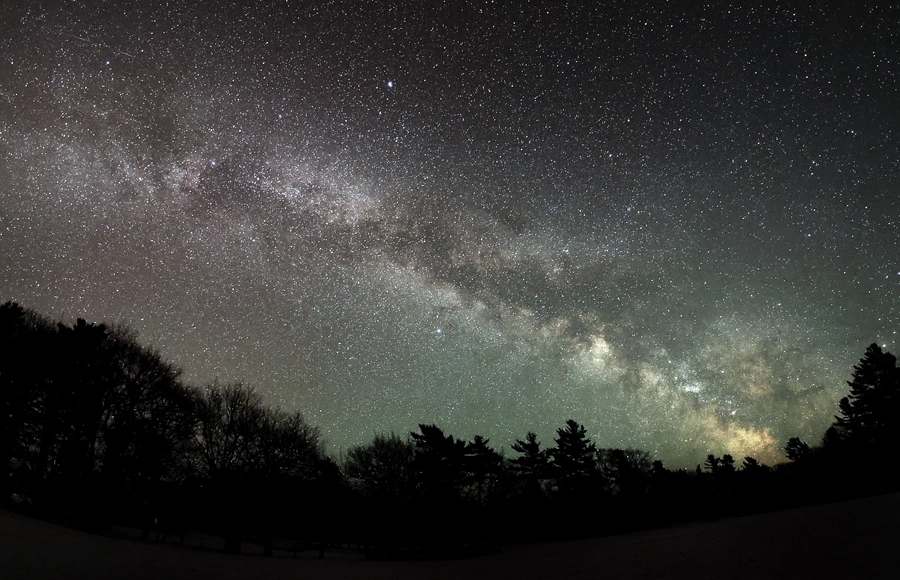
On a late April morning from the tip of Michigan’s Keweenaw Peninsula, I walked across two feet of hardened snow in whipping winds to find a sheltered spot for a photo of the summer Milky Way. It was an hour before the start of dawn. Other than the glow from a minor aurora far to the north, it was exceptionally dark — a true Bortle 1 experience. The sky was salty with stars.
Bob King
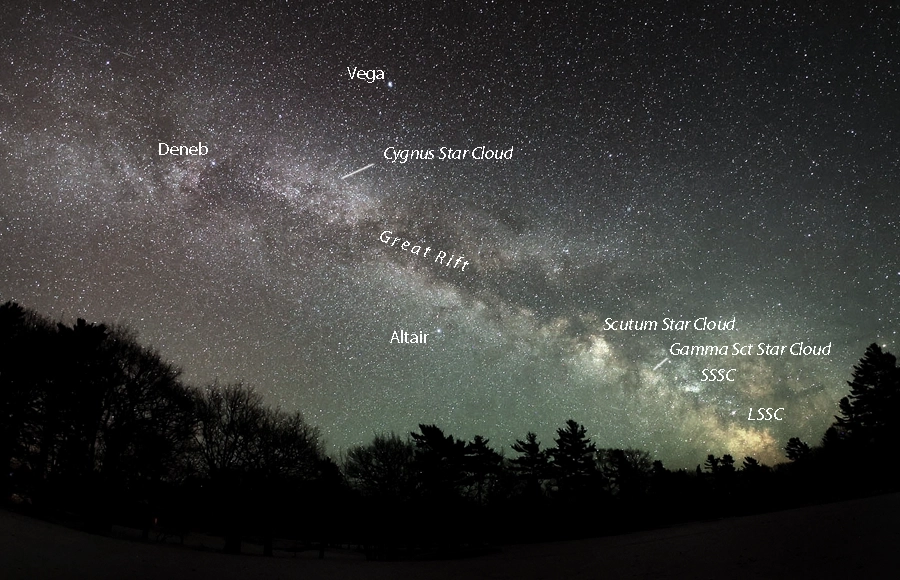
Nearly half the galaxy arched across the eastern sky from Cassiopeia to Sagittarius. While the camera did its work, I visually explored the archipelago of star clouds along the band’s length, from the bun-shaped Cygnus Star Cloud to the south to Scutum’s bright puff and from there to the chunky chicken noodle soup of Sagittarius. That’s when I noticed an unfamiliar bright clod tucked between the Scutum Star Cloud and Small Sagittarius Star Cloud (SSSC).
Bob King
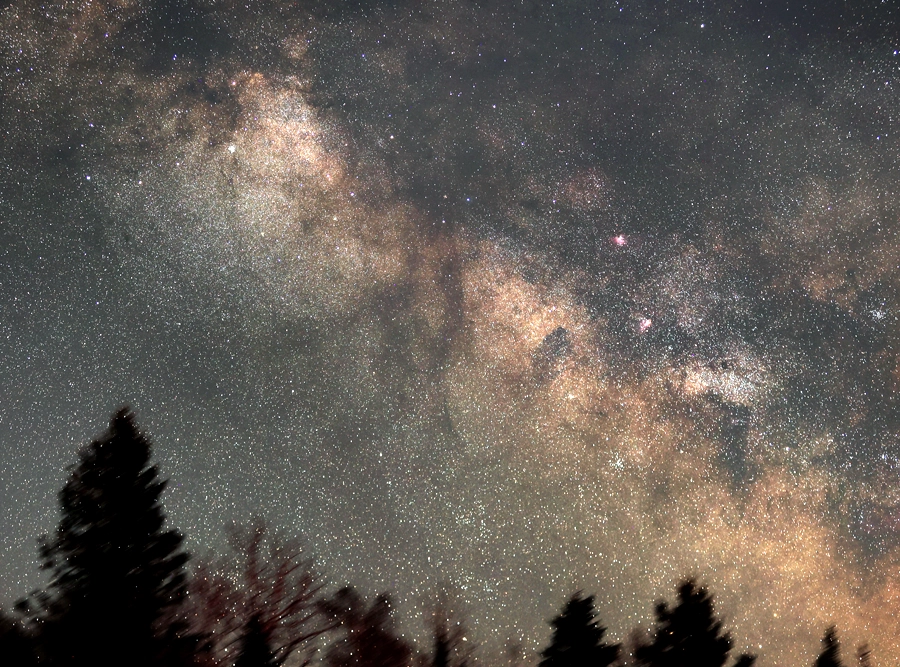
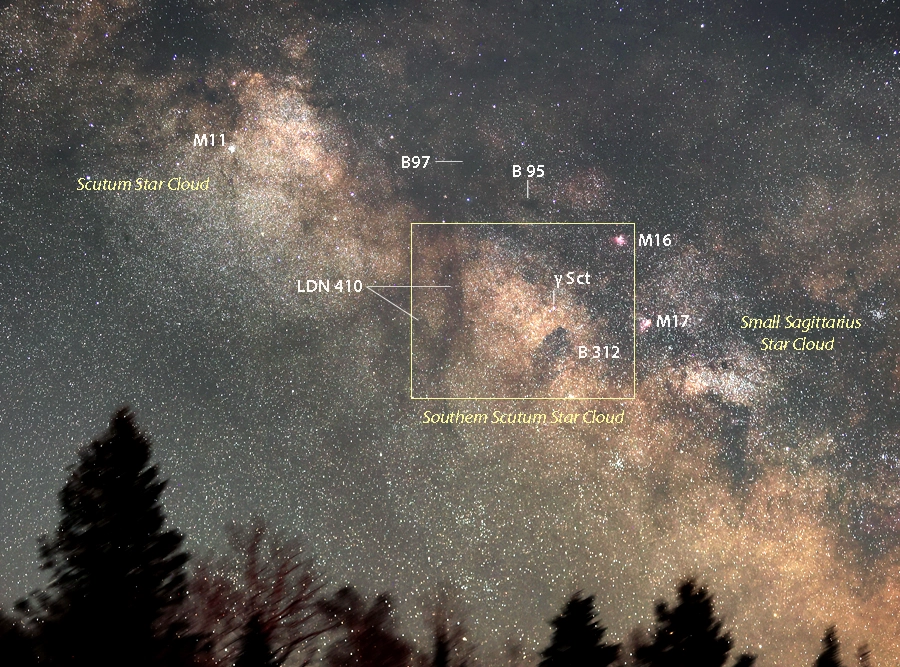
I must have seen this patch many times before, but until that moment it had never registered. My photos showed it even more clearly — compact, cleanly defined by dark nebulae, about 3° × 2.5° across, and located in southern Scutum. It resembled its neighbor to the west, the ~2° × 1° wide SSSC, but was somewhat larger and more diffuse. How could I have missed this?
I think part of the reason was that it had no formal name. Another is that the light pollution from my hometown dilutes this part of the sky. At that time, I nicknamed it the Southern Scutum Star Cloud in keeping with the tradition of naming star clouds after their host constellations. Seeing it made me wonder how many other unrecognized celestial entities deserved a moniker.
Later, I looked up the galactic knot on Stellarium, which identifies Milky Way star clouds, and found it labeled as a “patchy unnamed cloud.” That wouldn’t do. I dug further and discovered that Sky & Telescope Contributing Editor Brian Ventrudo had included it in his August 2024 article, “Summer Star Clouds”. Ventrudo dubbed it the Gamma Scuti Star Cloud after Gamma (γ) Scuti, the 4.6-magnitude star located within the puff’s southwestern edge. Now we were getting somewhere.
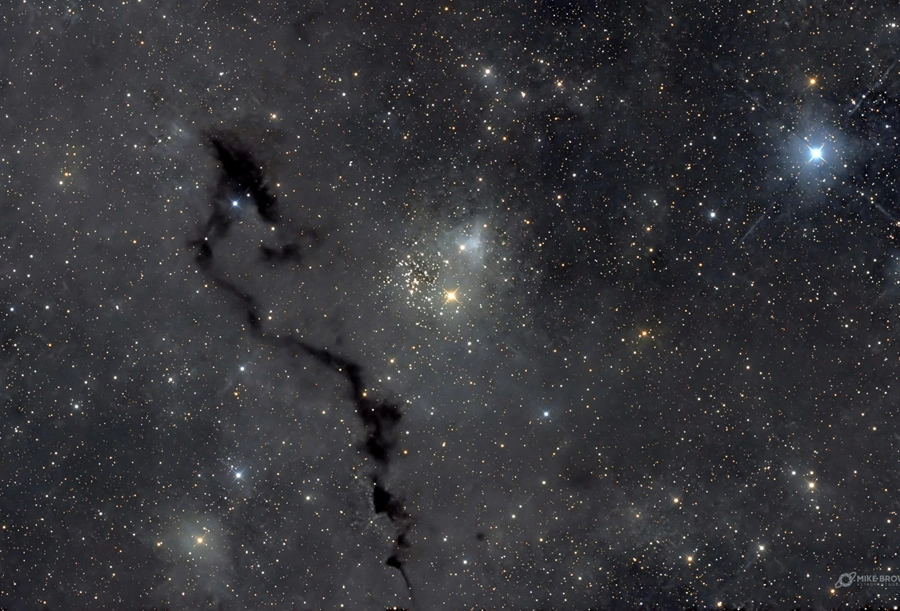
Ironically, star clouds are defined by the very thing that tries to extinguish them — opaque clots of cosmic dust and gas called dark nebulae. Were there no obscuring interstellar dust, the chunky, irregular Milky Way band we see now would expand in girth, brighten by multiple magnitudes, and look far more homogenous. Star clouds are holes in this dark curtain that allow us to peer into the depths of the galaxy and see billions of suns at a glance. The interplay in contrast between the two give the Milky Way its distinctly textured appearance.
Mike Brown
Although William Herschel was the first to notice these dark “holes” in space, it was 20th-century American astronomer Edward Emerson Barnard who realized their true nature as clouds of cosmic dust. His catalog contains almost 170 dark nebulae, each designated with the prefix B. In 1962, another American astronomer, Beverly Turner Lynds, expanded on Barnard’s work, compiling a list of 1,802 dark nebulae. If you’re intrigued by these dark, but hardly empty spaces, check out 57 Barnard highlights and Lynds’ Dark Nebula Catalog (LDN).

Rodney Pommier
Dark nebulae from both catalogs delineate the gumdrop-shaped Southern Scutum Star Cloud, and all are visible in binoculars from a dark sky. The pod-shaped B 312 (LDN 379), about 1.2° × 0.5° across, defines the southern border. LDN 410, darker and easier to see, shores up the northeastern flank, while B 97 — part of the larger, 8.4-square-degree LDN 435 complex — comprises a vast, dark “sinkhole” to the north. To the west lies another large region with a relative paucity of stars that I can’t identify as any particular nebula.
Framed by its dusky surroundings, the entire cloud fits comfortably in the field of view of my 10×50 binoculars. Dozens and dozens of mostly faint stars shimmer against a hazy, mottled backdrop of millions more.
Bob King
Gamma Aquilae and four 6th magnitude stars to its east form a compact asterism that buttresses the object’s southern border when viewed with the unaided eye. One of my favorite things about this second Scutum Star Cloud is the company it keeps. Just 2° to its west are two smaller, fainter puffs — M16, the Eagle Nebula, and M17, the Omega Nebula. Both were visible faintly with the naked eye that morning and resembled puffs of smoke (with stars involved) through binoculars. Together with Gamma Scuti, the trio formed a perfect equilateral triangle.
Maybe you’re already familiar with this second Scutum star cloud. If not, I encourage you to explore it at the next opportunity. A dark, moonless window ideal for Milky Way observation opens up from June 8–25. The only instruments you’ll need are your eyes and a pair of binoculars. Summer’s treasures await.