NASA / JPL-Caltech / SETI Institute
The putative vapor plumes detected escaping from Jupiter’s moon Europa might not be real.
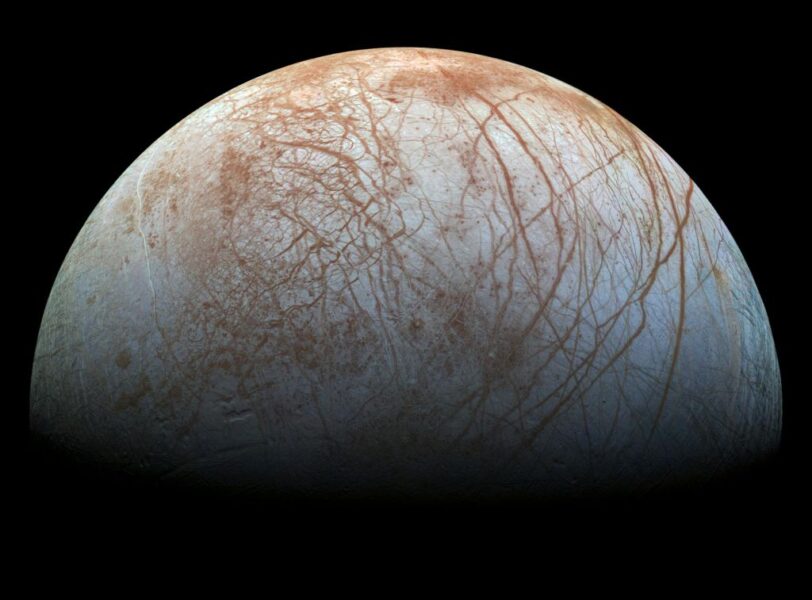
In 2013, Lorenz Roth (now at Royal Technical Institute, Sweden) and colleagues detected faint ultraviolet emissions from the southern hemisphere of Jupiter’s moon Europa using the Hubble Space Telescope. The team interpreted the signal as a plume of water vapor escaping from the moon’s surface.
The finding was widely accepted as evidence that liquid water was finding a way out of Europa’s subsurface ocean. (A geologically active surface and magnetic readings near the moon offer strong evidence of that ocean, separate from the plumes). At the time, the idea of Europa’s plumes seemed highly plausible. After all, Saturn’s moon Enceladus spews enough water vapor from its south pole to feed the planet’s E ring, as seen in close-up pictures captured by the Cassini spacecraft in 2025. So the Europa finding seemed reasonable. Furthermore, a 2018 reanalysis of archival data from NASA’s Galileo spacecraft, which reached the Jupiter system in 1995, seemed to confirm the presence of water plumes.
However, subsequent Hubble observations, the latest of which was captured in 2020, failed to detect the localized emissions again. This lack of confirmation prompted Roth and his coauthors to conduct a comprehensive reanalysis of the available data. Their results, published in Astronomy & Astrophysics, conclude that the original detection was, most likely, a statistical fluke.

NASA / JPL / University of Arizona
New Understanding
The team found two main flaws in the original analysis. The first problem was figuring out exactly where Europa’s signal was positioned on Hubble’s detector. Europa occupies only a small fraction of the pixels on Hubble’s 1,000 ✕ 1,000-pixel CCD. The location of the moon’s center in the images is slightly uncertain. Using an improved positioning estimate, the researchers found that their original alignment was off by two pixels horizontally and one pixel vertically. While this correction might not sound like a lot, the resulting alignment error created data artifacts that artificially inflated the apparent photon flux at the purported plume location.
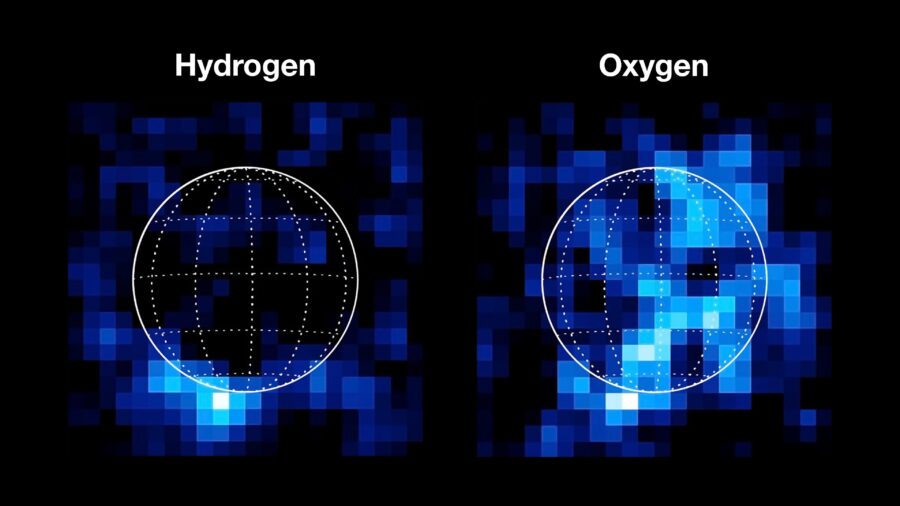
This positioning error was further compounded by a global atmospheric feature unknown a decade ago. More recent Hubble observations have revealed that there’s a thin but persistent hydrogen exosphere surrounding the entire moon. The hydrogen atoms scatter ultraviolet light from the Sun, producing a natural glow around the satellite. The glow led researchers to overestimate the amount of photons coming from the moon’s limb. Once the researchers corrected the target alignment and accounted for this global halo, the apparent plume signature dissolved into the background.
NASA / ESA / JPL-Caltech / SwRI
At the end of the day, the detection hinges on just a few additional photons hitting the detector in the right spot, Roth explains. “’Pushed to the limit’ is maybe a bit of an overly used phrase,” Roth says, “Here, you can simply bring it down to this: it’s something very, very faint in a very noisy environment.”
“I was very surprised by the finding,” says Juan Alday (Institute of Astrophysics of Andalusia). “I think it’s nice in the sense that this is how science should work. The pipelines we use for data analysis are constantly evolving as we learn over the years of conducting and analyzing new observations.”
A Mystery Remains
The new research doesn’t rule out that there could be transient plumes of water escaping from geysers or cracks in Europa’s surface. But the solid evidence the researchers once thought they had has now vanished. “If you don’t know if something exists and you find proof on a 90% level, it’s just not proof at all,” Roth says. “A 10% chance that it’s just random noise is just too high.”
At the same time, this new result doesn’t end the story for Europa’s water plumes. The detection made from Galileo’s 1995 data still stands. During a close flyby, 400 kilometers (250 miles) from Europa’s surface, the probe’s magnetometer measured magnetic anomalies accompanied by a dense concentration of charged particles. Using software models not available when the original data was acquired, researchers led by Xianzhe Jia (University of Michigan) revealed in 2018 that the probe likely flew through a water plume without anyone noticing. However, the fact that Jia and his colleagues were expecting to see the plume, as it had been previously revealed by Hubble, could raise eyebrows, Alday says.
While the researchers think that additional Hubble observations could provide further evidence about the presence of the plumes, or their absence, Roth says he’s not applying for additional observing time, considering that NASA’s Europa Clipper mission will investigate this exact possibility when it arrives in the Jupiter system in 2030. Plumes or no, scientists remain deeply interested in Europa’s subsurface ocean. That said, if liquid water is somehow escaping to space, it would enable us to sample and analyze the composition of a potentially habitable underground environment without needing to drill through kilometers of ice.