NASA
Two months ago, NASA leadership scrapped their longstanding plans for the lunar Gateway, an international space station designed to orbit the Moon and provide a home base for astronauts en route to the lunar surface. On Tuesday, May 27th, the agency outlined the first steps in its ambitious replacement: the Moon Base missions, complete with rovers, landers, and drones.
The agency is putting money where its mouth is, with more than $700 million contracted out amongst top players in the U.S. space industry. (By its completion, the total base is expected to cost $20 billion). But the timelines are ambitious, and some worry the U.S. may be pushing the boundaries of the international treaties it sought to sanction.
“I grew up thinking that [sustained lunar presence] was going to be something that happened 20 years ago,” says lunar scientist Julie Stopar (Lunar and Planetary Institute). Despite the hurdles, she adds, “I’m just really happy that they are moving forward with it.”
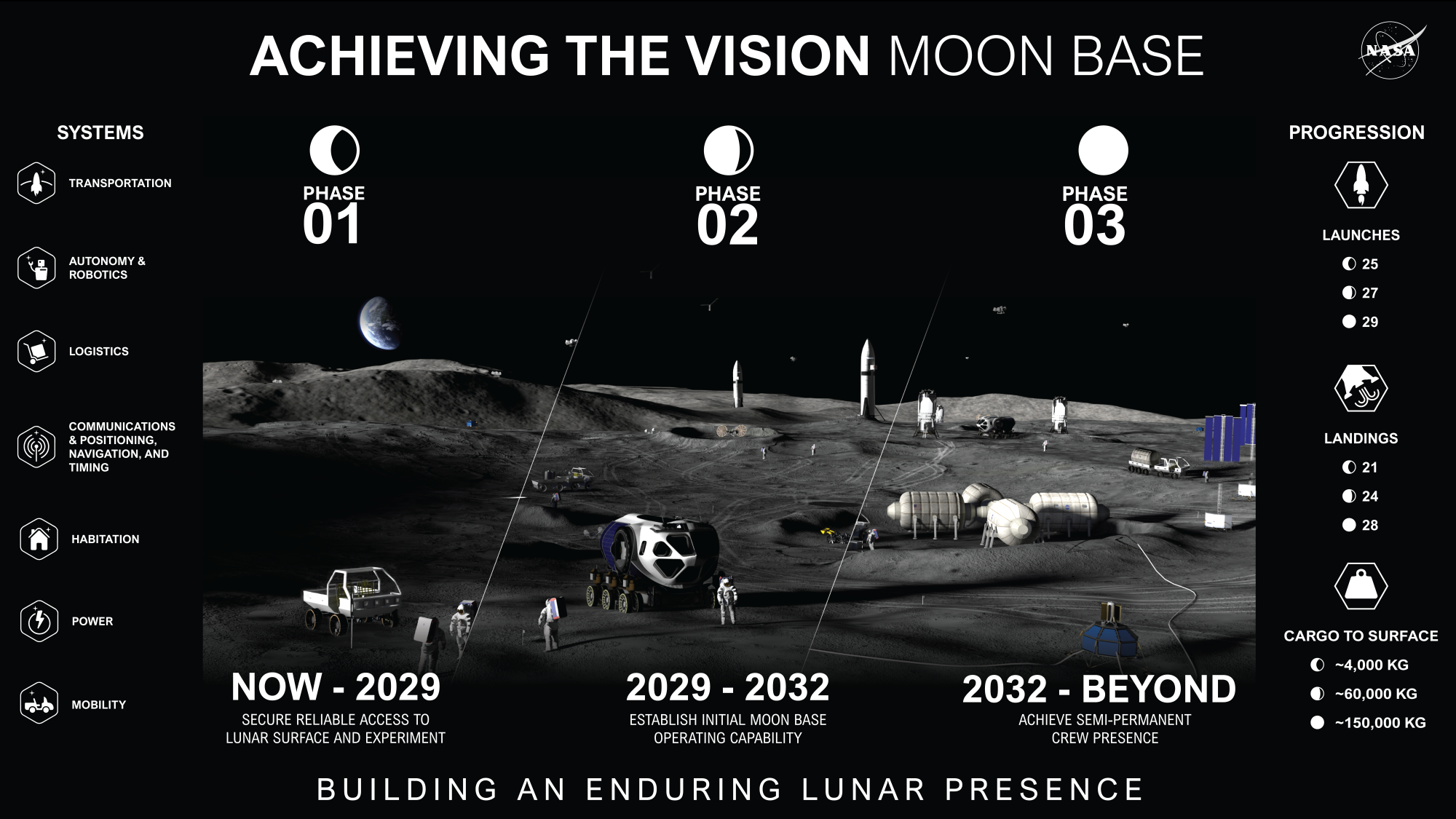
In total, the agency envisions the Moon Base in three broad parts: 2026 through 2029 for getting to the lunar surface and beginning experiments; 2029 through 2032 for initial operations, including potential nuclear power; and 2032 and beyond for a “semi-permanent” human presence.
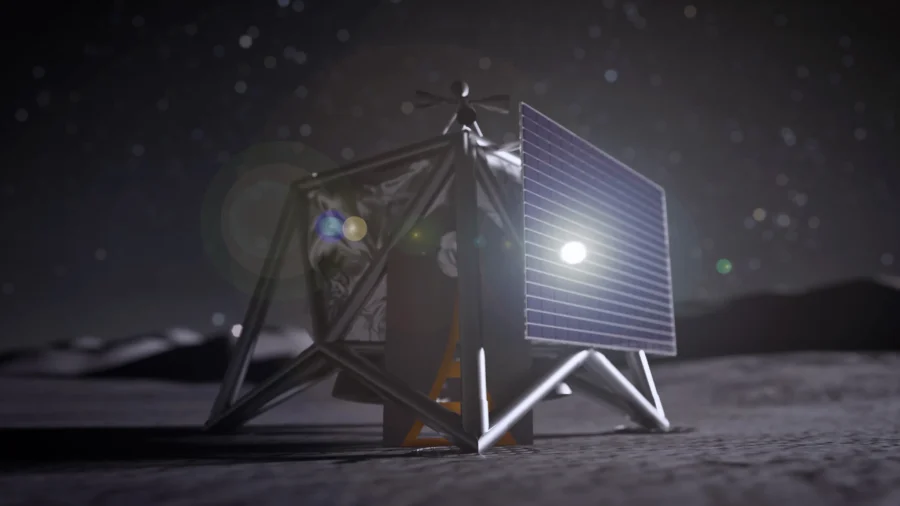
The first three Moon Base missions, outlined for 2026, serve to improve our understanding of the lunar surface, its evolution, and how human activity may influence it. Moon Base 1, set to characterize potential lunar landing spots as early as this fall, will include an instrument to study how thrusters interact with the lunar surface and a Laser Retroreflective Array to help orient orbiting spacecraft using reflected laser light. Moon Base 2 will serve as a technology demonstration for delivering a large lander, future versions of which could carry 10-plus science payloads. And Moon Base 3 will include an instrument to study “swirls” on the lunar surface that result from interactions with the solar wind.
“It’s encouraging to hear that they are including science in all of the plans,” says Stopar. Having a permanent science presence on the Moon is something that “the [planetary science] community has long been advocating for.”
But lunar scientist Simeon Barber (Open University) says that, unlike most NASA planetary science and astronomy missions, “these are not going to be traditional science missions.” Given the economic and human spaceflight incentives of Artemis and Moon Base, “you have to be more circumspect, more pragmatic,” about how you incorporate science, he adds.
Part of that science may come as NASA continues to solicit proposals for lunar instruments through their Commercial Lunar Payload Services program. But even with the plans already in place for Moon Base, Barber says scientists will be able to address important questions about the Moon’s formation, evolution, and structure.
On Tuesday, the agency also announced awards of approximately $220 million each to aerospace companies Astrolab and Lunar Outpost. They aim to build one-ton lunar rovers by 2028. The rovers, which should be capable of driving both autonomously and by humans, will ride to the Moon on landers from Jeff Bezos’ Blue Origin, which was awarded up to $280 million. But in a shocking setback, Blue Origin’s New Glenn rocket exploded on the launch pad during a prelaunch test on May 28th. Significant damage occurred to the launch pad, raising doubts about Blue Origin’s readiness for NASA launches in 2028.
“We will work with our partners to support a thorough investigation of this anomaly, assess near-term mission impacts, and get back to launching rockets,” wrote NASA Administrator Jared Isaacman on X after the explosion. “We will provide information on any impacts to the Artemis and Moon Base programs as it becomes available.”
SpaceX founder Elon Musk posted on X that the situation was “most unfortunate.” SpaceX notably did not receive any major contracts in NASA’s announcements this week.
NASA
Blue Origin isn’t the only company tapped to provide a lunar taxi for NASA. Firefly Aerospace, which landed successfully on the Moon in 2025, will deliver three or four one-meter drones in 2028, for a price of $75 million. The drones, called MoonFall, will be developed by NASA’s Jet Propulsion Laboratory (JPL) to take high-resolution imagery of the lunar surface before the first crewed lunar landing in the Artemis program.
Given the tight timelines of less than three years, “I wouldn’t say it’s impossible, but I do think it’s challenging,” says Barber. Much of the hardware will need to be created from scratch. Balancing the weight of so much cargo will need to be thought out. And NASA may hope to land some missions on the Moon’s farside, where our imagery is notably lacking compared to that for the nearside.
While exact landing sites are yet to be determined, NASA is generally looking toward the lunar south pole, where large amounts of water-ice are thought to hide in permanently shadowed regions (though recent results suggest those deposits might not be as accessible as previously thought).
Renewed Space Race?
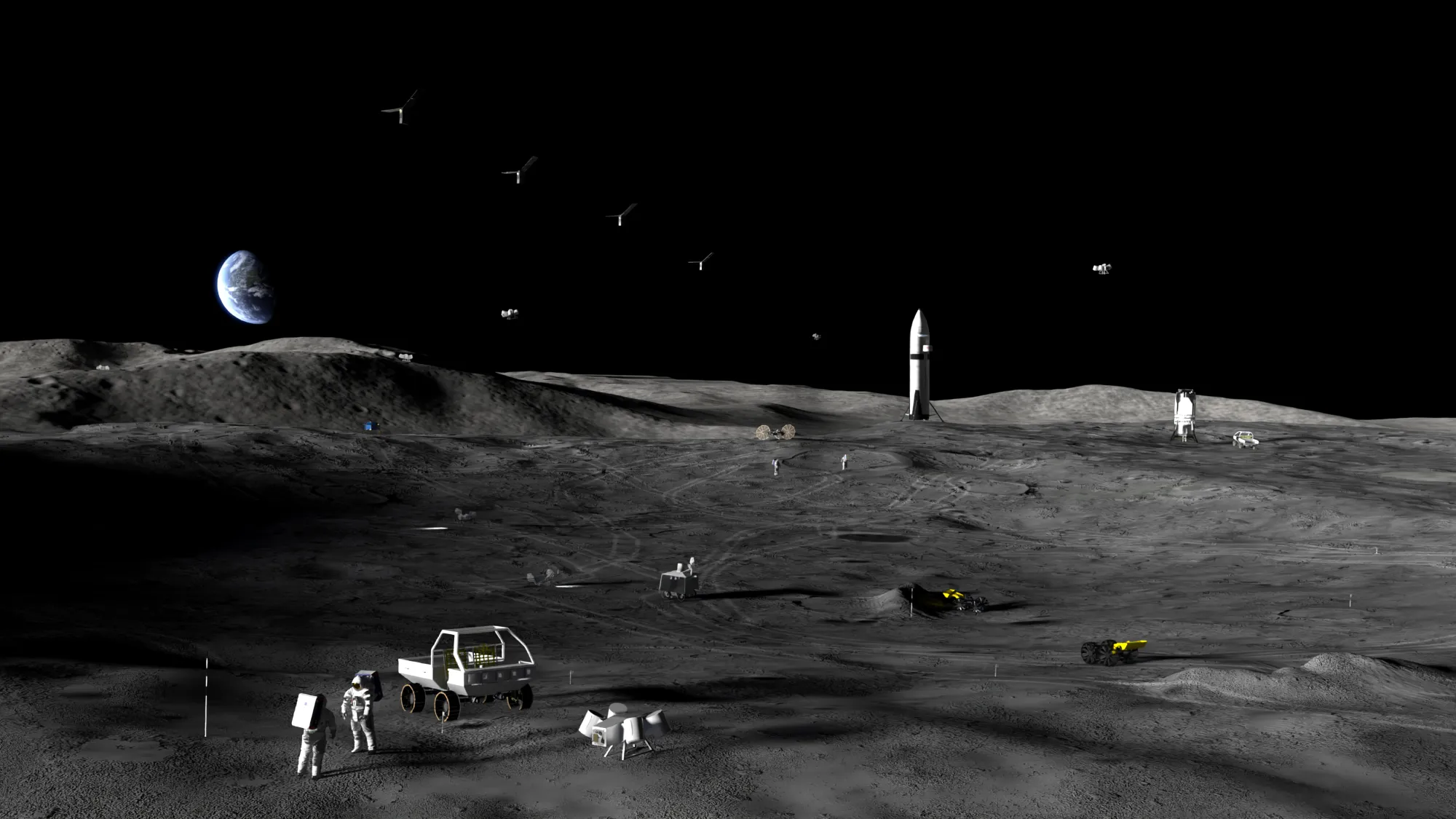
On Tuesday, NASA leadership expressed their vision for a total Moon base hundreds of square miles large.
NASA
“What was striking in particular was that if you believe NASA’s plans, we are talking about a fairly sprawling set of facilities,” says Dean Cheng, nonresident senior fellow at the Space Policy Institute (George Washington University). It’s impossible to divorce such plans from those already set by China, he explains; that country plans to land humans on the lunar surface by 2030. “What happens if the Chinese say, ‘Okay, well, we’re going to do the same thing,’” Cheng adds. “How do you prevent overlap, and how do you prevent either side from effectively laying claim to chunks of interesting real estate on the Moon?”
There’s a broadly understood idea that the first country to successfully set up shop on the Moon will be able to establish the norms and values for operating there. In 2020, in an attempt to provide a set of common principles, the U.S. launched the Artemis Accords, a succinct document now signed by 67 nations (notably, not China). Under the Accords, nations may establish “safety zones” around their own infrastructure, such that another country’s activities can’t cause “harmful interference.” But the Accords also state that such zones “will ultimately be temporary,” in alignment with the 1967 Outer Space Treaty that mandates that no nation can claim sovereignty over areas of the Moon.
In the NASA announcements this week, leaders expressed interest in using the JPL drones, after their surveying is done, as four points to establish a perimeter around a NASA lunar base. When asked if this perimeter would count as a safety zone, Isaacman stated that NASA wants to be “very mindful of the Outer Space Treaty,” and “would expect that to be reciprocal.”
Such discussions made Barber “slightly nervous that this is all being done in the context, probably, of a new space race,” he says. And Cheng is wary of NASA’s “ambitious” claims for impending sustained lunar presence with, as of yet, few details.
Still, says Cheng, this week’s announcements demonstrate that NASA is serious about its lunar ambitions. “It’s always cool to see humanity stretching its legs, reaching out farther.”