NASA
On Friday, May 29th, the United States Office of Management and Budget (OMB) released a 412-page document rewriting how federal grants should be issued and overseen across all agencies. The changes to the procedures, which were previously altered in 2024 to make the grants process clearer, were sweeping, touching on areas from international collaboration to academic publication costs. But the through line is made explicit: to align federal grant-making with “administration policies and priorities set by the President.” Immediately, it has sparked backlash from astronomers and planetary scientists, who see grave challenges for science if the rules come to fruition.
The proposal “threatens the entire space enterprise,” says Meredith MacGregor (Johns Hopkins University). Many of the suggested changes “sound minor but would completely mess up how we do science.”
Perhaps the most unilateral proposed change is that of the role of peer review. Typically, federal grants go through many rounds of ranking by panels of subject-matter experts. Under the revised rules, the final word on grants would instead be issued by political appointees, who may have no relevant scientific background. “Peer review remains advisory and does not replace agency discretion,” states the document. The concept, while not new, has historically been invoked rarely, and even then only to elevate low-scoring grants, rather than make political determinations.
“The idea that we can go through this rigorous [grant] process, and then political reasons will determine where the money goes, not what the best science is, hurts the science that we do as a whole,” says Yvette Cendes (University of Oregon).
Northrop Grumman
Under the new rules, those same political appointees would also have the ability to cancel already-awarded grants on topics that do not align with “program goals, Federal agency priorities, or the national interest.” Formalizing this cancellation ability is likely a response to the losses the administration has faced in the courts over cancelling grants without proper procedure. While topics of diversity, equity, and inclusion are explicitly targeted, the language is vague enough to spark worry among the astronomy community.
Cendes harkens back to the 2025 grant cancellations wrought by the now-defunct Department of Government Efficiency, where it seemed a keyword search approach was taken. “There’s an enormous amount of uncertainty,” she says — would grant managers eliminate funding based on the word “black” in black holes, or “diversity” in references to astronomical sources? “I wish that I wasn’t worried about these, and these are things that wouldn’t actually come up, but it’s not outside the realm of possibility.”
If grants were to be cut, Cendes worries that such cuts would impact the most vulnerable people in the field — namely, graduate students and postdoctoral researchers. In astronomy, telescope infrastructure is often shared among international partners, so the majority of grant funding covers salaries, she explains. “That’s obviously not a very stable way to treat our students, because they could be out of a job at any moment for arbitrary reasons.”
Another top concern among astronomers is language encouraging a “domestic-first framework,” where “international elements may be included only if the Federal agency determines that such elements are justified, consistent with program objectives, and in the national interest of the United States.”
International collaboration is one of the pillars of astronomy and planetary science, for physical reasons as much as social ones. Specific areas of the sky, as well as transient objects such as gamma-ray bursts or speeding asteroids, can only be seen from certain parts of the globe at any given time. If international collaboration were to be de-emphasized in funding, “a whole bunch of astronomy that I’ve worked on for the past 20 years becomes impossible,” says Michael Busch (SETI Institute). (Busch emphasized he was not speaking on behalf of his employer.) Such topics include the discovery and tracking of potentially hazardous asteroids, a key component of NASA’s planetary defense efforts.
For astronomy, “Just how this would [the OMB rules] work?” asks Busch. “I don’t think it could.”

NASA / JPL-Caltech
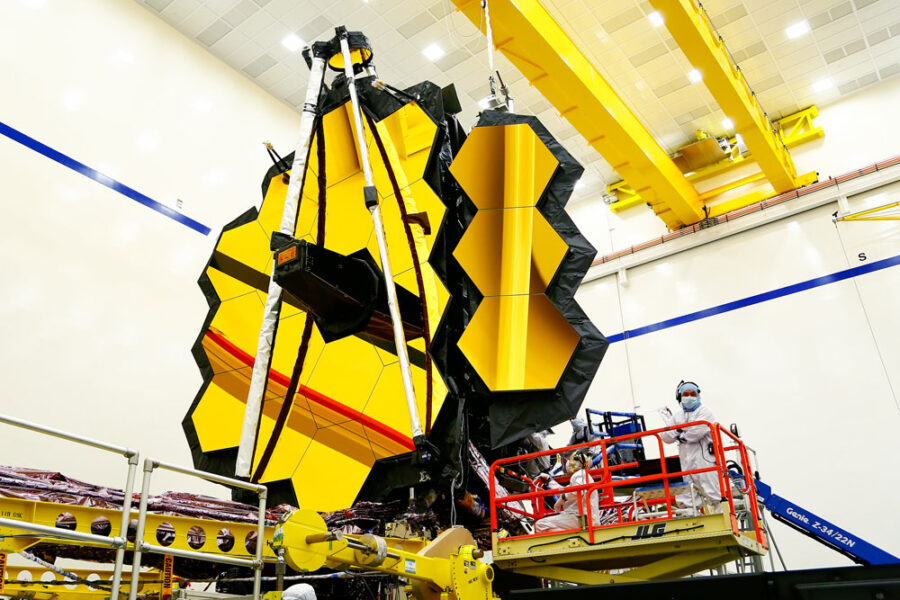
International collaboration isn’t just essential to ground-based observations, but space-based missions, too. “I don’t think there is a space telescope we have launched that’s not really tiny, that doesn’t have something contributed from an international partner,” says MacGregor. “If that becomes even more fraught and complicated than it already is, then that really undermines our ability to make progress.”
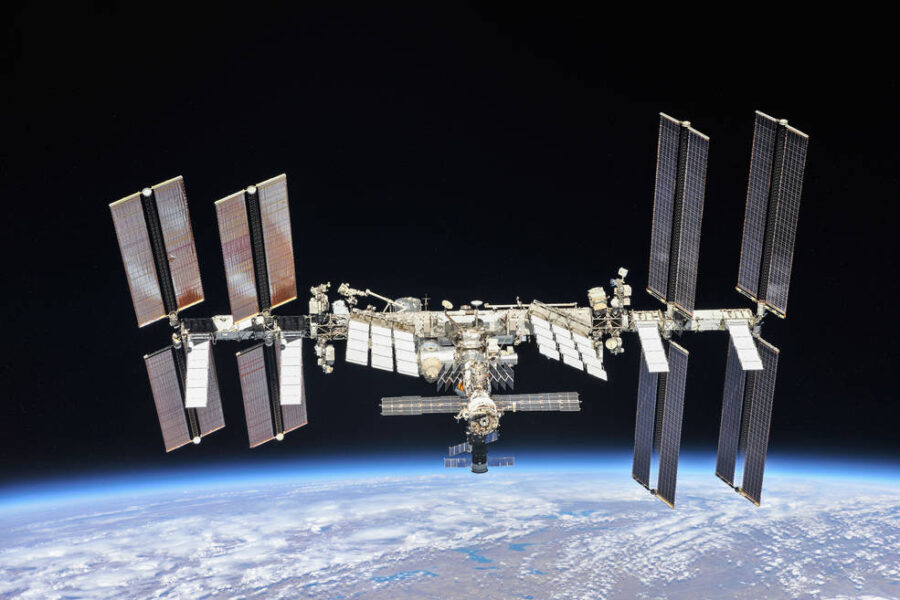
Busch sees parallels to the Wolf Amendment, a 2011 law that has since prohibited NASA from spending money on collaborations with scientists funded by the Chinese government. Yet, the OMB rules are “much more expansive,” he says. He wonders if the International Space Station, with contributions from Russia, might even need to be reevaluated.
Yet another disruptive proposal is to ban federal grants from covering academic publishing costs, including article processing charges and open-access fees. These costs allow research results to be published in a publicly accessible fashion. Since they can often be thousands of dollars per article, the fees are “not something that someone’s going to pay for themselves,” says MacGregor. Eliminating such support “completely upheaves the whole system of how we publish and disseminate science.”
The OMB rules are not yet in place. While the changes are set to be enacted October 1, 2026, there is a 45-day comment window open until July 13th, during which time scientists, advocacy organizations, and members of the public may express their views on the changes. In just the first week, more than 6,300 comments have been submitted. The OMB is required to respond to each comment, though it is unclear what form that response may take.
“Comments that point out that this is going to hurt American science are very important,” says Cendes, who also mentions that individuals may contact their congressional representatives with thoughts. The OMB proposals are “pretty egregious if you’re somebody who cares about American science, or just cares about science in general,” she says.