FRIDAY, JUNE 5
■ Venus and Jupiter shining together in the west at nightfall will grab attention all over the world this week. For months they’ve been approaching each other. Tonight they shine just 4° apart, as shown below. Venus is the brighter one. And catch Mercury 14° to their lower right, a little more than a fist at arm’s length.
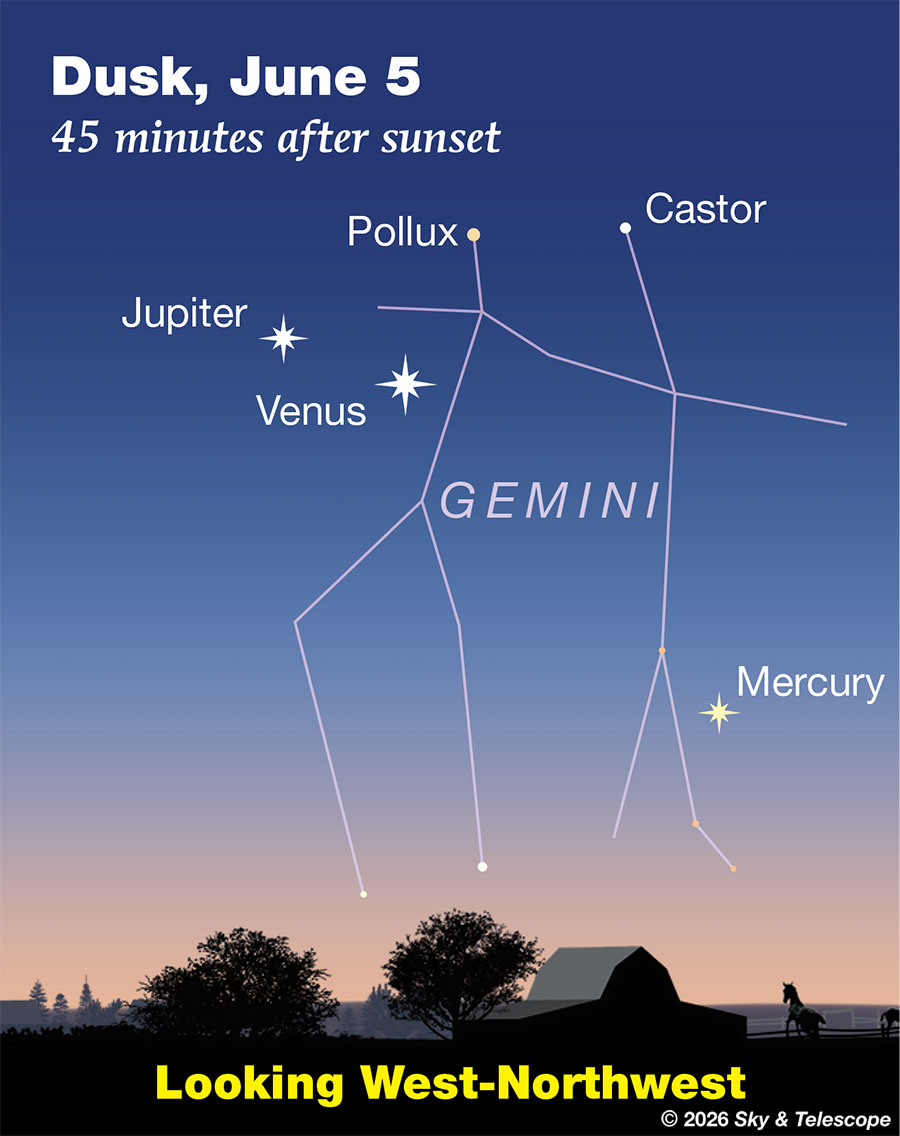
Venus and Jupiter will close in to shine just 1.8° apart next Monday June 8th, then 1.65° on their date of conjunction, Tuesday the 9th. For more see Bob King’s Venus, Jupiter Converge in Stunning June 9th Dusk Conjunction.
SATURDAY, JUNE 6
■ Capella sets low in the northwest fairly soon after dark (depending on your latitude). That leaves Vega and Arcturus as the two brightest stars in the evening sky. Vega shines fairly high in the east. Arcturus is very high up as you face south.
A third of the way from Arcturus down to Vega, look for semicircular Corona Borealis, the Northern Crown, with 2nd-magnitude Alphecca as its one moderately bright star.
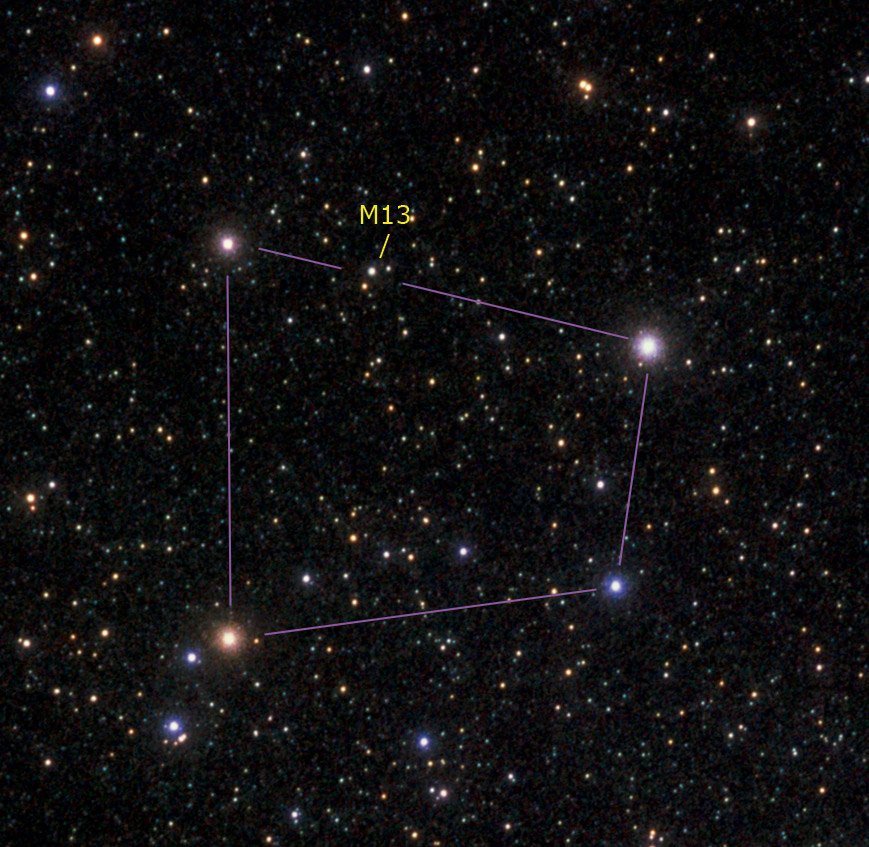
Two thirds of the way from Arcturus to Vega is the dim Keystone of Hercules. It’s lying almost level:

Use binoculars or a telescope to examine the Keystone’s top edge. A third of the way from its left end to the right is M13, one of Hercules’s two great globular star clusters, labeled below. In binoculars it’s a tiny glowing cottonball, 6th magnitude, flanked by two 7th-magnitude stars ¼° to its sides. A 4- or 6-inch scope begins to resolve some of its speckliness. Located 22,000 light-years away far above the plane of the Milky Way, M13 consists of several hundred thousand stars in a swarm about 140 light-years wide.
SUNDAY, JUNE 7
■ The Big Dipper has swung around to hang down by its handle high in the northwest after dark. The middle star of its handle is Mizar, with tiny little Alcor right next to it. On which side of Mizar should you look for Alcor? As always, on the side facing Vega! Which is now the brightest star in the east.
■ Last-quarter Moon tonight (exact at 6:01 a.m. Monday morning EDT). The Moon rises almost due east around 1 a.m., lower right of the Great Square of Pegasus. The Square, just risen, will be standing on one corner. Its top-right side will be pointing diagonally down to the Moon.
MONDAY, JUNE 8
■ Venus and Jupiter are almost their closest together this evening, 1.8° apart. . .
TUESDAY, JUNE 9
■ . . .and now Venus and Jupiter are finally in conjunction, 1.65° apart, as shown below. Don’t forget Mercury 14° to their lower right. Think photo opportunity! With a deep enough image in late twilight, how many 3rd- and 4th-magnitude stars of the Gemini stick figures can you bring out?
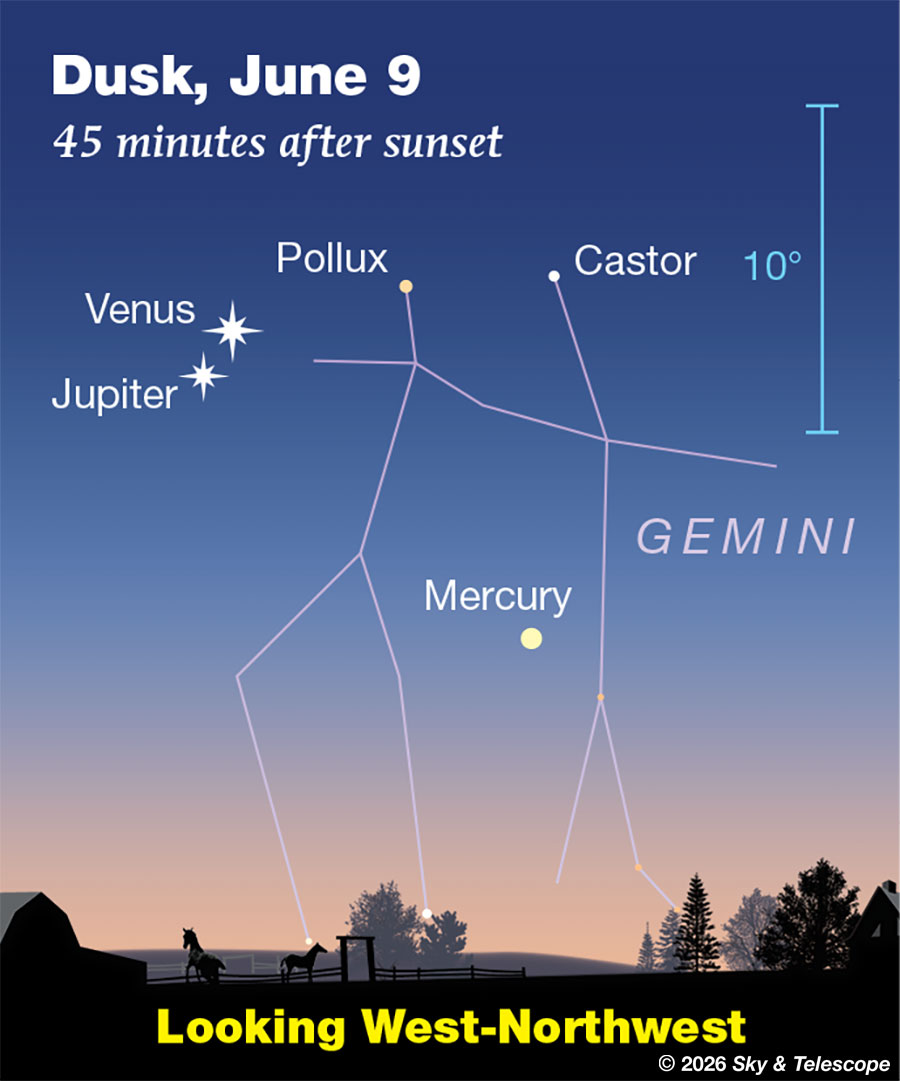
What will your telescope show? The two planets won’t fit together in the field of view at powers over about 30x, depending on your eyepiece. Venus will be a dazzling little gibbous disk just 14 arcseconds tall. Jupiter, farther from the Sun in space, will be a much dimmer ball 32 arcseconds wide and slightly compressed north-to-south. Both planets are on the far side of the Sun from us, so they appear almost as small as they get.
WEDNESDAY, JUNE 10
■ After dark, Vega is the brightest star high in the east. Barely lower left of it is 4th-magnitude Epsilon Lyrae, the Double-Double. Epsilon forms one corner of a roughly equilateral triangle with Vega and Zeta Lyrae, as shown below. The triangle is less than 2° on a side, hardly the width of your thumb at arm’s length.
Binoculars easily resolve Epsilon. And a 4-inch telescope at 120× or more should resolve each of Epsilon’s two components into a tight pair.
Zeta Lyrae is also a double star for binoculars, but much tougher. It’s unresolved in the photo below but is plainly a pair in nearly any telescope.
Delta Lyrae, below Zeta, is a much wider and easier pair, gold and pale blue.

THURSDAY, JUNE 11
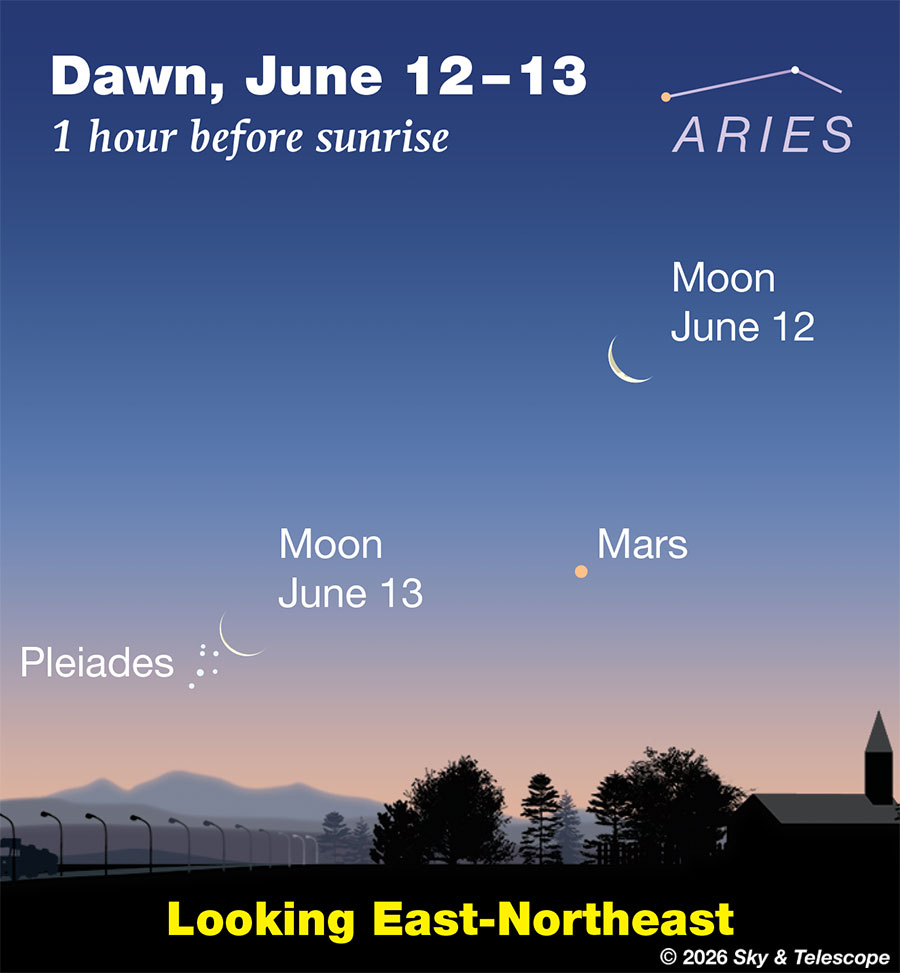
■ Mars has been gradually getting less difficult low in the dawn, and tomorrow morning the 12th, the waning crescent Moon helps point the way to it. The Moon will stand 6° or 7° above Mars, as shown below. You’ll need an open view toward the east-northeast by east.
FRIDAY, JUNE 12
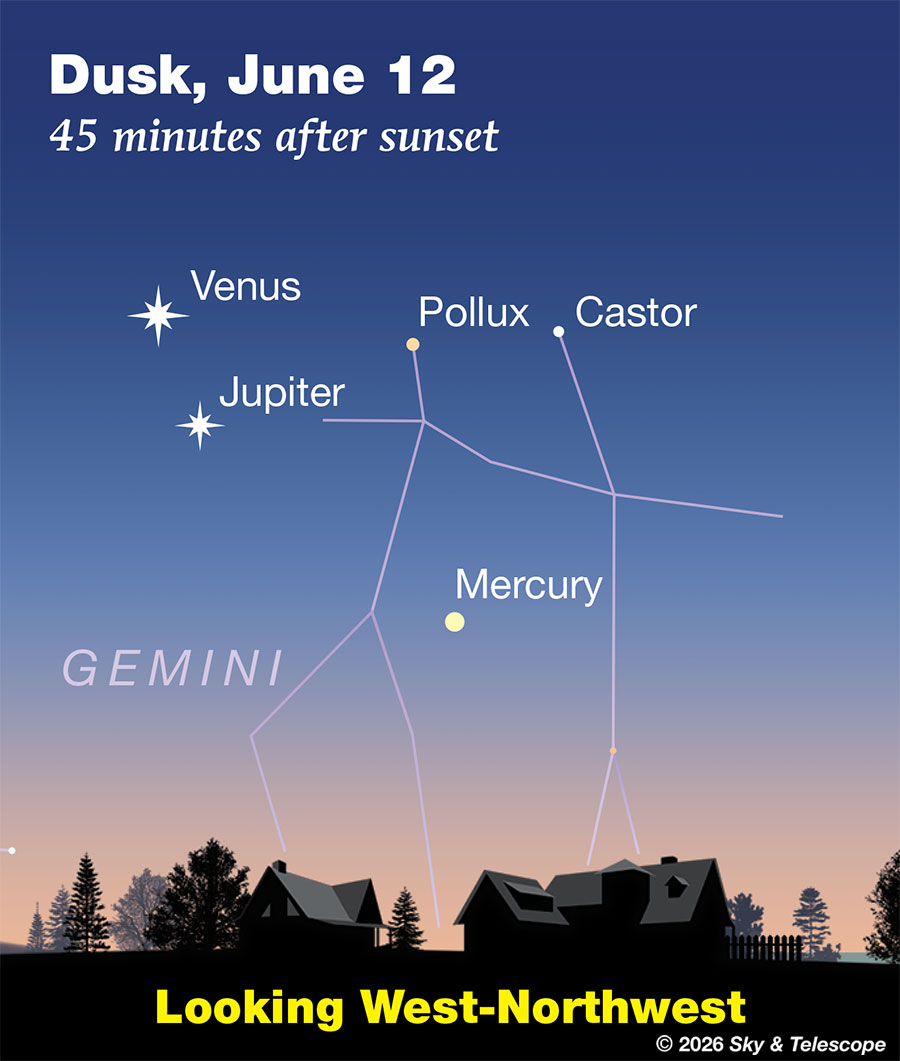
■ Venus and Jupiter continue their long twilight performance. In the coming week Venus will seem to maintain its place over your twilight horizon, but Jupiter and the Gemini stars will sink lower. Mercury will fade.
SATURDAY, JUNE 13
■ For much of the spring at mid-northern latitudes, the Milky Way lies right down out of sight all around the horizon in the evening. But now spring is nearing its end.
So look east after the night is fully dark. Looming up across the eastern sky is the rich stretch of the summer Milky Way through Cepheus, Cygnus, Aquila, and Scutum, left to right. It moves higher hour and every week. A hint for the light-polluted: The Milky Way runs horizontally under Vega, along the bottom edge of the Summer Triangle.
SUNDAY, JUNE 14
■ Bright Arcturus, very high toward the south these evenings, and Spica, about three fists at arm’s length below it and a bit right, form an almost perfectly equilateral triangle with dimmer Denebola, Leo’s 2nd-magnitude tail tip, off to their right. All three sides of the triangle are close to 35° long (35.3°, 35.1°, and 32.8°). Sky & Telescope columnist George Lovi named this the Spring Triangle (in the March 1974 issue), to go with those of summer and winter. For such a near-perfect equilateral, I say the name ought to be revived.
■ New Moon (exact at 10:54 p.m. EDT).
This Week’s Planet Roundup
Mercury shines lower right of brilliant Venus and Jupiter in the western twilight. It’s magnitude 0, not nearly as bright as they are. Look for Mercury about 45 to 60 minutes after sunset. All week it remains about 14° lower right of Venus (a little more than a fist at arm’s length), even as Venus and Jupiter trade places.
Venus and Jupiter, the two brightest planets, shine together in the west during twilight and for about 30 minutes after full dark before setting. Venus is the brighter of the two at magnitude –4.0. Jupiter is a seventh that bright at magnitude –1.9.
Watch them pass each other this week. On Friday June 5th they’re still 4° apart. They slide by each other between the evenings of Monday and Tuesday June 8th and 9th for North America, when they’ll shine 1.8° and 1.65° apart, respectively. That’s about a finger’s width at arm’s length. By Friday the 12th they’ll be 3½° apart again, now with Venus the higher one.
Both are in Gemini, and so is Mercury. Spot Pollux and Castor upper right or right of Venus and Jupiter. Pollux is slightly the brighter of the two Gemini heads.
Mars, magnitude +1.3, remains very low in the east as dawn brightens. Hunt for it about three fists to the lower left of much easier Saturn.
Saturn, magnitude +0.8, rises about an hour before the first glimmer of dawn. Catch it in the east-southeast as dawn begins to brighten. Nothing else there is as bright.
Just don’t confuse steady Saturn with flickering Fomalhaut, its near-twin in brightness, twinkling way off in the south-southeast three or four fists to Saturn’s right.
Uranus, magnitude 5.8 is hidden in the bright sunrise.
Neptune, magnitude 7.9, hides about 9° from low Saturn before the dawn. Not until well into the summer will Saturn and Neptune enter the evening sky. Mars won’t do so until nearly the end of the year.
All descriptions that relate to your horizon — including the words up, down, right, and left — are written for the world’s mid-northern latitudes. Descriptions and graphics that also depend on longitude (mainly Moon positions) are for North America. Eastern Daylight Time (EDT) is Universal Time minus 4 hours. UT is also known as UTC, GMT, or Z time.
Want to become a better astronomer? Learn your way around the constellations. They’re the key to locating everything fainter and deeper to hunt with binoculars or a telescope.
This is an outdoor nature hobby. For a more detailed constellation guide covering the whole evening sky, use the big monthly map in the center of each issue of Sky & Telescope, the essential magazine of astronomy.
For the attitude every amateur astronomer needs, read Jennifer Willis’s Modest Expectations Give Rise to Delight.
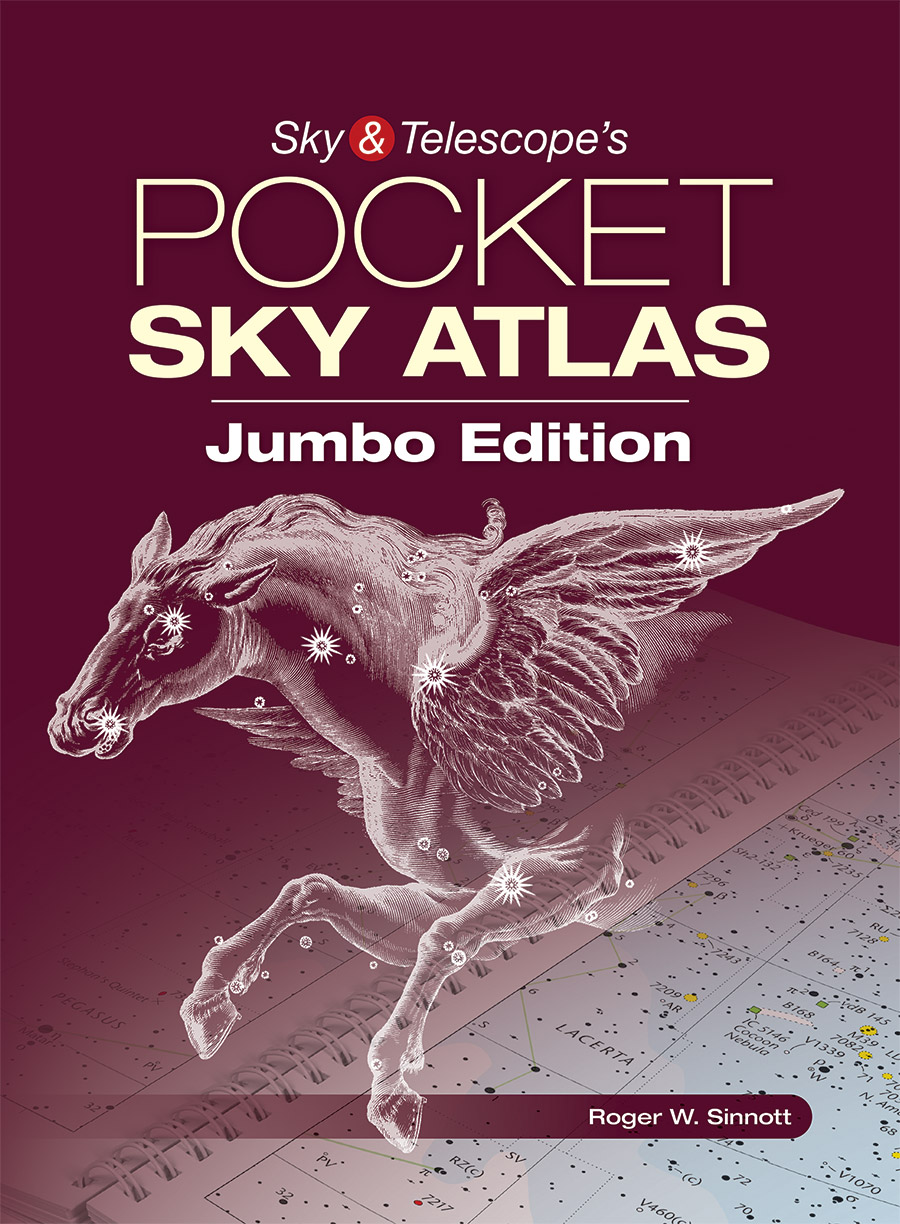
Once you get a telescope, to put it to good use you’ll want a much more detailed, large-scale sky atlas (set of charts). The basic standard is the Pocket Sky Atlas, in either the original or Jumbo Edition. Both show all 30,000 stars to magnitude 7.6, and 1,500 deep-sky targets — star clusters, nebulae, and galaxies — to search out among them.
Next up is the larger and deeper Sky Atlas 2000.0, plotting stars to magnitude 8.5; nearly three times as many, as well as many more deep-sky objects. It’s currently out of print, but maybe you can find one used.
The next up, once you know your way around well, are the even larger Interstellarum Deep-Sky Atlas (with 201,000+ stars to magnitude 9.5 and 14,000 deep-sky objects selected to be detectable by eye in very large amateur telescopes), and Uranometria 2000.0 (332,000 stars to mag 9.75, and 10,300 deep-sky objects).
For the necessary tricks, read How to Use a Star Chart with a Telescope. It applies just as much to electronic charts on your phone or tablet — which many observers find handier and more versatile, if sometimes less well designed and contextualized For the necessary tricks, read How to Use a Star Chart with a Telescope. It applies just as much to electronic charts on your phone or tablet — which many observers find handier and more versatile, if sometimes less well designed and contextualized — as it does to charts on paper.
You’ll also want a good deep-sky guidebook. A beloved old classic is the three-volume Burnham’s Celestial Handbook. It was my bedside reading for years. An impressive more modern one is the big Night Sky Observer’s Guide set (2+ volumes) by Kepple and Sanner. The pinnacle for total astro-geeks is the new Annals of the Deep Sky series, currently at 11 volumes as it works its way forward through the constellations alphabetically. So far it’s up to H.
Can computerized telescopes replace charts? Well, I used to say this:
“Not for beginners, I don’t think, unless you prefer spending your time getting finicky technology to work rather than learning how to explore through the sky yourself. As Terence Dickinson and Alan Dyer say in their Backyard Astronomer’s Guide, ‘A full appreciation of the universe cannot come without developing the skills to find things in the sky and understanding how the sky works. This knowledge comes only by spending time under the stars with star maps in hand and a curious mind.’ Without these, ‘the sky never becomes a friendly place.’ “
But things change. The technology has continued to improve and become more user-friendly — particularly with “plate solving” software that can now recognize any star field to determine exactly where the telescope is pointed — finally bypassing all aiming imperfections in the mount, tripod, gears, bearings and other mechanics, or in the user’s skill in setting up.
The latest revolution is the rise of small, photography-only “smartscopes.” These take advantage of not only today’s pointing technology, but also the vastly better capabilities of imaging chips and image processing compared to the human retina and visual cortex. The most sophisticated image stacking and processing can come built right in. The result is decent deep-sky imaging from shockingly small, low-priced units. The image may be viewable on your phone or computer as it builds up in real time. Some can directly enable contributions to citizen-science projects.
Smartscopes are changing the hobby at the entry level. For more on this see Richard Wright’s “The Rise of the Smart Telescopes” in the November 2025 Sky & Telescope. And read the magazine’s review of this especially small one.
If you get a larger, more conventional computerized scope that you can look through, make sure that its drives can be disengaged so you can swing it around and point it readily by hand when you want to, rather than only slowly by the electric motors (which eat batteries).
 Audio sky tour. Out under the evening sky with your
earbuds in place, listen to Kelly Beatty’s monthly
podcast tour of the naked-eye heavens above. It’s free.
“The dangers of not thinking clearly are much greater now than ever before. It’s not that there’s something new in our way of thinking, it’s that credulous and confused thinking can be much more lethal in ways it was never before.”
— Carl Sagan, 1996, The Demon-Haunted World: Science as a Candle in the Dark
“Facts are stubborn things; and whatever may be our wishes, our inclinations, or the dictates of our passion, they cannot alter the state of facts and evidence.”
— John Adams, 1770, in the summation of his unpopular, but successful, defense of British soldiers in the Boston Massacre trial
“Truly, whoever can make you believe absurdities can make you commit atrocities.”
— Voltaire, 1765, Questions sur les miracles