Researchers in Germany have brought Europe’s first and only superconducting TES-array X-ray spectrometer online at the BESSY II synchrotron, a leading 3rd-generation synchrotron light source.
The instrument was developed within a collaboration between the Helmholtz-Zentrum Berlin (HZB), the Max Planck Institute for Chemical Energy Conversion (MPICEC), and US’ National Institute of Standards and Technology (NIST).
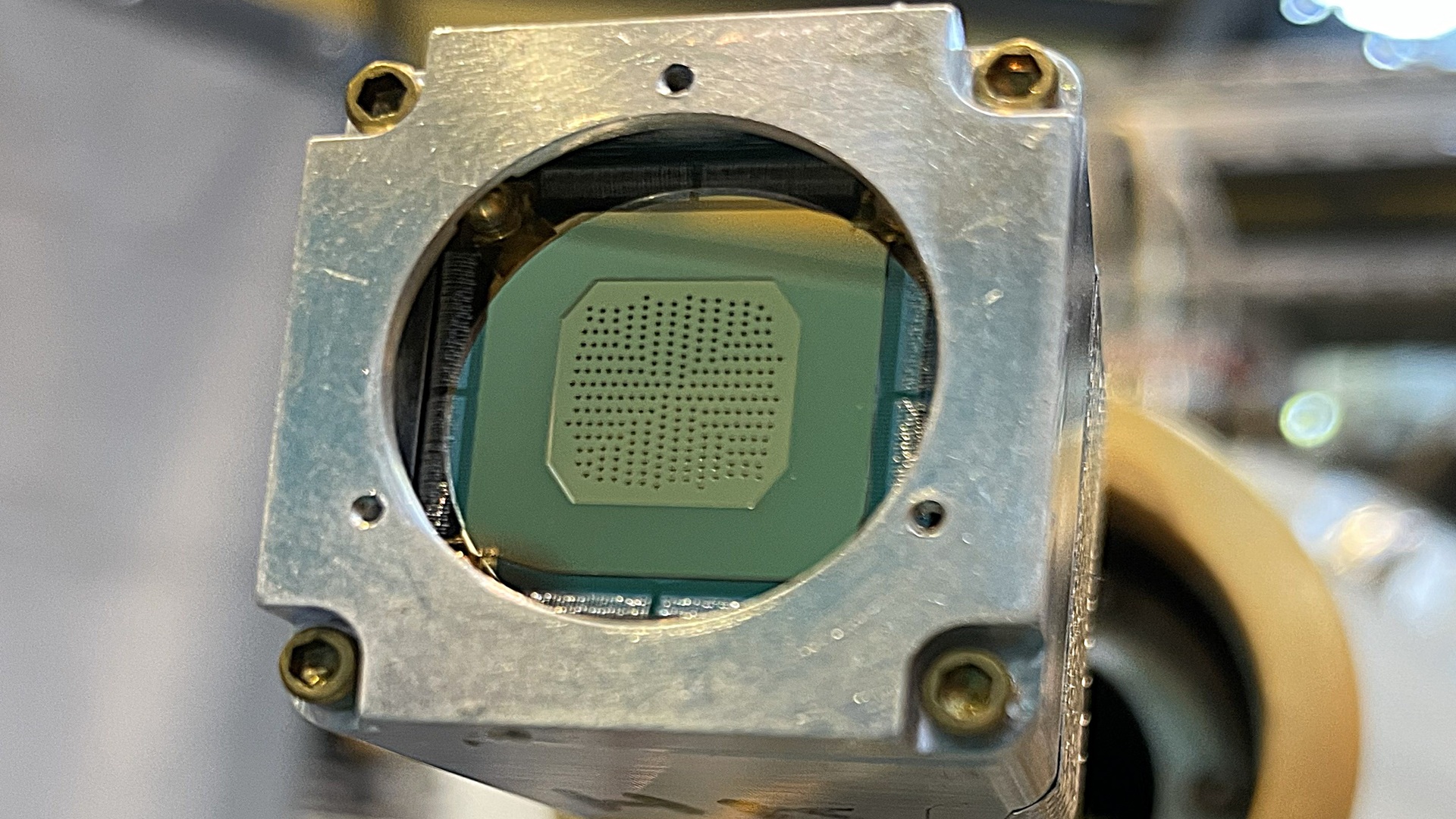
It relies on a 248-sensor detector array that can detect X-ray photons far more efficiently than conventional X-ray emission spectroscopy (XES) and resonant inelastic X-ray scattering (RIXS) systems. Its photon detection efficiency is 100 to 1,000 times higher than that of traditional wavelength-dispersive X-ray emission spectrometers.
According to the team, it will be used to investigate the electronic properties of atomically thin layers, nanostructures, and highly diluted atomic and molecular samples. The team expects the instrument to enable many new groundbreaking experiments.
The first TES spectrometer
Synchrotron facilities such as BESSY II generate intense beams of X-rays that allow researchers to probe the structure and properties of matter. However, techniques such as XES and RIXS require the detection of photons emitted by a sample after it interacts with incoming X-rays. This makes them highly photon-hungry.
These methods have traditionally been limited to large or highly concentrated samples. The Transition Edge Sensor (TES) spectrometer will enable studies of atomically thin layers, nanostructures, impurities, and highly diluted molecular systems.
Credit: Régis Decker / HZB
“The superconducting Transition Edge Sensor (TES) array photon detector that we have now put into operation at BESSY II is around 100 to 1000 times more efficient to detect photons than conventional XES and RIXS spectrometers,” Régis Decker, PhD, a HZB scientist responsible for the new instrument, said.
Decker explained that the system could provide insights into molecular chemistry, molecular biology, and quantum materials. It also complements techniques such as angle-resolved photoemission spectroscopy (ARPES). ARPES is widely used to investigate electronic band structures.
Reshaping X-ray analysis
The instrument could significantly cut experiment times. In practice, this means that measurements that would normally take hours with conventional systems could now be completed in just a few minutes. This would make it possible for scientists to collect data more efficiently and investigate more materials.
HZB pointed out that the TES array spectrometer contains 248 sensors that are superconducting when cooled to 25 millikelvin (mK). This is just a fraction of a degree above absolute zero. It is achieved using a helium-4/helium-3 (He4-He3) dilution refrigerator similar to the cryogenic systems used in quantum computers.
Once X-ray photons emitted by a sample strike one of the sensors, they cause a tiny temperature increase that briefly disrupts the sensor’s superconducting state. This change in electrical resistance is detected through a circuit based on an array of Superconducting Quantum Interference Devices (SQUIDs).
The spectrometer is integrated with a custom ultra-high-vacuum sample chamber that allows researchers to transfer, prepare, and measure samples at temperatures ranging from 10 kelvin (K) to room temperature.
The setup is installed at the BESSY II UE52-SGM beamline, where scientists can also control the polarization of incoming X-rays. “We are looking forward to receiving exciting research proposals from our user community,” Decker concluded in a press release.