At a glance
Expert’s Rating
Pros
- A very clean cut thanks to the double blade
- Chain drive tackles even steep slopes
- 528 Wh battery with fast charging and long service life
- Precise navigation even under trees
- High-quality metal Construction
Cons
- Quite loud in turbo mode at 74 dB(A)
- Edges remain uncut when mowing along edges
Our Verdict
The price, starting at around $3,199, seems high at first but is justified by the unusually robust technology, the long-lasting LiFePO4 battery, the high coverage rate, and the extreme off-road capability.
Price at time of review
This value will show the geolocated pricing text for product undefined
Best Price Today
Price When Reviewed
$3,199
Best Prices Today: Lymow One Plus
Robotic mowers without boundary wires have long been standard, but the Lymow One Plus takes a radically different approach. Instead of wheels and a compact design, the manufacturer has opted for caterpillar tracks, a front-mounted dual cutting deck, and high engine power. We tested the system on hilly, uneven terrain and checked whether the tank-like appearance is more than just marketing hype. Here’s what we learned.
The price, starting at around $3,199, seems high at first but is justified by the unusually robust technology, the long-lasting LiFePO4 battery, the high coverage rate, and the extreme off-road capability.
Lymow One Plus: Design and build quality
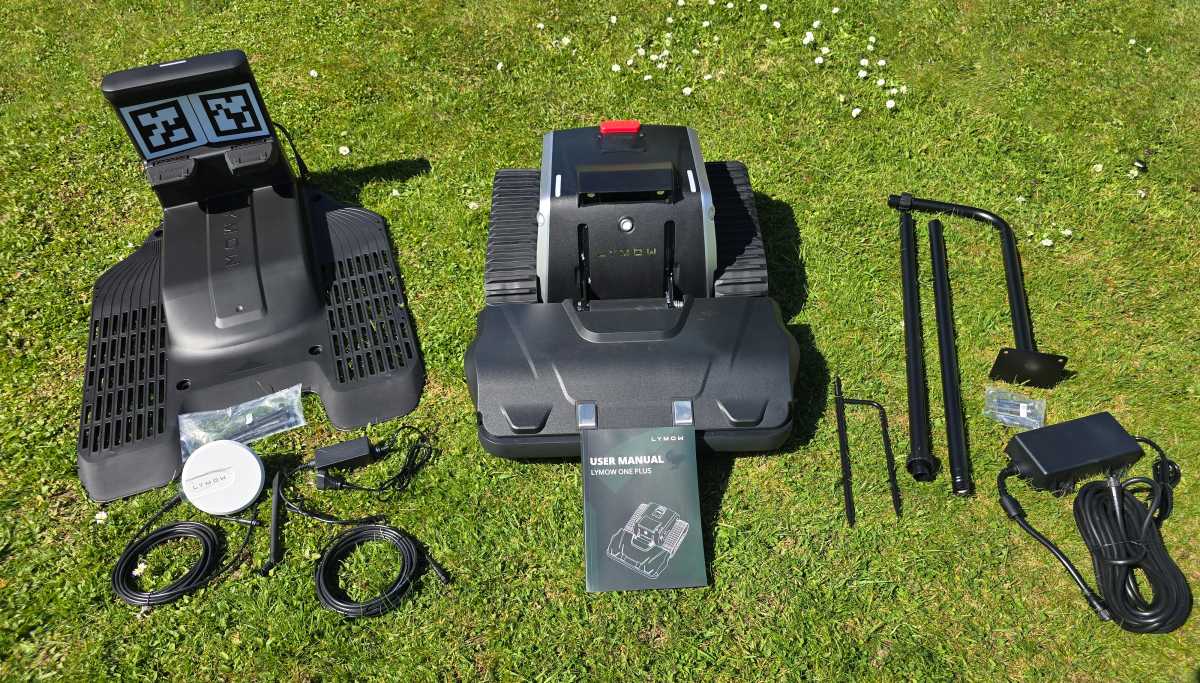
The delivery package weighs in at around 103 pounds. The contents are extensive and include mounting hardware for both soil and concrete as well as the charging station and RTK antenna. The user manual is multilingual.
Christoph Hoffmann
Once unpacked, the robot can be moved by a strong adult thanks to the side carrying handles and its rear-heavy center of gravity.
Visually, the Lymow is more reminiscent of a construction site vehicle than a traditional garden helper. Wide tracks, a front-mounted mowing deck, and the camera tower characterize its appearance.
The low center of gravity and wide track width improve off-road capability. The front-mounted mower deck also reaches areas where the central blade discs of many competitors fail.
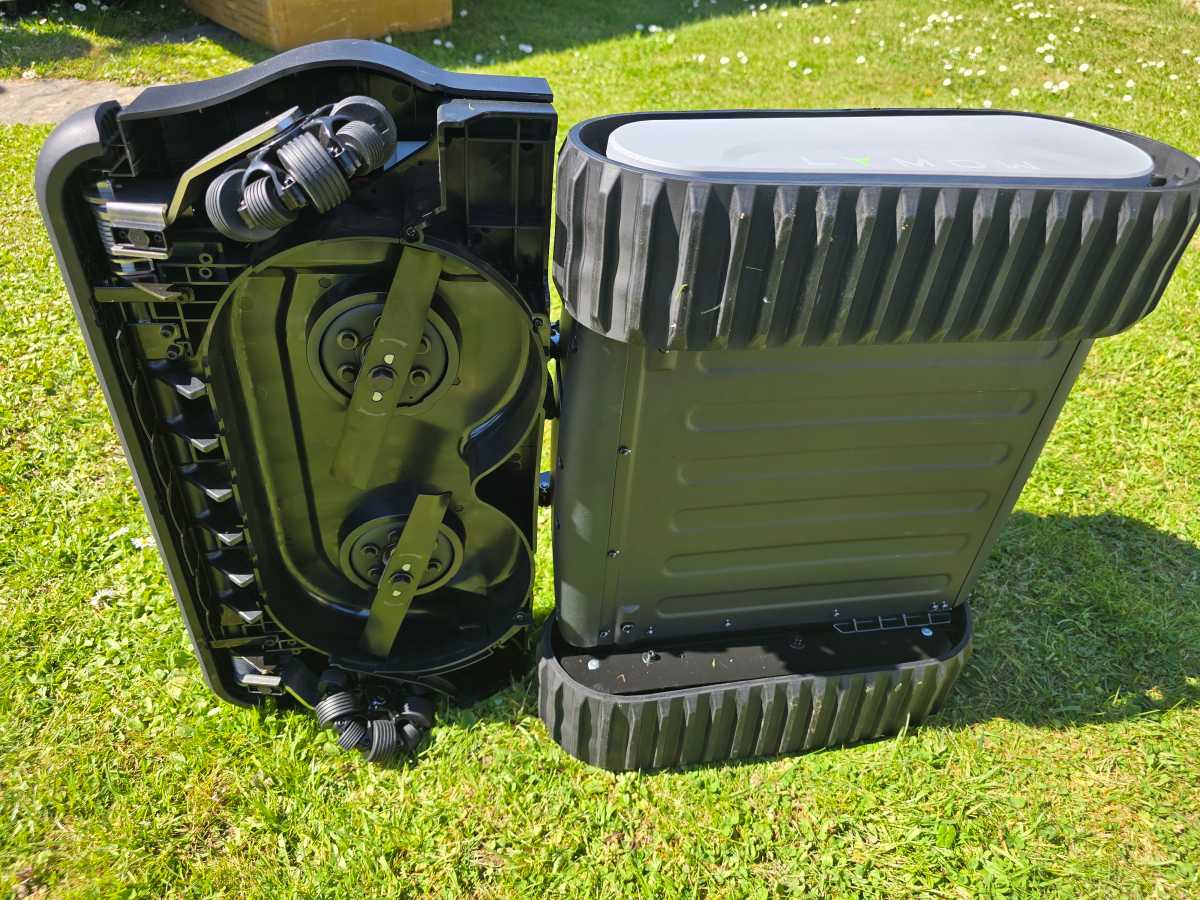
The chassis and mower suspension are made of high-strength steel and a frame of A380 die-cast aluminum, respectively. All connections, wheel suspensions, and the electric height adjustment are generously dimensioned. The construction appears solid and torsion-resistant.
The movable mowing head is connected to the main chassis via two powerful springs and joints and follows the terrain independently of the robot body.
Christoph Hoffmann
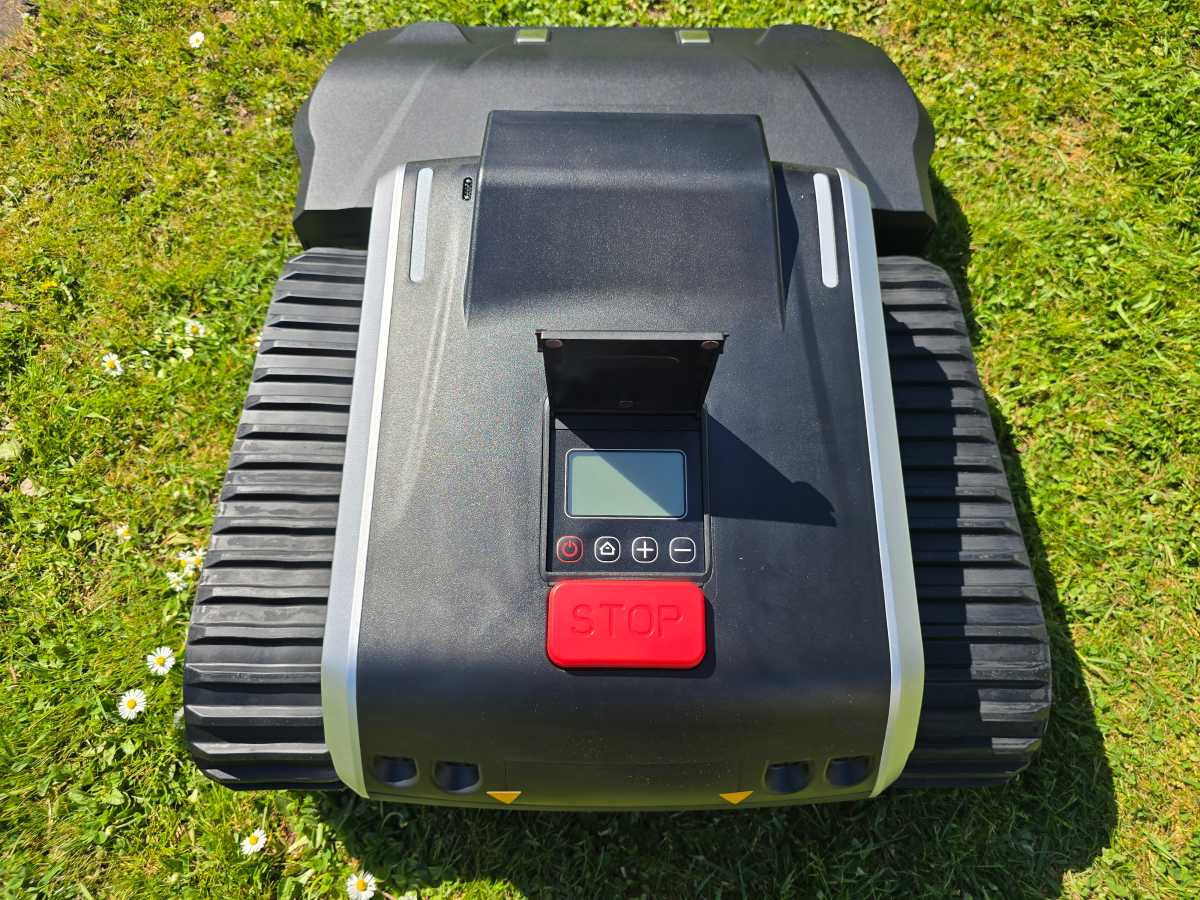
On the top, beneath a flap, there is a small control panel with the basic functions for On, Off, Return to Base, and mower height. The side charging contacts are designed as spring-loaded rails, which makes docking easier even at a slight angle.
Christoph Hoffmann
The IPX6 protection rating allows the unit to be hosed down with a garden hose. The operating temperature range is 14 to 113 Fahrenheit.
Lymow One Plus: Features
At the heart of the machine is the LYCUT 2.0 mower deck. Two rotating blade discs made of SK5 tool steel with a hardness of 50 HRC operate at up to 6,000 revolutions per minute.
The cutting width is an impressive 15.7 inches, and the cutting height can be adjusted electrically between 1.2 and 3.9 inches. The robust steel blades are more reminiscent of classic lawnmowers than typical robotic mower blades. Even tall or dense grass barely fazes the mower deck. The mower motor’s peak power is 1,785 watts, with a rated power of 680 watts.
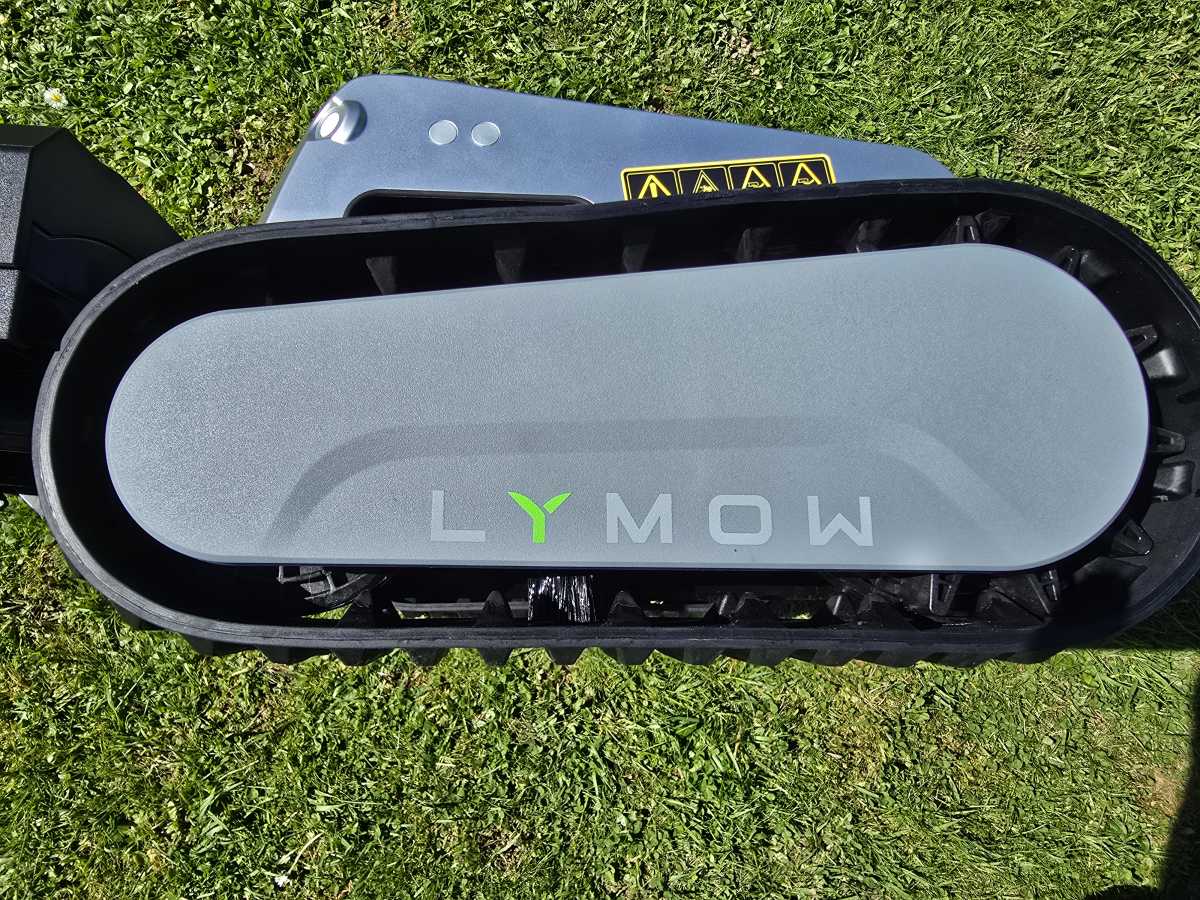
Power is transmitted via two wide rubber tracks with a deep-tread pattern. They distribute the weight over a large contact area and ensure traction on wet, sandy, or loose ground.
Christoph Hoffmann
Lymow specifies a maximum climbing ability of 100 percent or 45 degrees. In our test, the robot reliably handled gradients of up to around 30 degrees. The robot can drive over obstacles up to seven centimeters high. Turning maneuvers leave no visible marks on the turf because both tracks can rotate in opposite directions and the wide contact surface reduces pressure.
The Lymow One Plus combines several systems for navigation. RTK satellite positioning ensures centimeter-accurate positioning, with an external antenna providing the correction data. VSLAM also comes into play, i.e. visual localization via the two front cameras. If the robot temporarily loses the RTK signal, it can continue mowing autonomously for around 100 to 150 square meters or ten minutes.
Obstacle detection is handled by an AI camera, five ultrasonic sensors, and two Hall sensors for edge detection. Two LEDs on the tower illuminate the area in front of the robot in low-light conditions, enabling night-time operation.
Power is supplied by a LiFePO4 battery with a capacity of 15 Ah at a nominal voltage of 35.2 volts. This corresponds to around 528 Wh. This battery technology is considered to be significantly more durable and thermally stable than conventional lithium-ion cells. Lymow quotes 2,000 charge cycles at 80 percent remaining capacity. The battery charges in around 90 minutes using the 405-watt fast charger. A single battery charge is sufficient for up to 2,300 square meters. The robot can cover up to 7,000 square meters per day.
The system offers plenty of connectivity: Bluetooth, Wi-Fi, and 4G mobile are integrated. A SIM card for 4G is included and can be used free of charge for the first year.
Up to 80 mowing zones and maps covering a total of 60,000 square meters can be stored. Also on board: a rain sensor, lift sensor, anti-theft protection with geofencing alerts, and a live feed from the front camera via the app.
Lymow One Plus: Set up
Set-up is more complex than with many LiDAR robotic mowers. First, a suitable location for the charging station must be found. In front of the station, there should be an obstacle-free area approximately three meters wide and 1.5 meters deep, with the ground as level as possible. The ground anchors or expansion bolts supplied secure the station depending on the surface.
Placing the RTK antenna is more tricky. It needs a clear view of the sky, so no dense tree canopy or high walls in the immediate vicinity. The supplied mast can be assembled from several segments and either anchored in the ground or mounted on a façade or shed using a wall bracket. The connection cable to the charging station is ten meters long. Alternatively, the included power supply unit can power the antenna separately.
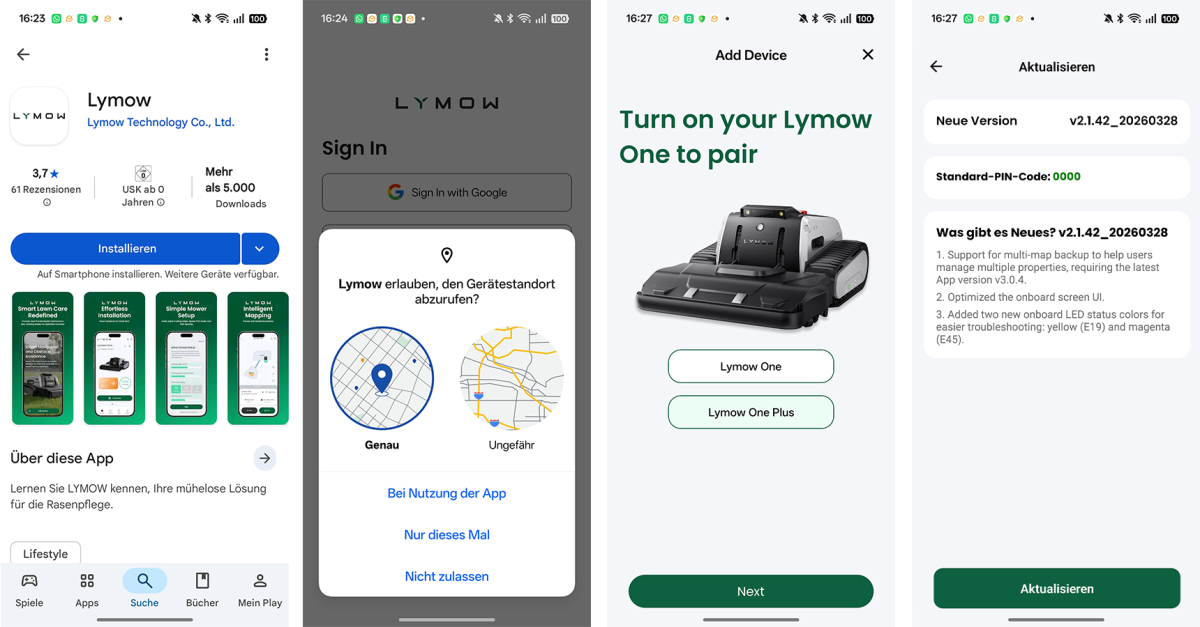
The rest of the setup is handled entirely via the Lymow app for Android and iOS. Once a user account has been created, the robot pairs with the smartphone via Bluetooth and connects to the Wi-Fi network. This is followed by the firmware update and pairing of the RTK antenna via QR code. The app guides you through each step with tutorials.
Christoph Hoffmann
The initial mapping is done manually. Using a virtual joystick in the app, you trace the boundaries of the property and define restricted areas such as flower beds, trees, or ponds. On our test site, this process took around 30 to 45 minutes.
Multiple mowing zones can be created, separated, or merged, even retrospectively. If the RTK antenna is moved later, the entire map must be recreated.
Lymow One Plus: Performance
Even in the first few minutes, it’s clear that the Lymow One Plus is in a different league compared to other compact lawn robots. The mower starts up quickly and works in straight lines. The speed can be continuously adjusted between 0.3 and 1.0 meters per second. At maximum speed, the Lymow covers large areas noticeably faster than typical robotic mowers.
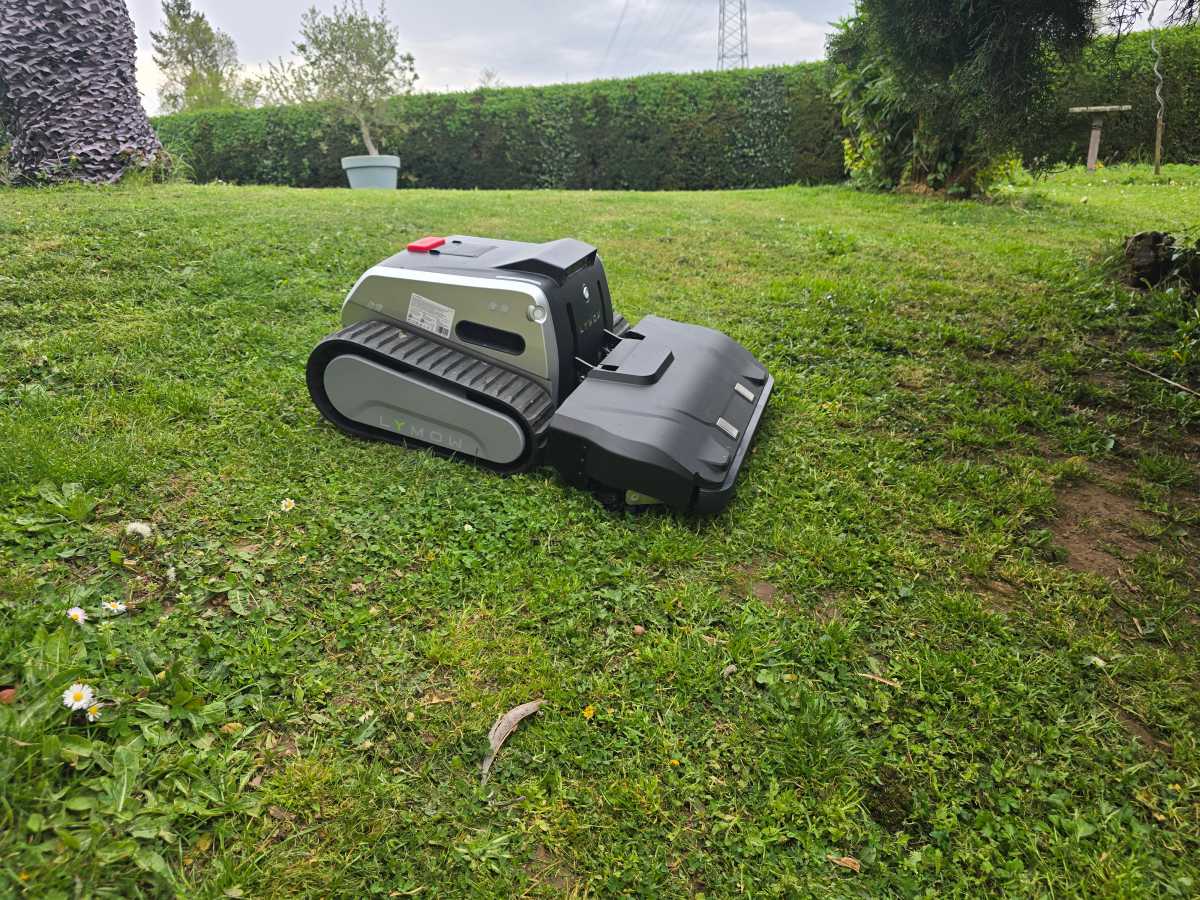
The cut is impressive after the first mowing session. The high airflow straightens the blades of grass, the SK5 blades cut cleanly, and the mulch is finely distributed. The advantage of the dual-blade design is clearly evident in dense or overgrown grass. While many robotic mowers with small blades get bogged down, the Lymow continues to work reliably, even in taller grass. Fallen leaves are also shredded in turbo mode and distributed across the lawn.
Christoph Hoffmann
Noise levels are one of the design’s weaknesses. In standard mode, the Lymow remains noticeably louder than typical robotic mowers. In turbo mode, the noise level rises to 74 dB(A). This makes it virtually impossible to relax in the yard while the mower is in operation.
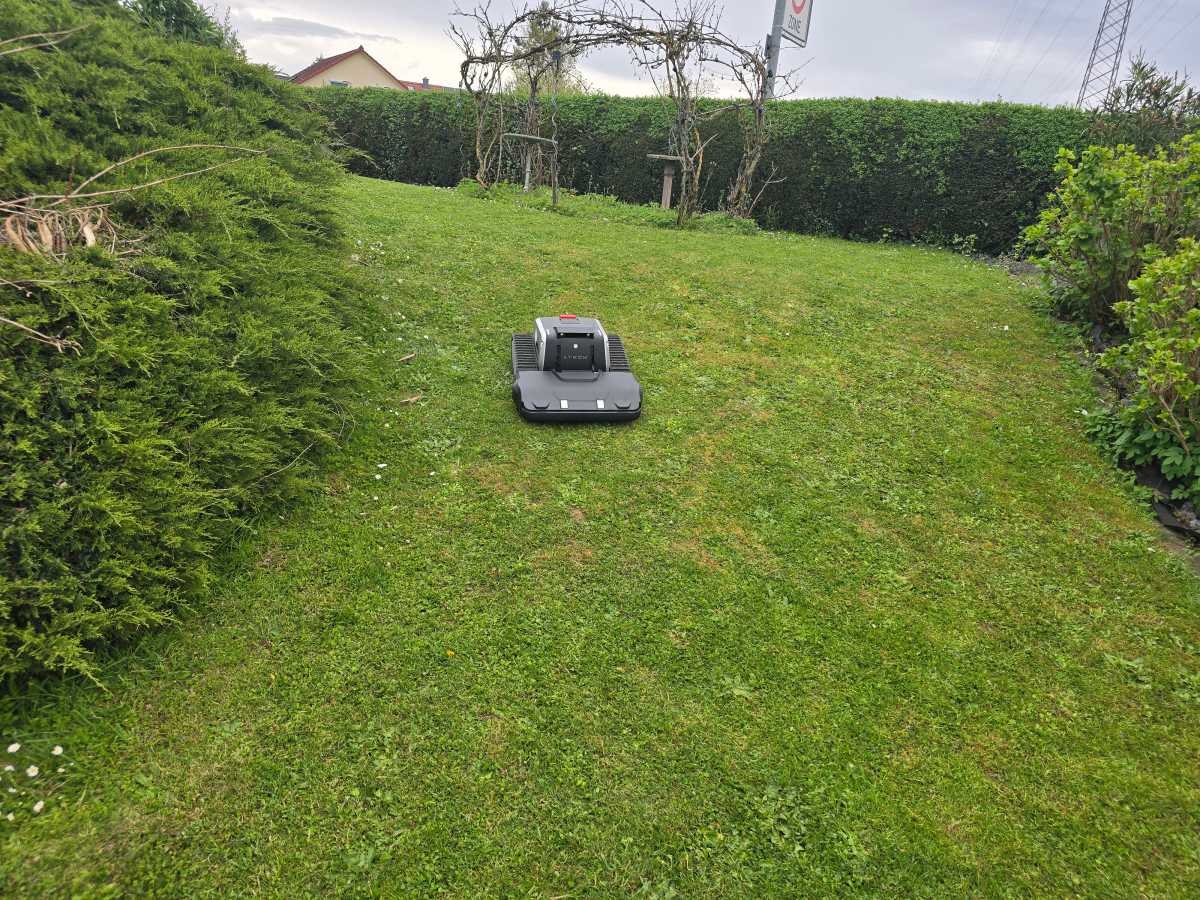
Bumps and dips in the ground pose little problem for the Lymow. The floating mowing deck follows the terrain independently of the main body and keeps the cutting height constant. Even on wet grass and soft ground, the tracks find grip where wheels are more likely to spin. The Lymow tackled gradients of up to around 30 degrees on our test area without slipping.
Christoph Hoffmann
The obstacle detection works reliably. Toys, patio furniture, sprinklers, branches, and even a stuffed hedgehog placed on the ground are detected and avoided proactively. The robot reduces its speed, swerves in a controlled manner, and then resumes its path. Only very flat objects such as a folding ruler lying on the ground are detected late. In the event of direct contact, the mower stops immediately.
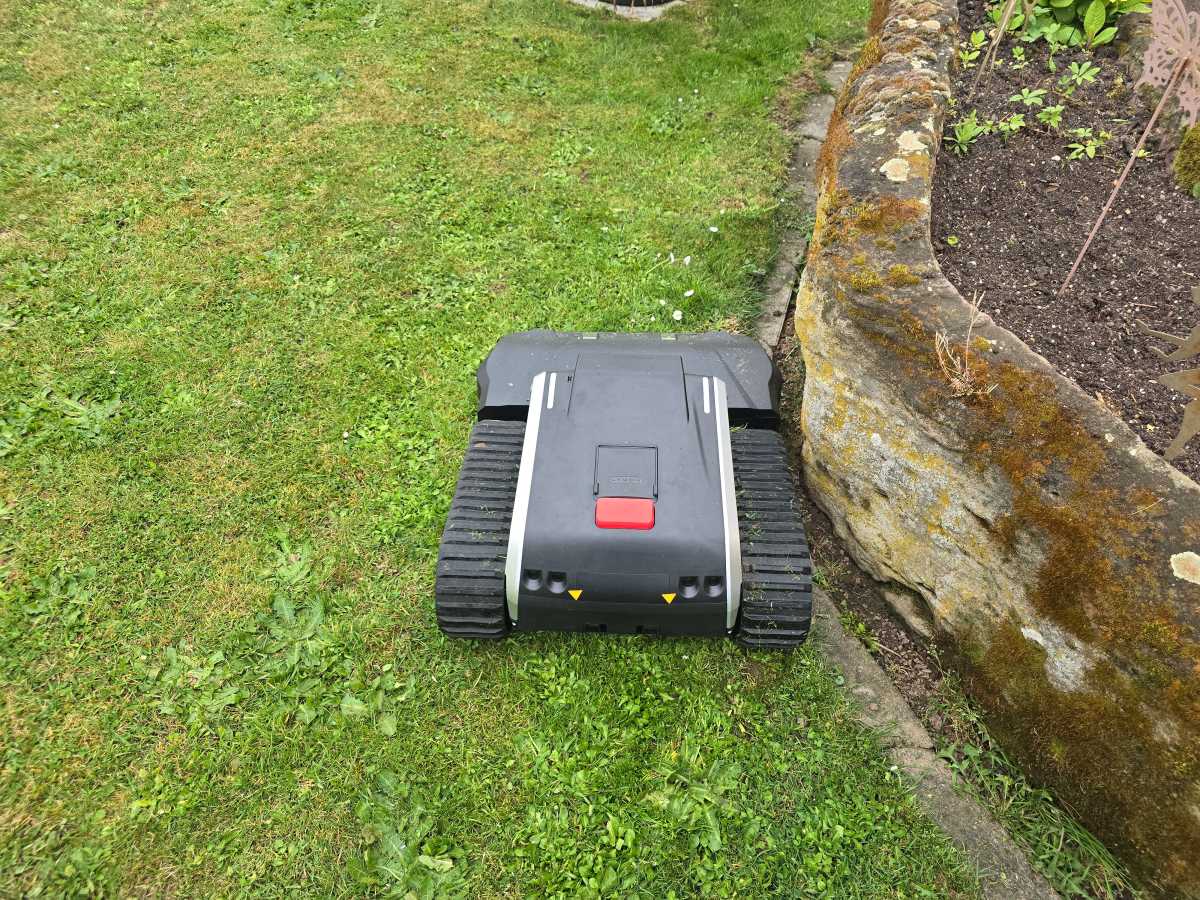
The Lymow shows weaknesses when mowing edges. A strip of 10 to 20 centimeters remains along trees, shrubs, or restricted areas. On driveable lawn edging stones, however, the robot achieves an almost clean result because it can roll over the stones using a chain. The safety distance can be reduced in the app, although this increases the risk of the mower slightly driving over the edge.
Christoph Hoffmann
At temperatures below 68 degrees Fahrenheit, the side discharge did not work reliably because the rubber cover becomes too stiff. In turbo mode, it worked flawlessly. In other modes, clippings occasionally accumulated. This did not affect the mowing result. The clippings were instead distributed beneath the robot. Thanks to the high ground clearance and the open mowing deck, the area beneath the robot is relatively easy to clean.
The Lymow app is comprehensive and clearly structured. Path spacing, strip angle, cross-pattern, mowing sequence, number of edge passes, and even the deactivation of the outer mowing motor can be configured per zone. An RTK diagnostic displays the number of satellites and signal quality in real time. Maps can also be backed up and restored if necessary.
On a single battery charge, the Lymow achieved 142 minutes of mowing time at medium speed on our 531 square meter test area, after which 42 percent of the battery capacity remained. In combination with the 405-watt fast charger, three full mowing cycles are said to be possible in twelve hours. Standby power consumption is around 12.5 watts, though this rises to about 45 watts when the handbrake function is activated on slopes.
Lymow One Plus: Conclusion
The Lymow One Plus is designed for large, steep lawns. This is precisely where its unusual design comes into its own. The chain drive delivers enormous traction even on wet or uneven ground, the floating dual mower deck ensures a clean cut even with tall or dense grass, and the RTK-VSLAM navigation works with astonishing reliability even in difficult conditions. Conventional robotic mowers reach their limits much sooner in similar environments.
The Lymow is less suitable for small, winding yards or those with precisely maintained edges. The high noise level in turbo mode makes it less suitable for some residential environments. If you’re mainly looking for a quiet, unobtrusive, convenient solution for a standard lawn, you’re better off with cheaper RTK models.
The price, starting at around $3,199, seems high at first but is justified by the unusually robust technology, the long-lasting LiFePO4 battery, the high coverage rate, and the extreme off-road capability. As a result, the Lymow is more of a replacement for a small ride-on mower than a traditional robotic mower, which is precisely what makes it special.
Technical specifications
- Model: Lymow One Plus
- Dimensions: 750 × 600 × 320 mm (L × W × H)
- Weight: 35.2 kg
- Drive: Chain drive (two rubber tracks)
- Maximum gradient: 100% (45°)
- Obstacle clearance: up to 70 mm
- Mowing speed: 0.3 to 1.0 m/s
- Cutting system: LYCUT 2.0 with two rotating SK5 steel blades (50 HRC)
- Cutting width: 400 mm
- Cutting height: 30 to 100 mm (electrically adjustable)
- Blade speed: 3,000 to 6,000 rpm
- Rated power of mower motor: 680 watts
- Peak power of mowing motor: 1,785 watts
- Battery: LiFePO4, 15 Ah, 35.2 V (approx. 528 Wh)
- Charger: 405 W (10 A) or 200 W (5 A)
- Charging time: 90 mins (10 A) or 150 mins (5 A)
- Maximum runtime: 3 hours
- Battery life: approx. 2,000 charge cycles
- Area coverage per charge: up to 2,300 m²
- Area coverage per day: up to 7,000 m²
- Area coverage per hour: up to 930 m²
- Navigation: RTK VSLAM
- RTK coverage radius: up to 1 km
- Emergency mode without RTK: 100 to 150 m² or up to 10 minutes
- Obstacle detection: AI camera, 5 ultrasonic sensors, 2 Hall sensors
- Connectivity: Bluetooth, Wi-Fi, 4G (SIM card included, 1 year free)
- Multi-zone management: up to 80 zones
- Map storage: up to 60,000 m²
- Protection class: IPX6
- Operating temperature: −10 °C to 45 °C
- Noise level: 60 dB(A) Eco / 62 dB(A) Standard / 74 dB(A) Turbo
This article originally appeared on our sister publication PC-WELT and was translated and localized from German.