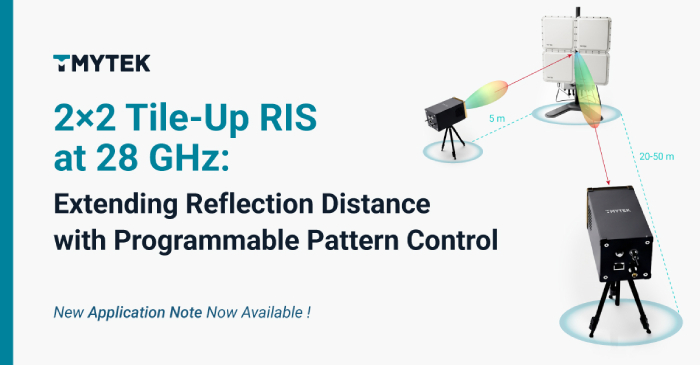
TMYTEK has developed a 28 GHz 2×2 Tile-Up Reconfigurable Intelligent Surface (RIS) system with programmable pattern control to extend mmWave reflection distances and improve coverage in challenging wireless environments.
Millimeter-wave (mmWave) frequencies such as 28 GHz are central to next-generation wireless networks due to their ability to support high data rates. However, their deployment is often limited by high path loss and poor diffraction around obstacles, particularly in non-line-of-sight (NLOS) scenarios. TMYTEK’s Tile-Up RIS technology addresses these limitations by enabling dynamic control of reflected signals to enhance coverage and signal quality.
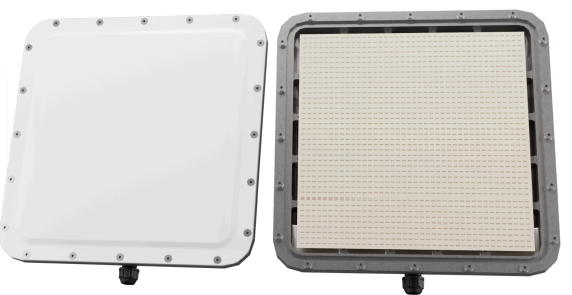 RIS 28 GHz (Left) w/ Radome. (Right) The Reflection Elements.
TMYTEK uses the 28 GHz Tile-Up RIS, which integrates with a pattern control graphical user interface (GUI), allowing researchers to rapidly reconfigure beam directions and evaluate different reflection paths without physically repositioning the RIS panels. This programmable approach creates a flexible test environment for dynamic link measurements over distances ranging from 20 m to 50 m, supporting validation of broader and more stable mmWave coverage.
They published an application note with measurements to show the 2×2 Tile-Up RIS configuration consistently outperforms a single RIS tile across the tested range. The larger configuration achieved received power improvements of 2.90 dB to 6.07 dB between 20 m and 50 m. The advantage became more pronounced at longer distances, delivering gains of 5.45 dB at 45 m and 6.07 dB at 50 m, indicating stronger long-range reflection capabilities.
TMYTEK’s Tile-Up RIS platform is designed for scalable experimentation, enabling multiple 28 GHz RIS panels to be combined into a larger effective aperture. The system also offers flexible beam direction control and integrates with TMYTEK’s broader 28 GHz ecosystem, including BBox One, UD Box, and the TMXLAB Kit, providing researchers with a repeatable workflow for RIS validation and wireless communication studies.
The application note demonstrates the growing role of programmable RIS technology in overcoming mmWave propagation challenges, offering a practical approach for extending coverage and improving network performance in future 5G and emerging 6G deployments.
Click here to read the application note.
Click here to learn more about the 28 GHz RIS Solution from TMYTEK.