South Korea’s Pohang University of Science and Technology has found a way to turn waste heat (from data centers, EV batteries, and factories) into electricity without relying on scarce, expensive materials.
But let’s first understand the need. Every single time you type a prompt into ChatGPT, a tiny burst of heat is unleashed inside a sprawling data center server room. And with the never-ending prompt saga, the scale of the problem just keeps increasing.
The physical toll of artificial intelligence is rising. Electric vehicle batteries bake under heavy usage. Giant factories vent massive amounts of boiling exhaust straight into the atmosphere.
Engineers have been trying to capture this escaping waste heat and turn it back into electricity using thermoelectric devices. But it has a barrier. The raw materials required, like bismuth and tellurium, are rare, expensive, and trapped in chaotic global supply chains.
Silicon is cheap, common, and ready for mass production. There is just one catch: it is a terrible thermoelectric material because it lets heat escape too easily.
Now, a South Korean research team has found a way to trap that heat by turning solid structures into microscopic pipes.
“Because this technology is highly compatible with domestic semiconductor manufacturing technology, this approach can contribute to leading the next-generation thermal management market without relying on rare materials,” the researchers stated.
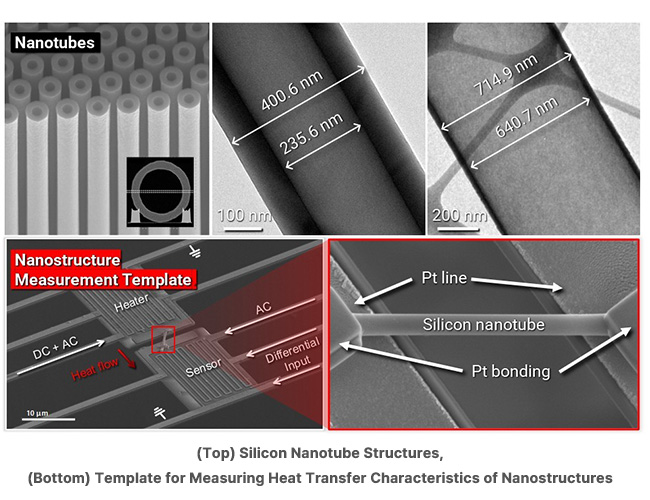
Hollow silicon nanotubes
A team led by Professor Chang-Ki Baek and Ph.D. candidate Ki Yeong Kim at POSTECH (Pohang University of Science and Technology) has successfully altered how heat travels at the nanoscale.
Rather than using solid, rod-shaped silicon nanowires, the team engineered hollow silicon nanotube structures.
As a result, the hollow tubes slashed thermal conductivity by 70 percent compared to solid wires. Even when the scientists controlled the experiments so that both structures had the exact same surface area, the hollow tubes still ran 33 percent cooler.
To understand why this works, you have to look at phonons, which are the quasi-particles that represent atomic vibrations transferring heat through a solid.
In a solid wire, phonons move freely like open highway traffic. In a hollow nanotube, these particles hit a dead end. The POSTECH team discovered that these heat vibrations become trapped in specific zones, a phenomenon called phonon localization. The energy gets stuck behind the barrier, unable to push forward.
Solving the challenge
Earlier, it was hypothesized that phonon localization could only be achieved under extreme cryogenic conditions near absolute zero or within highly complex, custom-fabricated materials.
However, Baek’s team proved it can happen in a relatively simple nanotube structure at near-room temperature.
Turning this newfound mechanism into practical applications could change energy efficiency by converting wasted heat into usable electricity on a massive scale.
As the technology uses abundant silicon rather than volatile rare metals, it can be integrated into existing semiconductor manufacturing pipelines.
This high compatibility with current chip-making infrastructure could help the technology to rapidly commercialize and lead the next-generation thermal management market, securing a stable and cost-effective supply chain.
The findings were published in Nano Energy.