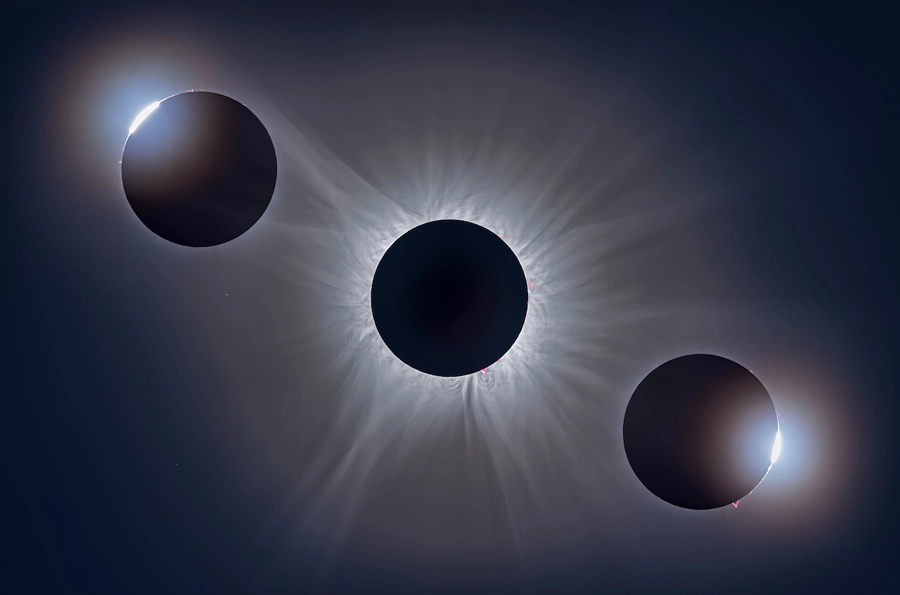
Alan Dyer, amazingsky.com
If you like your pizzas with extra cheese, then mark August 12th on your calendar. That day, mainland Europe will see its first total eclipse of the Sun since 1999. Later that same evening, the annual Perseid meteor shower reaches its maximum activity under a new Moon. How much astronomical goodness can you pack into 12 hours? Most of us are so used to major celestial events occurring months and years apart, so the combination of an eclipse and major meteor shower is truly exciting!
Of course, only a tiny fraction of humanity will get to witness totality. But many skywatchers, including those in roughly the northern third of the U.S. and most of Canada, will experience a partial solar eclipse. The eclipse will start around 1 p.m. on the East Coast and 10:30 a.m. in northern Montana. For the contiguous U.S., the maximum obscuration of 29.3% happens from the northern tip of Maine. Farther south and west the percentage decreases.
| City | Time of maximum eclipse | % Obscuration |
| Québec City, QC | 1:46 p.m. | 24.0% |
| Boston, MA | 1:55 p.m. | 16.0% |
| Philadelphia, PA | 1:54 p.m. | 7.0% |
| Washington D.C. | 1:53 p.m. | 3.7% |
| Ottawa, ON | 1:43 p.m. | 15.5% |
| Chicago, IL | 12:28 p.m. | 0.1% |
| Minneapolis, MN | 12:13 p.m. | 0.5% |
| Winnipeg, MB | 12:02 p.m. | 5.4% |
| Edmonton, AB | 10:39 a.m. | 6.5% |
| Fairbanks, AK | 8:27 a.m. | 36.8% |
Leah Tiscione / S&T; Source: Fred Espenak
Chasing the shadow
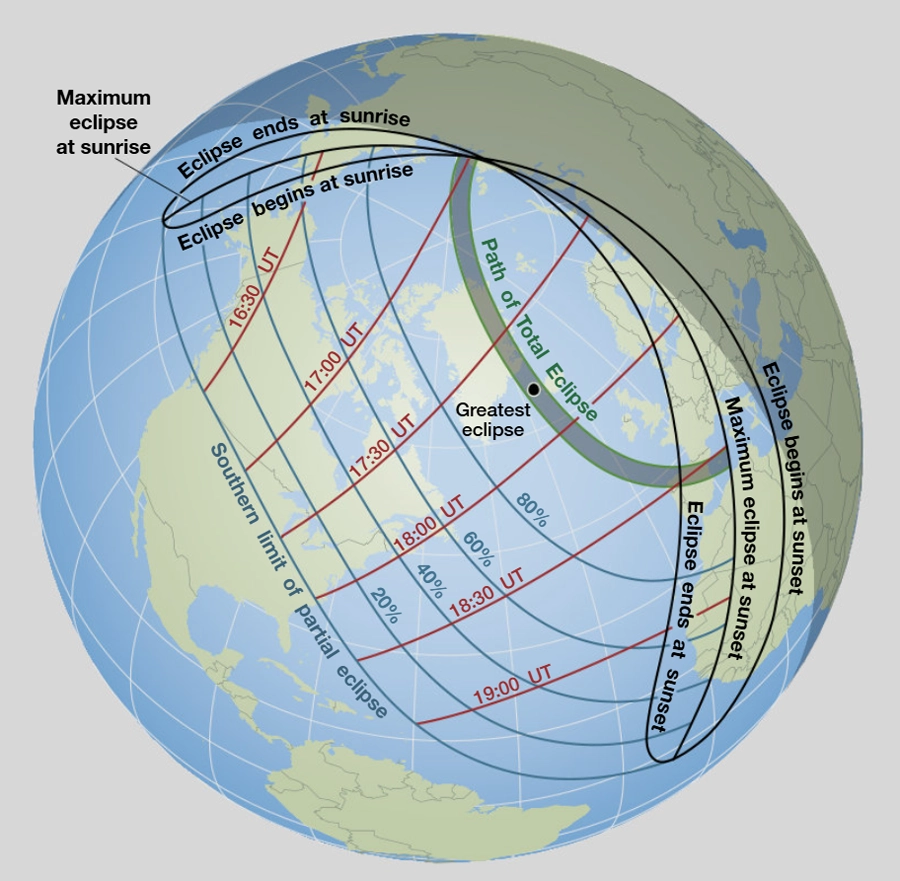
The Moon’s dark shadow, or umbra, touches down at sunrise in remote northern Siberia. Soon after, it nearly grazes the North Pole — missing it by 100 km (60 miles) — before sweeping south over Greenland’s east coast. Totality reaches a maximum of 2 minutes, 18 seconds off Iceland’s west coast. The island’s capital, Reykjavík, scores 63 seconds of totality starting at 5:48 p.m. local time. Traveling at some 3,400 km/h (2,100 mph), the umbra speeds southeast on its way to northern Spain and a tiny corner of Portugal.
Stellarium
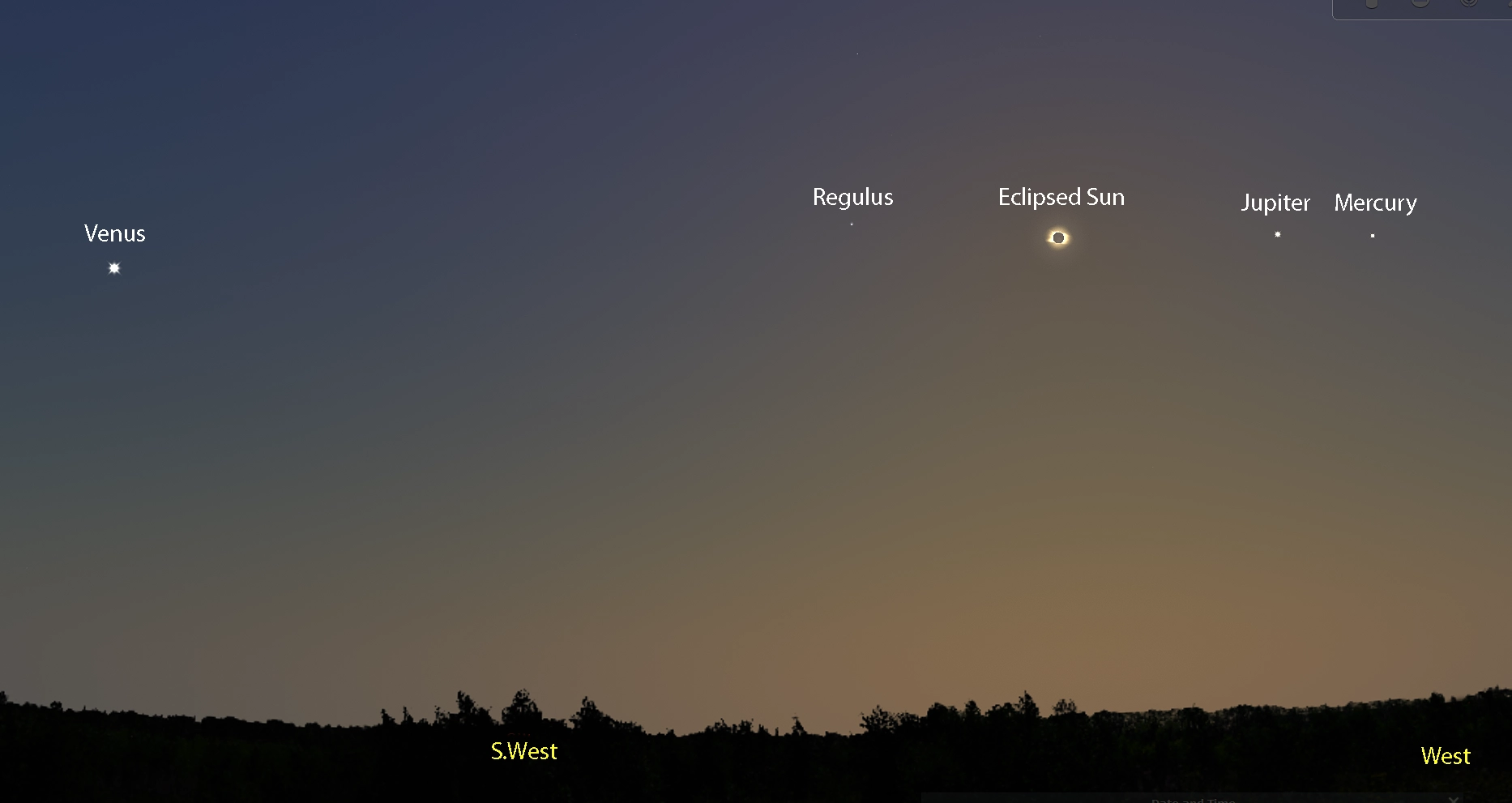
Landfall occurs near the port city of A Coruña in northwestern Spain, where totality begins at 8:28 p.m. and lasts 1 minute, 12 seconds. Sweeping from the Atlantic coast to the Balearic Islands and the Mediterranean Sea, the lunar shadow spans about 300 km across. Shouts of jubilation will rise into the air in quick succession (weather permitting) as the umbra plunges Valladolid, Zaragoza, and Palma on the island of Mallorca into darkness. From the east coast and the Balearic Islands, observers will experience a unique sunset eclipse with the Sun in totality just a few degrees above the horizon. Atmospheric refraction will distort its outline and redden the corona. Clouds and crepuscular rays may add additional colors and textures.
Totality sends its final kiss as the Sun sinks into the Mediterranean about 160 km east of Mallorca. Spain’s two largest cities, Madrid and Barcelona, lie just south and north of the path of totality, respectively. From Madrid’s city center, 99.96% of the Sun will be obscured (northern Madrid metropolitan area will see seconds of totality) and 99.82% in Barcelona.
Weather and resources
Europe is currently experiencing a heat wave, so if you’re planning a trip to Spain or Portugal keep water handy and bring an umbrella for Sun protection. Daytime highs for western Iceland are typically in the upper 50s (14° C). Cloud cover is key. Ground observations along the eclipse track between 2000 and 2021 collected by meteorologist Jay Anderson indicate a 40% chance of sunshine in mid-August over parts of eastern Greenland and 32% in Reykjavík.
Faraway the most promising conditions will be in Spain and the Balearic Islands, where the percentage of possible sunshine rises to around 70%. Always bear in mind that statistics say one thing, but what happens on a particular day is up for grabs. One caveat — smoke. There are currently more than a dozen major wildfires burning in Spain, any one of which could affect the visibility of the eclipsed Sun. For additional resources on weather, local eclipse circumstances, and eclipse photography, check out these links:
Tips and observables
Totality will be brief, in most places under 2 minutes. Careful planning is a must if you want to both observe and photograph the eclipse. What worked for me during the April 2024 total eclipse was to set aside exactly 1 minute of the 4-minute-long totality for closeup telephoto photography. Using an intervalometer, I made a series of exposures from short to long, repeated these in reverse, then walked away from the camera to just look up and enjoy the view.
By adhering to my plan, it felt like totality lasted a long time, relatively speaking. I shared the thrill with my fellow passengers, appreciated the indescribable loveliness of the vibrant corona (both naked-eye and with binoculars — be sure to bring a pair), marveled at a snaggle-toothed prominence, spotted shadow bands at totality’s conclusion, and even took a few quick snapshots with my phone. Such a luxury! For this eclipse, I plan to spend 20 seconds at the camera and a minute-plus going gaga!
J. Kelly Beatty
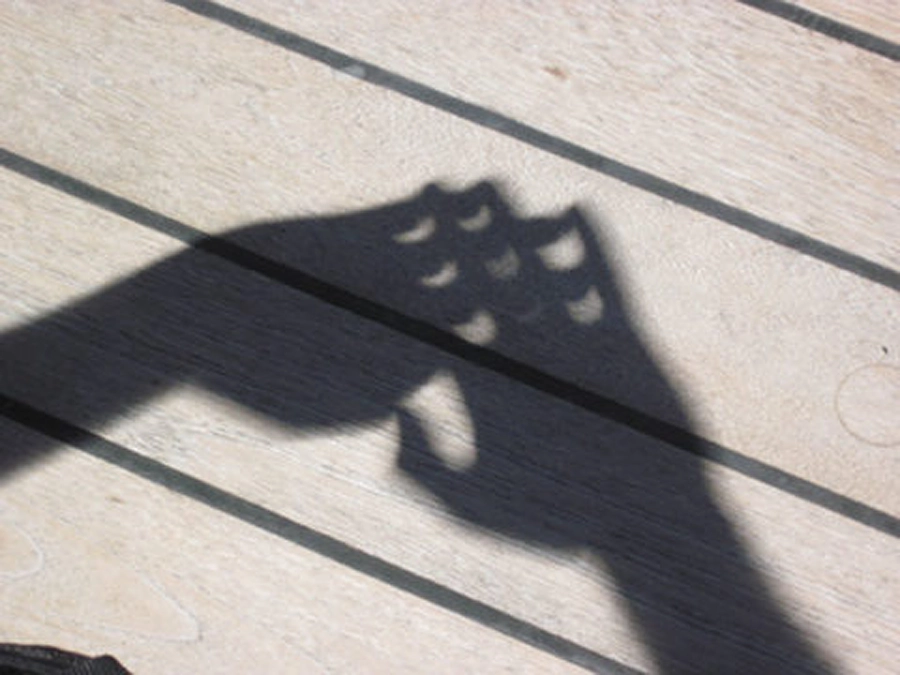
A half hour before totality, the air temperature begins to drop. About the same time, daylight assumes an eerie, diluted quality as the Sun narrows to a slim crescent. Small apertures like the gaps between your fingers (or leaves on a tree) project images of the skinny Sun. Finally, the suddenness with which the Sun disappears as the Moon’s shadow zooms in from the west at more than 2,400 km/h makes the hairs in the back of your neck stand up. Anticipation, amazement, fear, wonder, exhilaration, peace, connection, and relief. We feel so many emotions during a total solar eclipse. No wonder many of us keep coming back for more.
Oh, about those Perseids. I’ll spotlight them in a post next week. Clear skies and good luck to all!