Contacts:
Meg Thacher, Associate Editor
(202) 328-2010 x22182, [email protected]
Edwin L. Aguirre, Associate Editor
(617) 500-6793 x131, [email protected]
Susanna Kohler, Director of Communications & Media Relations, American Astronomical Society
(202) 328-2010 ×127, [email protected]
Note to Editors/Producers: This release is accompanied by high-quality graphics; see the end of this release for the images and links to download.
On August 12th, North America will be on the very edge of the global visibility zone for a solar eclipse that will be total over parts of Greenland, Iceland, and Spain. Though not as impressive as a total solar eclipse, skywatchers in the northeastern U.S. and Canada will see the Moon cover up part of the Sun’s face.
The path of the total eclipse — no more than about 180 miles wide — starts along Russia’s northern coast, just misses the North Pole, and then plunges southward into the North Atlantic along Greenland’s eastern shore. From there, it clips western Iceland (including Reykjavík) then cruises across Spain, ending at sunset southeast of Mallorca in the Mediterranean Sea.
On average, a total solar eclipse occurs every 18 months, but eclipse-chasers have endured a 2½-year dry spell since the last one on April 8, 2024, in North America. Given all the millions across the U.S. who saw totality in both 2017 and 2024, many eclipse-chasers are heading to Greenland, Iceland, and especially Spain to see this one.
Meanwhile, a deep partial eclipse will be observable from western Europe — those in London will see 91% of the Sun’s disk covered, 83% from Oslo — and a more modest partial eclipse from the northeastern third of the contiguous U.S. and all of Canada. At Sky & Telescope’s home office in Cambridge, Massachusetts, at its maximum the Moon will cover 16% of the Sun’s disk at 1:55 p.m. That fraction climbs to 31% in Halifax, Nova Scotia (3:00 p.m.) and 53% at St. John’s, Newfoundland (3:35 p.m.).
The table below gives local times and circumstances for selected cities (note: times before noon are in bold type). For the circumstances and times for hundreds of other cities (or your location specifically), see the eclipse calculator provided by the late Fred Espenak at eclipsewise.com. Read more on this eclipse in the August 2026 issue of Sky & Telescope and on Bob King’s S&T blog. For general eclipse information, visit the American Astronomical Society’s eclipse info page.
| Local Times for August 12th’s Partial Solar Eclipse | ||||
| Cities in U.S. | Eclipse begins | Mid-eclipse | Eclipse ends | Max area covered |
| Boston, MA | 1:02 | 1:55 | 2:46 | 16% |
| Cleveland, OH | 1:07 | 1:40 | 2:12 | 3% |
| Milwaukee, WI | 12:04 | 12:26 | 12:48 | 1% |
| Minneapolis, MN | 11:55 | 12:13 | 12:31 | 1% |
| New York, NY | 1:08 | 1:54 | 2:39 | 10% |
| Philadelphia, PA | 1:11 | 1:54 | 2:35 | 7% |
| Portland, ME | 1:58 | 2:54 | 3:47 | 20% |
| Washington, DC | 1:18 | 1:53 | 2:27 | 4% |
| Cities in Canada | Eclipse begins | Mid-eclipse | Eclipse ends | Max area covered |
| Alert, NU | 1:10 | 2:09 | 3:09 | 93% |
| Calgary, AB | 10:11 | 10:37 | 11:03 | 2% |
| Halifax, NS | 1:58 | 3:00 | 3:58 | 31% |
| Iqaluit, NU | 12:19 | 1:24 | 2:28 | 61% |
| Ottawa, ON | 12:50 | 1:43 | 2:34 | 16% |
| Québec, QC | 12:48 | 1:46 | 2:43 | 24% |
| Saint John’s, NF | 2:29 | 3:35 | 4:37 | 53% |
| Saskatoon, SK | 11:11 | 11:47 | 12:24 | 6% |
| Toronto, ON | 12:56 | 1:40 | 2:24 | 8% |
| Whitehorse, YT | 8:40 | 9:27 | 10:15 | 23% |
how to view the eclipse safely
Anyone watching the solar eclipse should do so very carefully. “Looking directly at the Sun can damage your eyes,” explains Meg Thacher of Sky & Telescope magazine. “During a partial solar eclipse you might be tempted to stare directly at the Sun, something you wouldn’t normally do.” The result can be temporary or permanent blurred vision or blind spots at the center of your view.
Fortunately, there are many easy ways to watch the show safely. You can look at the Sun directly through special solar filters. If you still have “eclipse glasses” from 2024 or 2017, make sure you check them very carefully for tears, scratches, or pinholes by holding them up in front of a bright light source. If they’re not damaged, you’re good to go — otherwise toss them! If you don’t have those, an easy indirect method is to poke a small hole in a card, face it toward the Sun, and hold a second card about 3 feet behind it in its shadow. With your back to the Sun, you can then view the image of the partially eclipsed Sun projected onto the second card. Sunglasses, no matter how dark, are not safe for solar viewing. Sky & Telescope provides more information about safely viewing a partial solar eclipse here.
Or bring a camera (even a smart phone) and a safe solar filter that fits over the front of the lens for a chance to take some extraordinary photos. For a how-to, see Sky & Telescope’s article How to Safely Photograph the Sun.
Graphics
Sky & Telescope is making the illustrations below available to editors and producers. Permission is granted for nonexclusive use in print and broadcast media, as long as appropriate credits (as noted) are included. Web publication must include a link to SkyandTelescope.org.
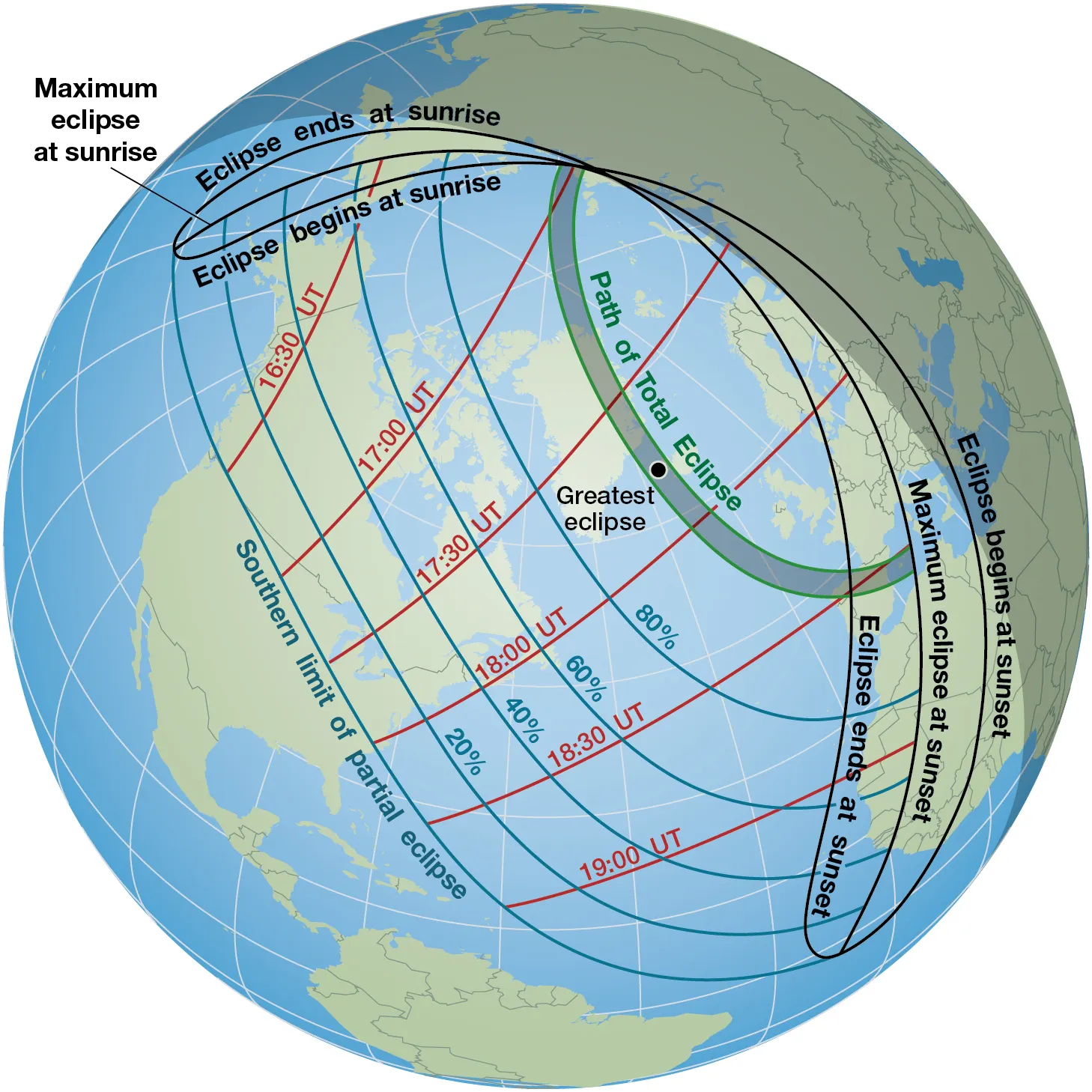
Leah Tiscione / Sky & Telescope
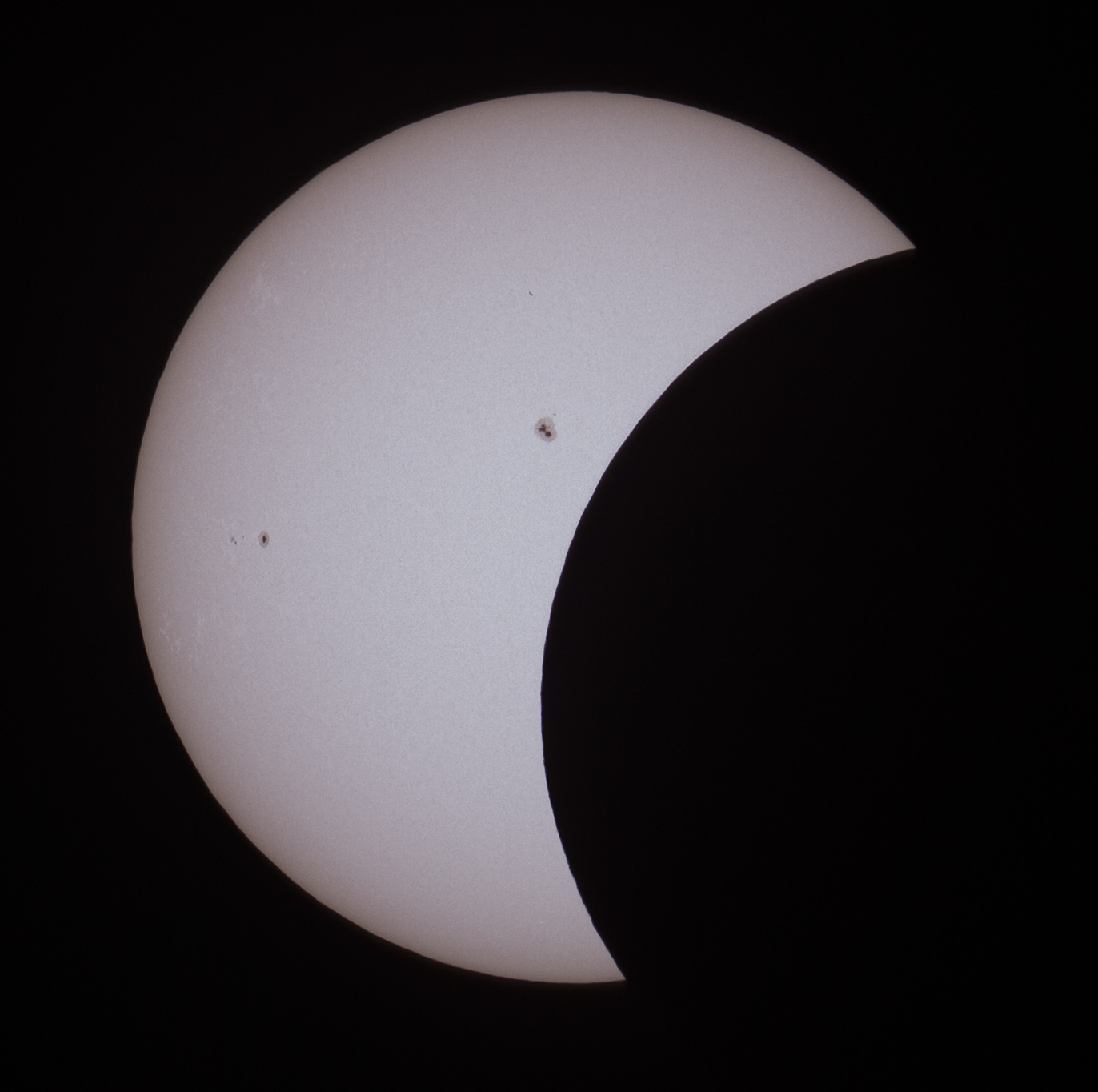
Sean Walker

Charlie Bates, courtesy Mark Margolis / Rainbow Symphony