Dell also offers configuration options with Intel Core Ultra X7 358H and Core Ultra 9 386H processors, Intel Arc graphics, 32GB of memory, and 1200p or 2560×1600 non-touch displays. Dell doesn’t let you freely mix and match components, though. For instance, you can’t opt for 16GB of memory and 512GB of storage but get an Intel Core Ultra X7 358H processor with Intel Arc Graphics.
To get Arc graphics, you’re limited to a configuration with the Core Ultra X7 chip, 32GB of memory, 1TB of storage, and the 2560×1600 non-touch display (that’s not OLED either). This configuration comes out to $2,119, but saw a discount to $1,819 at the time of writing, which seems like a great deal next to our test configuration if you prize performance.
Dell also offers an AMD-powered version of the Dell 16S.
Dell 16S: Design and build quality
Foundry / Mark Knapp
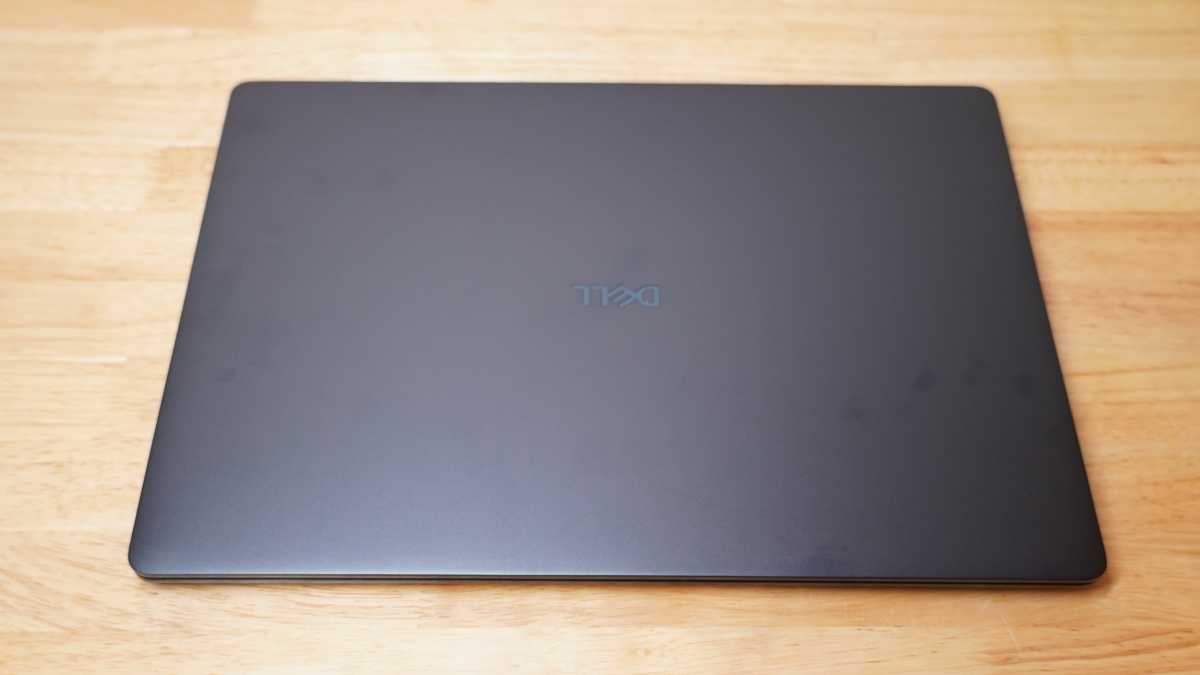
The Dell 16S is a big and rather plain laptop. That’s not to say it’s not a polished, quality machine, but it doesn’t sport much style. It has a plain, dark chassis thankfully made with sturdy metal. It feels plenty robust. The seams between panels are also clean. This gives it some elegance but still not style.
Plain isn’t bad, though. Simplicity has its benefits, and there’s little to get confused about with the Dell 16S. The speaker grilles are easy to spot on the underside near the outer edges of the base. The air intakes sit beneath a large grille on the underside, and warm air exhausts through the display hinge. It may not be the neatest exhaust path, but the wide rear rubber foot helps prevent that warm air from being drawn back into the cooling system. Two more rubber feet at the front keep the laptop nice and secure on desks and tables.
The Dell 16S’s hinge is stiff and avoids any wiggle while typing and almost instantly stops wiggling after adjustments. Despite that stiffness, I can open the lid with one hand cleanly without needing to hold the base down. There’s not much lip on the lid to get purchase on, though, so having a bit of fingernail can help.