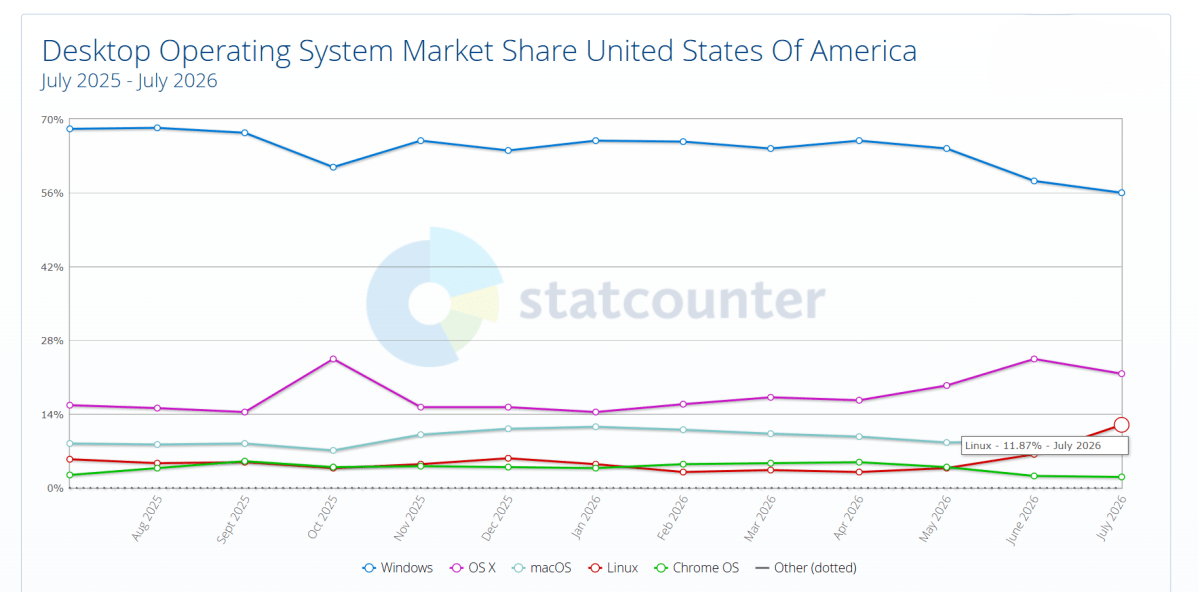
That figure, compiled by StatCounter, isn’t replicated in other areas of the world. Yet. Still, StatCounter (which gathers its data from reports from at least 1 million websites which allow it to track data) indicates steady growth since April, which showed that Linux was at 2.91 percent of the market StatCounter tracks and 3.71 percent in May.
Foundry / Statcounter
(According to the StatCounter data, it even looks like Linux is passing “macOS,” currently at about 8 percent by StatCounter’s data. It’s really not, since StatCounter breaks the data out into macOS — or 8.25 percent — and OS X, at 21.7 percent. Realistically, those two should be combined to put Apple’s OS share at about 30 percent of U.S. users, versus 56 percent for Windows.)
No metric is perfectly accurate, and StatCounter’s data can only track the sites it monitors. ZDNet also didn’t quite see the same enthusiasm for Linux on the U.S. government’s data tracker, either. Nevertheless, the market share of Linux has been largely flat for decades at about 3 percent, StatCounter found, and over the last few months it’s begun to take off.
Why? StatCounter doesn’t say, of course. Some of this can might be attributed to Linux-based gaming handhelds like the Steam Deck — which have been around for months at this point. Still, StatCounter accumulates its data from websites, not devices, and it seems unlikely that the sharp price increase of the Steam Deck actually attracted users who decided to browse the web rather than play games.
Others have suggested that the increased surge in Linux market share might be something else altogether: bots, or specifically AI agents running on behalf of a user but via a Linux-based server. There could be some truth to that, as most “deep thinking” algorithms at least touch several websites as they search. That could indicate a false positive, or not! Agents have also been around for several months, giving time for StatCounter to filter them out.
Still, whether the surge signal is a false positive or not, there are clearly reasons why it could be true. Here, Windows takes the blame: pushing Copilot into every corner of the OS, pervasive advertising, the improved efficiency of running Linux on older PCs. Simply choosing a Linux distro has never been easier, and the fervor for which enthusiasts have begun to push Bazzite or more productivity-oriented distributions rivals those who have adopted electric vehicles — most never want to go back.