NASA is funding an ambitious new concept that could send swarms of tiny, silent, spherical “aerobots” floating through the eerie underground caves of Titan, Saturn’s largest moon.
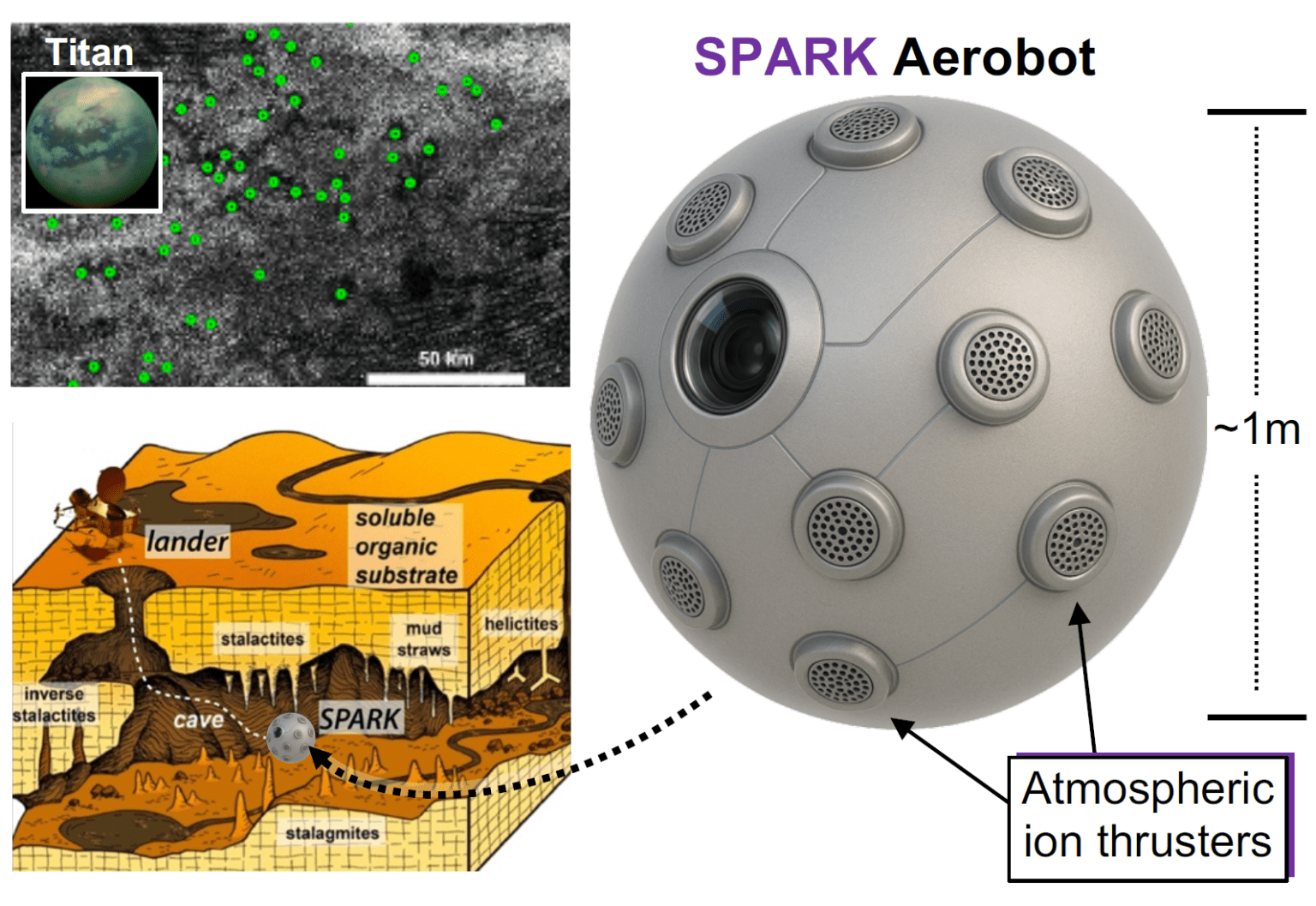
The project is called SPARK or Solid-state Propulsion for Autonomous Reconnaissance of Karst. Led by Daniel Drew, an assistant professor at the University of Hawaii at Mānoa, SPARK uses electrohydrodynamic (EHD) propulsion, commonly known as atmospheric ion thrusters
As EHD thrusters are solid-state and silent, the tech offers omnidirectional maneuverability without generating heavy downwash that could disturb delicate surface layers.
Its surface is carved with liquid methane lakes and “karst” terrain, a landscape full of sinkholes, underground channels, and frozen caves.
Ion-powered flying drones
To explore the hydrocarbon-carved caves and sinkholes of moon Titan, NASA has awarded an early-stage NASA Innovative Advanced Concepts (NIAC) grant to the SPARK project.
SPARK will develop small, flying aerobots capable of navigating terrain that regular land rovers cannot traverse.
Despite uncertainty around when the SPARK aerobots might fly relative to future Titan mission timelines, project lead Drew is confident in the potential of EDH.
Inspired by hobbyist high-voltage “lifters” during his time at UC Berkeley, Drew adapted EHD propulsion to pioneer centimeter-scale “ionocraft” and micro-hovercraft capable of carrying payloads.
Although he considers himself one of the few researchers pushing this niche field forward, but the hope is that SPARK will eventually serve as a groundbreaking cave-exploration scout on Titan, much like the Ingenuity helicopter did on Mars.
These thrusters offer long endurance, maneuverability, and cold resistance without disturbing delicate surface layers.
Earth’s atmosphere makes ion propulsion inefficient for practical daily flight. It consumes too much power for too little lift.
As per NASA, EHD thrusters are projected to be over 100 times more power-efficient on Titan than on Earth, offering double the relative efficiency gains seen by traditional rotorcraft.
“In favorable atmospheric conditions like those on Titan, however, we expect power savings of over 100x, at least twice the benefit received by rotorcraft,” the agency noted.
Titan‘s unique atmosphere makes it easier to create the electric charges needed for flight; hence, the aerobots might be able to use much lighter power converters. On top of that, their solid-state thrusters have no moving parts to freeze or jam, eliminating the heavy heating equipment traditional mechanical propellers would need to survive Titan’s extreme cold.
Racing the mission clock
The immediate question is when SPARK might actually fly.
NASA’s premier Titan mission, the Dragonfly rotorcraft lander, is targeted for launch in 2028. SPARK is currently at the very beginning of a nine-month feasibility study. It must pass through a two-year Phase 2 evaluation before a flight-ready mission becomes realistic. Though potential mission delays could still open up opportunities for these innovative flyers to tag along.
In the Phase-1, the team will run feasibility experiments, model EHD performance in Titan-like conditions, explore tethered-power balloon station-keeping, and perform engineering trade studies to define a prototype design for Phase II.
For now, Drew and his collaborators at NASA’s Jet Propulsion Laboratory and the Blue Marble Space Institute of Science are focusing on computer modeling and thermal testing. They aim to prove that high-voltage ionic wind can conquer alien worlds.