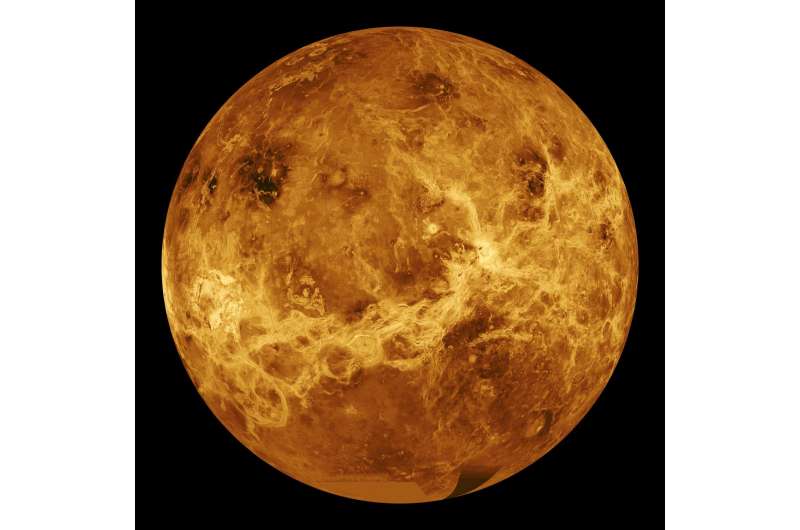
Venus appears pale yellow in visible light, but ultraviolet images reveal dramatic dark and bright patterns moving with the planet’s upper sulfuric acid clouds. Scientists have known about these markings for roughly a century, yet the chemical identity of the material responsible—the “unknown absorber”—remains unresolved.
An international research team has now placed new quantitative constraints on the properties of this mysterious absorber. By combining observations of Venus with radiative-transfer modeling, the researchers estimated how strongly the liquid inside Venus’s cloud droplets would need to absorb light to reproduce the planet’s observed ultraviolet and blue reflectance.
The study, published in Astrobiology, approached the mystery from a new perspective. It used a model to answer a question posed by lead author Dr. Jan Spacek: “If we were to collect Venus’s cloud droplets into a spectrometric cuvette, how would the re-formed bulk liquid appear?”

From bright clouds to dark liquid
The difference between how a cloud looks and how its material looks when collected in bulk can be striking. Cigarette smoke, for example, appears white because its submicrometer particles scatter light very efficiently. Yet when the smoke particles are collected in a flask, they form a dense suspension of burned tobacco—a tar-like sludge.
A similar optical principle applies to Venus’s clouds, as their particle size distribution is comparable to that of cigarette smoke. Thus, even though the clouds appear pale yellow to a remote observer, the liquid forming the cloud droplets might be surprisingly dark.
“Our model effectively asks what would happen if we could collect that cloud material into a cuvette and put it into a laboratory spectrometer,” said lead author Spacek of the Foundation for Applied Molecular Evolution, U.S. “This is important, as light absorption in a bulk liquid may be correlated with the concentration of light-absorbing material in the solution.”
The researchers combined observations of Venus with a radiative-transfer model that accounts for multiple scattering by cloud droplets and atmospheric molecules. They translated the astronomical observations into a quantity routinely measured in laboratory UV-visible spectroscopy: the absorption coefficient of the bulk cloud liquid.
“The key is that Venus’s cloud particles scatter sunlight very efficiently, so the brightness observed from space cannot be directly compared with the absorption of a bulk liquid measured in the laboratory,” said Dr. Lee Yeon Joo of the Planetary Atmospheres Group within the Institute for Basic Science (IBS), South Korea, who performed the radiative-transfer model calculations in the study.
“By accounting for the scattering and absorption by the cloud particles and atmosphere, the model allows us to estimate how strongly the liquid of cloud droplets itself must absorb light.”
A demanding absorption threshold
Within the modeled 365–455 nm range, the required decadic absorption coefficient reaches approximately 1,278 cm-1 at 375 nm. The result implies that the unknown absorber must either absorb light very efficiently, occur at a very high concentration or both.
Highly absorbing conjugated organic molecules could satisfy this requirement. Here, “organic” refers to carbon-based compounds and does not imply a biological origin. Molecules with light-absorption strengths characteristic of efficient porphyrinoid pigments would require concentrations on the order of 10 grams per liter.
The authors stress that they are not proposing chlorophyll, heme or any specific biological pigment as the Venus absorber; these compounds serve only as familiar examples of efficient light absorbers.
The shape of the spectrum provides another important constraint. Simple organics exposed to concentrated sulfuric acid can form dark, chemically complex “tar-like” mixtures. However, such complex mixtures tend to absorb broadly across the visible spectrum, appearing brown or black. That does not match the steep decrease in absorption inferred for Venus between 365 and 455 nm.
“If the observed light absorption is due to conjugated organic matter, the relatively sharp absorption profile is consistent with a chemically defined absorber that resists conversion into the tar-like mixture we typically observe with organics dissolved in concentrated sulfuric acid,” Spacek said.
“Paradoxically, by placing additional constraints on the unknown absorber, we might have made the mystery even more intriguing,” said Janusz J. Petkowski of Wroclaw University of Science and Technology, Poland.
“The model places a demanding constraint on any proposed absorber,” said Paul B. Rimmer of the University of Cambridge, U.K. “Many of the proposed inorganic candidates would need to be present at very high concentrations to match the required absorption.”
Tests for future Venus missions
The findings do not show that life exists in Venus’s clouds, nor do they demonstrate that the absorber is organic. Instead, the study establishes quantitative requirements that any candidate—organic or inorganic—must satisfy, including absorption efficiency, concentration, atmospheric distribution and compatibility with a realistic cloud-particle size distribution.
These constraints can now be tested experimentally and, ultimately, by direct exploration. The Morning Star Missions to Venus initiative is developing in situ approaches to investigate Venusian cloud chemistry, including searches for complex organic molecules and measurements relevant to the unknown absorber.
The Autofluorescence Nephelometer, designed to search Venus’s cloud particles for fluorescence that is expected to be associated with organic molecules, is planned for a Rocket Lab mission to Venus.
Publication details
Jan Spacek et al, A Model of UV–Blue Absorbance in Bulk Liquid of Venusian Cloud Aerosols Is Consistent with Efficient Organic Absorbers at High Concentrations, Astrobiology (2026). DOI: 10.1177/15311074261477502
Provided by
Institute for Basic Science


Citation:
Venus’s mysterious clouds may hide an exceptionally strong light absorber (2026, August 27)
retrieved 27 August 2026
from https://phys.org/news/2026-08-venus-mysterious-clouds-exceptionally-strong.html
This document is subject to copyright. Apart from any fair dealing for the purpose of private study or research, no
part may be reproduced without the written permission. The content is provided for information purposes only.