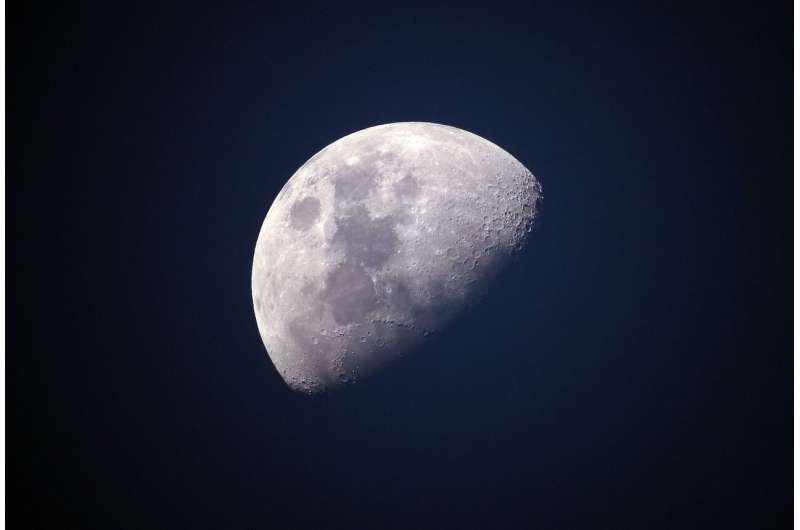
The discovery of water in dark craters at the moon’s poles has sparked a “moon rush” to establish bases there, followed by villages, cities and heavy industry. How sustainable is this rush?
Soon after the moon was formed, asteroids bombarded it, creating its pockmarked topography. Near the moon’s poles, there are dozens of crater floors that have not seen direct sunlight in about 4 billion years. Many of these cryogenically cold “pits of eternal darkness” are below a temperature of 110K, forming “cold traps” in which water ice won’t sublimate away by more than a millimeter in a billion years, even in the vacuum at the moon’s surface. And there is water to freeze: Some of those asteroids brought it along with them.
Since 2013, we have known that water is still there, possibly as much as 1 billion tons (910 million tonnes), thanks to a succession of moon-orbiting missions that have mapped likely locations in increasing detail.
The presence of water at the lunar poles changes everything about human visits to the moon. Suddenly, it is practical to envision a “moon village” where people could survive without importing every last bit from Earth. They could grow their own food and have showers and functional toilets, unlike the astronauts on the International Space Station (ISS). This possibility has sparked ambitions from people like Jeff Bezos to move heavy industry to the moon and Elon Musk’s ambition to have “self-growing cities” there. These are enticing visions, but are they attainable?
The study is published in Frontiers in Space Technologies.
The good news
We realized that we could make a first feasibility estimate simply by looking at how much power and water a large population would use on the moon, and how long a city of 100,000 or 1 million people could survive there. How sustainable is a city on the moon?
The good news is that power, even without nuclear reactors, is not a problem. That’s because the rims of the craters containing the pits of eternal darkness are in almost permanent sunlight. (That’s why they are sometimes, slightly incorrectly, referred to as the “peaks of eternal light.”)
Up on those highly illuminated rims, it would be possible to generate 3 gigawatts of electricity using kilometer-tall towers covered with photovoltaic arrays. It should be possible to manufacture solar panels on the moon. There’s certainly plenty of silicon. This could even make AI data centers on the moon possible by placing them near these sunny peaks. That would be the start of a true lunar economy.
The bad news
The bad news is that, even assuming a generous 1 billion tons (910 million tonnes) of water to start with, without recycling, the answer to our question of sustainability is that the city would last only a few years. Even in the best-case scenario, with 98% efficient recycling of water—the same as achieved on the ISS—a city of 1 million people will run out of water in just over a century.
That is a problem for sustainable moon settlement. And today’s best estimates of the amount of water on the moon are about 30 times less than 1 billion tons, shortening the time to water exhaustion by the same factor. This means that even a small city would run dry after just a decade or so. A moon village with 1,000 people, or even a town with 10,000 people, would instead be sustainable for several centuries or more.
There are potential solutions. We could improve the efficiency of water recycling by a factor of five or more; reduce water use through new techniques such as vertical farming; import water, probably from accessible asteroids; or simply find more water.
Of these, it may be this last hope that is most promising. Current water-surveying techniques do not reach more than a few meters below the surface, while the rubble-like rocks of the surface regolith typically extend tens of meters down and may contain water in the cold traps. If the ambitious plans of the space billionaires are to be realized, finding more water will be the first step.
More information
No Cities on the Moon: a Billion Tons of Water is not enough for Sustainability, Frontiers in Space Technologies (2026). DOI: 10.3389/frspt.2026.1894104
Key concepts


Citation:
No cities on the moon—there isn’t enough water, scientists say (2026, September 14)
retrieved 14 September 2026
from https://phys.org/news/2026-09-cities-moon-isnt-scientists.html
This document is subject to copyright. Apart from any fair dealing for the purpose of private study or research, no
part may be reproduced without the written permission. The content is provided for information purposes only.