What are the chances of finding extraterrestrial life in our solar system? Frank Postberg, a professor of planetary science at Freie Universität Berlin, has published a study in Science Advances with an international team of researchers. They present new evidence that it is easier to determine the constituents of the ocean hidden beneath Enceladus’s icy surface than previously assumed.
Postberg also contributed to a second study published the same day. In that study, he and another planetary scientist from Freie Universität, Dr. Nozair Khawaja, helped show that certain microorganisms could tolerate the conditions in Enceladus’s ocean better than previously thought. The results increase the likelihood of finding evidence of life on Saturn’s moon.
What makes Enceladus so attractive in the search for life in space?
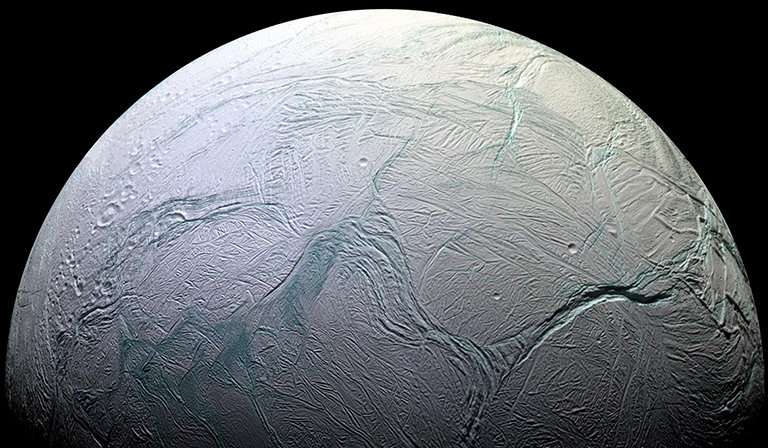
Enceladus is considered one of the most promising places to search for extraterrestrial life in our solar system. Researchers suspect that a global ocean of liquid water lies beneath the moon’s icy crust, with a rocky core farther below. Due to cryovolcanic activity, gigantic plumes break through cracks in the crust at the moon’s south pole, ejecting ice particles hundreds of kilometers into space.
NASA’s Cassini spacecraft passed through these plumes multiple times to analyze their composition. Enceladus’s ocean is the only extraterrestrial “body of water” from which scientists have been able to directly analyze samples. The samples revealed traces of various salts and organic compounds. Previous analyses by Cassini also indicated hydrothermal processes on the seafloor and other conditions that could support life.
Enceladus ice plumes separate and sort the ocean’s components
Postberg’s study, “Cassini CDA Observes Compositional Segregation of Enceladus’ Ice Grains from Slow Freezing and Fragmentation of Oceanic Spray,” includes surprising findings about what happens to the ocean water on its way into space. The international team used Cassini data, long-term laboratory experiments and theoretical models to reconstruct the process.
Droplets form at the ocean’s surface as gas-filled bubbles rise and pop. Water vapor then carries the droplets through cracks in the ice shell and out into space. Scientists previously believed the droplets froze instantaneously. The new findings reveal that they freeze slowly, allowing most components (including dissolved ones) to separate from each other. Salts and organic materials are thus distributed in different locations inside each freezing droplet. Various types of previously dissolved salts also separate; for example, sodium chloride (table salt) separates from sodium carbonate.
On their way up, the frozen droplets accelerate to speeds of up to 1,000 km/h (620 miles per hour). If they hit the walls of the icy cracks, they break into fragments only a few micrometers in size before shooting into space. As a result, ice particles often consist of just one highly concentrated, previously segregated substance.
“Enceladus actually does a lot of the work for us in preparing samples for analysis that usually take a lot of effort in chemical labs on Earth,” says Postberg, who led the study. “The oceanic constituents are separated from each other and simultaneously concentrated into individual ice particles.”
Making it easier to find signs of life
This mechanism helps researchers characterize the ocean as a potential habitat for life. It is also particularly useful in the search for biosignatures, or measurable indications of life. If an ocean droplet contained components from alien microbes, those components could separate from others as the droplet froze. After fragmentation, the microbial material might be found in only a small fraction of ice particles. In those particles, however, it would be highly concentrated and relatively pure.
“That is great news in the search for life,” says Postberg. “Future spacecraft will have to analyze many individual ice particles in the plume. But if they come across one with microbial material in it, they could identify biosignatures in the particle relatively easily with already available technology.”
The discovery could have important implications for future space missions to Enceladus, such as the ESA’s L4 mission, which is being planned. The mission will specifically look for signs of life on Saturn’s moon. Postberg’s lab at Freie Universität Berlin has previously conducted laboratory studies demonstrating that specialized instruments can detect microbial cellular material in individual particles from the ice plumes.
Could life really exist on Enceladus?
A recent study offers new insight into this question. On the same day Postberg’s article appeared in Science Advances, scientists at Ludwig-Maximilians-Universität München (LMU) published another article in the journal: “Enceladus-Like Geochemistry Fuels Methanogenesis under Extreme CO₂-Limitation.” Postberg and Khawaja contributed to the study.
The scientists reproduced the conditions of Enceladus’s ocean in a laboratory. The ocean has a very low concentration of oxygen, a very high concentration of carbonate and is very alkaline (with pH values of 10 or 11). After recreating these conditions, including the ocean’s hydrothermal interaction with its rocky floor, they introduced Methanothermococcus okinawensis into the simulated environment.
This microorganism is a methane-producing archaean that normally lives near deep-sea hydrothermal vents on Earth. It does not need oxygen, which is rare on Enceladus, to survive. Its metabolism requires only hydrogen and carbon dioxide.
The results were surprising: The organism failed to grow in an optimal laboratory medium at such a high pH because it lacked dissolved carbon dioxide. By contrast, it continued to grow in the Enceladus simulant, producing methane using hydrogen generated by water-rock reactions. Under the simulated conditions, the microorganisms were even able to adapt their metabolism to the low amounts of carbon dioxide. “This was really a surprise to us,” Khawaja said. “This was an experiment for which we did not expect such a successful outcome.”
Taken together, the two studies in Science Advances shed new light on the search for extraterrestrial life. “On Enceladus the specific geochemical conditions might allow one of the oldest known metabolic systems on Earth to work, even in very alkaline environments,” Postberg says. “While that doesn’t mean that there is life on Saturn’s moon, our first study shows that—in the event that there is—future space missions might have a good chance of finding traces if they analyze individual ice grains from Enceladus’s plume.”
Publication details
Frank Postberg, Cassini CDA observes compositional segregation of Enceladus’ ice grains from slow freezing and fragmentation of oceanic spray, Science Advances (2026). DOI: 10.1126/sciadv.aee7256. www.science.org/doi/10.1126/sciadv.aee7256
Vanessa Helmbrecht et al, Enceladus-like geochemistry fuels methanogenesis under extreme CO2 limitation, Science Advances (2026). DOI: 10.1126/sciadv.aei0167. www.science.org/doi/10.1126/sciadv.aei0167
Provided by
Free University of Berlin


Citation:
Great news from Saturn’s moon Enceladus in the search for life in space (2026, September 25)
retrieved 25 September 2026
from https://phys.org/news/2026-09-great-news-saturn-moon-enceladus.html
This document is subject to copyright. Apart from any fair dealing for the purpose of private study or research, no
part may be reproduced without the written permission. The content is provided for information purposes only.