Last week, Omdia reported that India’s smartphone shipments dropped 26% in Q3 to their lowest level since 2016. Now Counterpoint Research has published its own numbers, and while they’re a bit less dire, they paint the same picture. Shipments apparently fell 20% year-on-year in July-September, to their lowest level in a decade. Unsurprisingly, record-high memory prices are to blame, since they drove up device costs. With demand staying soft, brands also kept less stock in stores, even ahead of the festive season.
The cheaper end of the market took the hardest hit. Shipments of phones under INR 20,000 ($210) declined by 47%, as rising prices pushed models into higher price bands. Counterpoint says the pressure was especially strong below INR 15,000 ($158), with consumers holding on to their phones for longer and putting off upgrades.
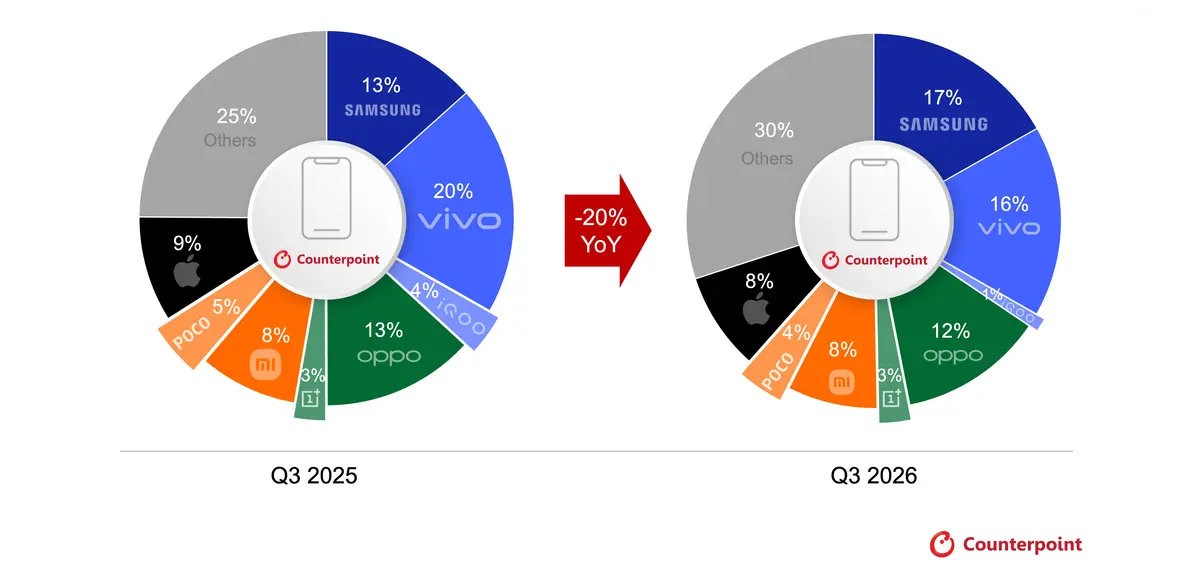
Samsung reclaimed the top spot after nine quarters with a 17% share, thanks to its Galaxy A series and relatively measured price hikes. vivo (excluding iQOO) was a close second with 16%. Oppo came in third with 12%, driven by triple-digit growth above INR 20,000 ($210). Xiaomi (including Poco) was fourth, also with 12%, and it was the top brand in the INR 10,001-20,000 ($105-$210) band. Meanwhile, the iPhone 18 Pro series got off to a strong start, with initial sales nearly 20% higher than those of the iPhone 17 Pro family.
Ai+ Smartphone was the fastest-growing brand, with shipments up 306%, and Indian brands as a whole went from a 2% share to 7%. itel grew 88%, and Google was up over 50%, helped by the Pixel 11 devices. On the chipset side, MediaTek stayed on top with a 45% share, while Unisoc saw a resurgence as brands focused on making more profit in the lower price segments.
Looking ahead, Counterpoint expects India’s smartphone market to shrink by around 13% in 2026, with another round of price hikes likely after the festive season sale. Brands are already reacting by launching more 4G and lower-spec models in the mass market, and the firm thinks 2027 will be challenging as well. So if you were hoping for prices to come back down soon, definitely don’t hold your breath.