One Wi-Fi HaLow access point can connect up to 8,191 sensors, but connectivity is only half the congestion problem. Edge AI addresses the other half: what gets sent.
In modern factories, warehouses, and processing plants, the number of connected devices is growing at a rapid pace. Facilities now use thousands of smart sensors to monitor equipment health, track inventory, measure temperatures, and keep automated production lines running smoothly.
However, the sheer number of devices that need to be connected creates a serious problem: network congestion. If thousands of sensors try to transmit at the same time over a standard wireless link, the result is long delays, packet loss, and rapid battery drain.

The increasing proliferation of connected industrial network devices can create severe network congestion. Image used courtesy of Adobe Stock.
To address this issue, industry is taking a two-pronged approach. Wi-Fi HaLow provides reliable, long-range wireless communication, while edge AI processes data on the sensor itself before anything is sent over the network.
The Bottleneck: Why Standard Networks Struggle in Factories
Most wireless devices in everyday life rely on standard Wi-Fi, Bluetooth, or cellular networks. These technologies work well at home or in an office, but industrial environments present four distinct obstacles.
The first is physical. Industrial facilities are filled with thick concrete walls, heavy steel machinery, and high metal storage racks. Standard Wi-Fi signals, which operate on 2.4 GHz and 5 GHz frequencies, struggle to pass through these barriers. As a result, companies have to install dozens of access points, which increases equipment costs and wiring complexity.
The second is scale. Traditional Wi-Fi routers are typically designed to support a few dozen or a couple of hundred devices at once. When a plant tries to connect 5,000 to 10,000 sensors, standard access points quickly become overloaded. Devices end up competing for the same wireless channel, which leads to continuous data collisions and delays.
The third is data overload. Many traditional systems stream raw data continuously from every machine directly to a central cloud server. Sending that much raw sensor data 24/7 wastes internet bandwidth, drives up cloud storage costs, and clogs the local network.
The fourth is battery life. Standard Wi-Fi requires frequent active communication with the router, so battery-powered sensors consume power rapidly. Replacing batteries across thousands of remote sensors spread over a large industrial site requires significant time and maintenance expense.
Understanding Wi-Fi HaLow: Built for Industrial Scale
To overcome the physical limits of traditional Wi-Fi, the Wi-Fi Alliance introduced an industrial-friendly standard known as Wi-Fi HaLow (IEEE 802.11ah). Instead of using crowded, higher-frequency bands, Wi-Fi HaLow operates in the sub-1 GHz frequency range. This lower frequency gives it distinct operational advantages.
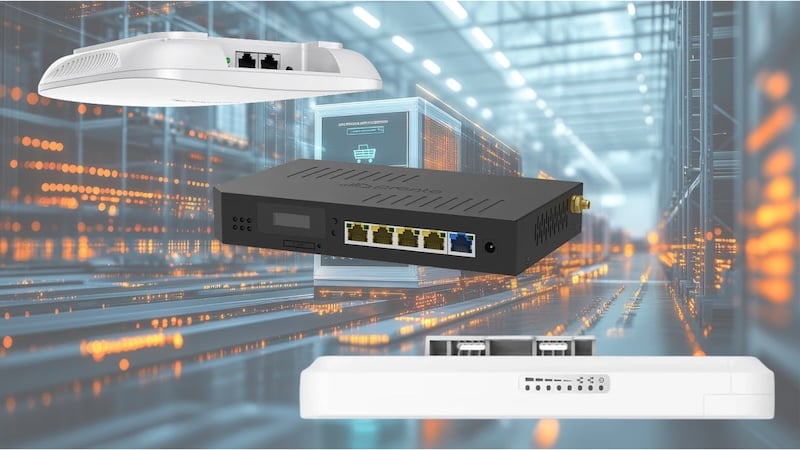
Indoor access points, edge AI routers, and cloud controllers enable Wi-Fi HaLow in industrial settings. Product images used courtesy of Pronto Networks; background image used courtesy of Adobe Stock.
The first is range. Sub-GHz signals travel significantly farther and pass easily through solid walls, metal shelving, and industrial equipment. A single Wi-Fi HaLow access point can cover up to 1 kilometer in open space, reaching across expansive factory floors where standard Wi-Fi would fail.
The second is capacity. Standard Wi-Fi networks can manage only a limited number of active connections per router, but a single Wi-Fi HaLow access point can natively connect up to 8,191 devices. A massive warehouse or entire plant floor can therefore run from a handful of access points rather than dozens of separate hubs.
Wi-Fi HaLow also organizes how devices share the channel. Built-in scheduling methods group devices and assign each one a specific transmission window. Rather than thousands of sensors talking over each other at once, each device waits for its turn, which virtually eliminates packet collisions and keeps data flow smooth and predictable.
Finally, advanced power-saving sleep modes extend battery life. Battery-powered sensors can remain asleep for hours, days, or even weeks at a time without losing connection to the network. They wake up only when scheduled to transmit data or when an issue is detected, which allows sensors to run on small batteries for years.
The Role of Edge AI: Processing Data at the Source
While Wi-Fi HaLow fixes the wireless connection problem, it is equally important to manage how much data travels through the air. This is where edge AI comes into play.
In conventional setups, sensors are “passive.” They simply measure values and send all the raw readings to a central server or cloud platform for analysis. With edge AI, small, power-efficient microchips are built directly inside the sensor node. These chips run compact artificial intelligence models right where the physical action is happening.
Instead of sending constant, unchanging data, the sensor analyzes the information locally. An edge AI sensor on an industrial pump, for example, can continuously check vibration and sound patterns. It knows what normal operation looks like, so if everything is running smoothly, it remains silent and does not transmit unnecessary data.
The sensor wakes the wireless radio only when it spots an unusual pattern, such as early bearing wear, excess heat, or a pressure drop. It then sends a concise alert describing the exact issue. Filtering and analyzing data locally in this way can eliminate more than 90% of unnecessary network traffic, which frees up wireless capacity for critical alerts and prevents industrial networks from slowing down.
How Wi-Fi HaLow and Edge AI Work Together
When combined, Wi-Fi HaLow and edge AI complement each other to create an efficient, scalable industrial IoT ecosystem.
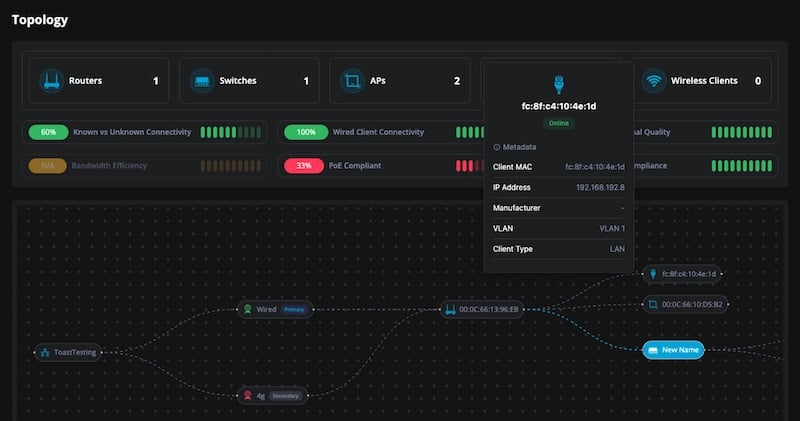
Edge AI and Wi-Fi HaLow connectivity can complement each other to create efficient, scalable industrial IoT systems. Image used courtesy of Pronto Networks.
A typical fault unfolds in four steps:
- Sensors monitor silently. Thousands of battery-powered sensors track machinery without flooding the airwaves with redundant readings.
- AI spots faults instantly. As soon as an irregularity occurs, the internal edge AI model identifies it within milliseconds.
- HaLow sends the message reliably. The sensor powers up its sub-GHz radio and sends a compact alert directly through walls and past machinery to the main access point.
- Maintenance teams act. Plant operators receive timely warnings before machines break down, avoiding costly unplanned downtime.
Practical Steps for Plant Managers and Engineers
Adopting this architecture does not require overhauling an entire facility overnight. Teams can take practical steps to plan an effective deployment.
A good starting point is to review existing plant networks to see where connectivity frequently drops or where high sensor density causes delays. Next, determine where local intelligence makes sense. High-frequency monitoring, such as vibration analysis on rotating motors or continuous acoustic checks, gains the most benefit from edge AI filtering. Simple metrics like ambient tank levels or periodic ambient temperature can transmit lightweight data at scheduled intervals.
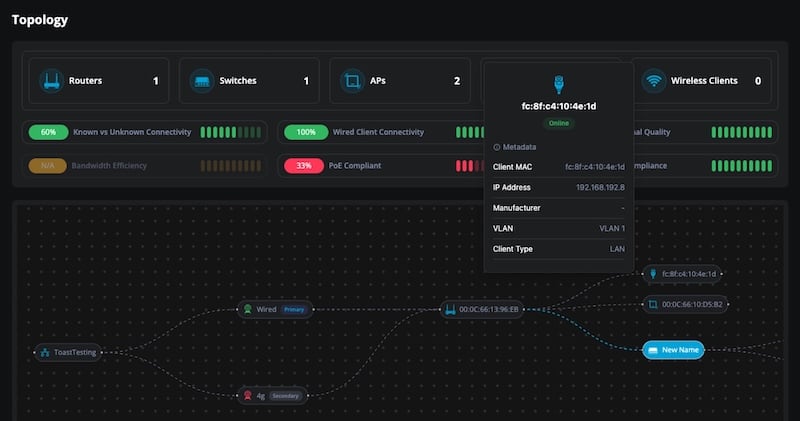
A network topology view like this one helps teams spot where connectivity drops and where dense sensor clusters cause delays. Image used courtesy of Pronto Networks.
Teams should also test sub-1 GHz Wi-Fi HaLow equipment across the plant floor to determine baseline signal penetration around heavy metal structures. Good coverage can eliminate unnecessary repeaters and complex mesh wiring. Finally, prioritize open, standard protocols. Solutions that support standard IP communication (IPv4/IPv6) let new sensors integrate easily with existing SCADA, PLC, and factory software systems without proprietary translation boxes.
Pairing Wi-Fi HaLow’s long-range, high-density reach with the localized intelligence of edge AI lets industrial facilities eliminate network bottlenecks. It also reduces maintenance costs and allows IoT deployments to scale with confidence.