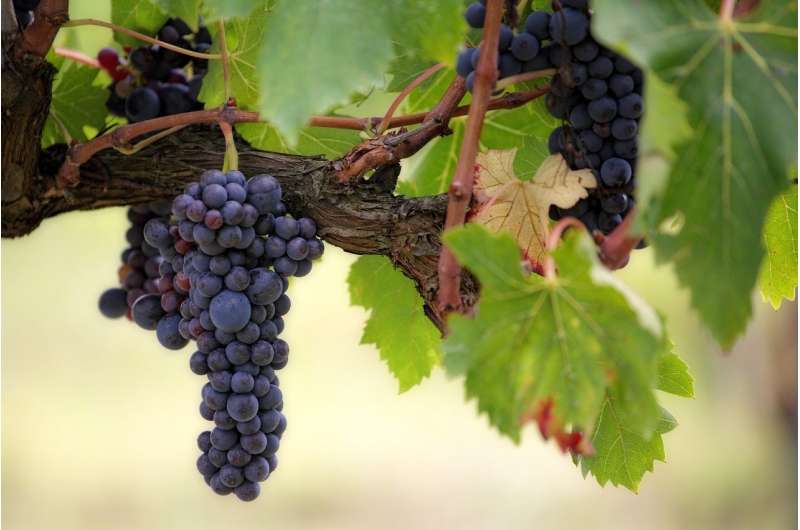
The U.S. is the fourth-largest wine-producing country by output volume, and approximately 80% of its production occurs in California. Ever since the 19th century, California’s premier wine-growing regions have been the Napa Valley and Sonoma County, thanks to their favorable microclimate. But grape yield and quality are very sensitive to the local environment, which means the climate crisis could shake up California’s wine industry.
Now, a study appearing in Frontiers in Climate shows that established regions including Napa and Sonoma could struggle to sustain their wine production under severe climate change. Others, like northern and coastal California, could become new wine-growing powerhouses.
“Our findings reveal that the outlook for Mendocino and Monterey is uniquely promising because of a dual trend: They are projected to experience both increasing climatic suitability for wine-growing and a decrease in extreme fire-weather days,” said Dr. Yusuke Hiraga, an assistant professor at Tohoku University in Sendai, Japan, and corresponding author of the study. “This combination makes these areas stand out as comparatively favorable expansion zones, distinct from many other regions with either rising suitability alongside increased wildfire weather or declining suitability.”
Wildfires and global warming
Together with Takuya Matsumoto, a master’s student at Tohoku University, Hiraga modeled California’s current and future climatic suitability for wine grape cultivation. They focused on 379 wine-growing locations listed by the California Wine Institute, predominantly in the North Coast region and across the Central Coast.
To forecast climate change, the authors mapped projections from global climate models onto a 4-kilometer-by-4-kilometer (2.5-mile-by-2.5-mile) grid across the mainland U.S. They considered two alternative carbon emission scenarios from the Intergovernmental Panel on Climate Change: RCP4.5, which assumes that mitigation policies are gradually implemented, and the “worst-case scenario” RCP8.5.
For each scenario, they modeled three periods: 1976–2005 (“baseline”), 2040–2069 (“mid-century”) and 2070–2099 (“late century”). Each grid cell’s suitability for growing grapes and the expected quality of its vintage were predicted by a machine learning algorithm. To capture wine quality, the scientists trained an algorithm on wine ratings by professional tasters, published between 1996 and 2023 in the magazine “Wine Spectator.”
The authors likewise modeled the shifting weather conditions linked to wildfire risk and expected severity within each cell. These were expressed as the Fire Weather Index (FWI), calculated from climatic variables like moisture and wind speed. A higher FWI implies a greater likelihood that accidental ignitions will turn into conflagrations.
In vino veritas
The results showed that the suitability of currently important wine-growing regions, like Napa, Sonoma, San Luis Obispo and Santa Barbara, is likely to decline sharply under severe climate change. In contrast, suitability was predicted to increase greatly in Mendocino, Monterey and in central to southern coastal areas. Suitability was found to depend mostly on yearly total precipitation, cumulative temperature across the growing season between early April and late October, the minimum temperature of the coldest month, and the vapor pressure deficit—the difference between how much moisture the air holds and how much it holds when saturated.
The number of days with extreme wildfire weather conditions tended to increase across large swaths of California, but especially in northern regions and inland high-elevation areas. However, this decreased in large parts of Mendocino and Monterey. Wine-growing suitability tended to be greater under RCP4.5 than under RCP8.5 for the late century, suggesting that higher greenhouse gas emissions could lead to a decline in vintage quality.
“While our study highlights long-term shifts in climatic and fire-weather suitability through the end of the century, it does not attempt to predict a specific timeline for when emerging areas will surpass currently established regions in wine-growing potential,” Hiraga warned. “Such a precise forecast is complex, as the future of viticulture is shaped not only by climate change and wildfire weather but also by a wide array of anthropogenic factors.”
Advice to vintners in currently established, high-profile regions
“The path forward requires active adaptation to both shifting climatic conditions and increasing wildfire risk. Our analysis suggests that proactive strategies—such as careful varietal selection—will be critical, as our models indicate that different grape varieties respond quite differently to extreme fire-weather conditions,” Hiraga said.
More information
Dual pressures of climate change and wildfire hazard on wine-growing potential in California, Frontiers in Climate (2026). DOI: 10.3389/fclim.2026.1838268


Citation:
Global warming, increasing wildfire risk threaten viability of some California winery regions (2026, July 8)
retrieved 8 July 2026
from https://phys.org/news/2026-07-global-wildfire-threaten-viability-california.html
This document is subject to copyright. Apart from any fair dealing for the purpose of private study or research, no
part may be reproduced without the written permission. The content is provided for information purposes only.