I keep at least one of these lightweight little USB-C hubs in my backpack at all times. You should too!
Why you should trust PCWorld for USB-C hub reviews and buying advice: PCWorld has been supplying news, reviews, and recommendations for the best computing products since our first magazines hit newsstand shelves in 1983. We maintain a rigorous testing process, and our reviews are not influenced by advertisers or other considerations. Most of these products were purchased directly by PCWorld reviewers, but in certain cases review units have been provided by the manufacturers.
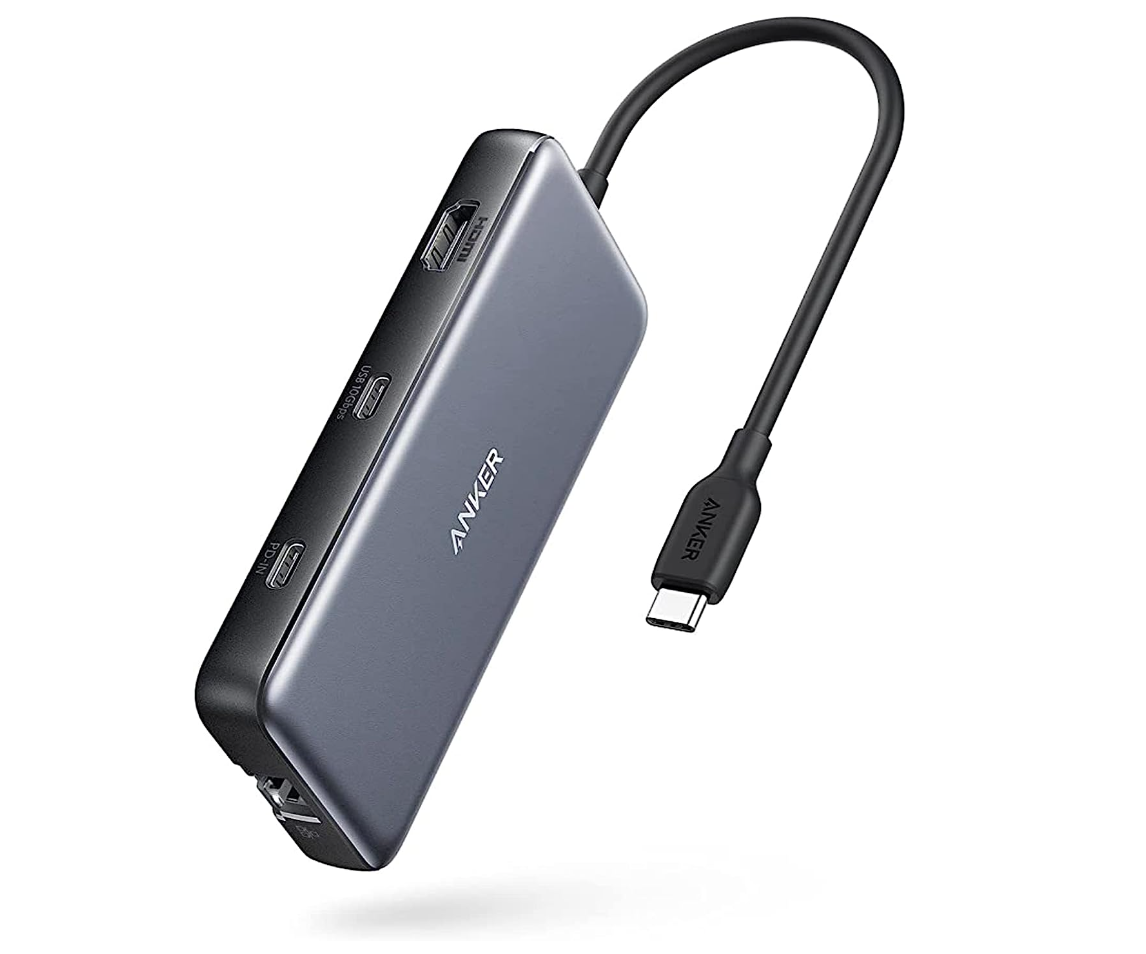
Anker 555 8-in-1 USB-C Hub – Best overall USB-C hub
Pros
- Excellent build quality
- Supplies 85W of power
- Good mix of ports
Price When Reviewed:
$49.99
Who should buy the Anker 555 8-in-1 USB-C Hub?
I’d recommend this USB-C hub to just about anyone. Most users will be able to take advantage of the USB-A ports for legacy mice and keyboards, the HDMI port, a USB-C port, and Ethernet. These are the ports I’d expect on a device like this. If you’re looking for more display ports or more USB-C connections, however, you’ll need to buy a more premium device.
Anker 555 8-in-1 USB-C Hub: Further considerations
Can a USB-C hub feel elegant? This one does. Anker’s 8-in-1 USB-C hub feels surprisingly weighty (4.5 ounces), with a premium metallic (aluminum and polycarbonate) sheen that keeps the hub cool. Overall, Anker’s hub is well designed, with adequate spacing between the two 5Gbps USB-A ports. There’s also a 5Gbps USB-C connection for data, plus a second USB-C port for power input at up to a rated 85W. (The charger allows up to 100W in, but supplies 85W.) There’s both an SD card slot and a microSD card slot, too.
I had previously recommended Anker’s 7-in-1 Hub instead. Both hubs are similar, but this upgrade adds two things: an Ethernet port, and an HDMI port capable of 60Hz. The earlier pick output just 30Hz, and that capability was getting a bit outdated.
The hub offers an 18-month warranty, and it even ships with a carrying pouch. I think this hub includes the right mix of ports for the right price.
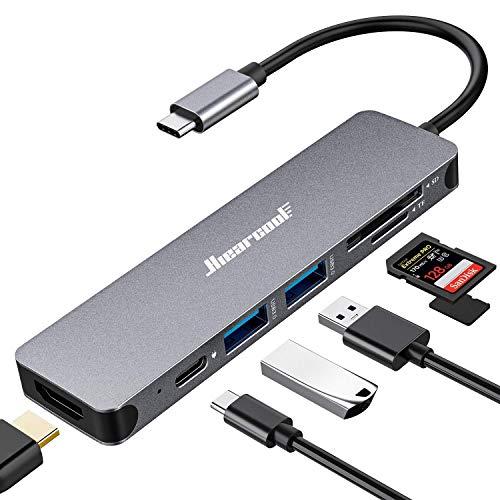
Hiearcool USB-C Hub – Best budget USB-C hub
Pros
- Just the basics
- Solid price
- 100W pass-through charging
Best Prices Today:

44% off original price$19.99
Who should buy the Hiearcool USB-C Hub?
This is a hub for basic expansion, especially if you own an older laptop. It has one HDMI port that’s only capable of 4K resolution at a fatiguing 30Hz. However, it will work just fine for a single external 1080 display or even a 1440p monitor, if you own one. The two USB-A ports are designed for a mouse and keyboard, or a printer. If you need something cheap and capable, this hub will work just fine.
Hiearcool USB-C Hub: Further considerations
Let’s face it: If you’ve ever browsed Amazon’s inventory of USB-C hubs, it’s easy to be overwhelmed. I can tell you that I factor in price heavily on some of these picks, and this is a USB-C hub that I’ve personally used. It works, it offers a myriad of ports, and it does so at a very, very good price. It even ships in multiple colors, which is handy when peering into the depths of a travel bag or briefcase.
This hub includes a pair of USB-A ports, microSD and SD card slots, and an HDMI port, and that’s all. It accepts up to a rated 100W of USB-C input charging, too.
OWC USB-C Travel Dock – Best budget USB-C hub runner-up
Pros
- Compact
- A good mix of ports
Cons
- A little on the slow side
- USB-C cable feels a little short for comfort
Price When Reviewed:
$54.99
Best Prices Today:
Who should buy the OWC USB-C Travel Dock?
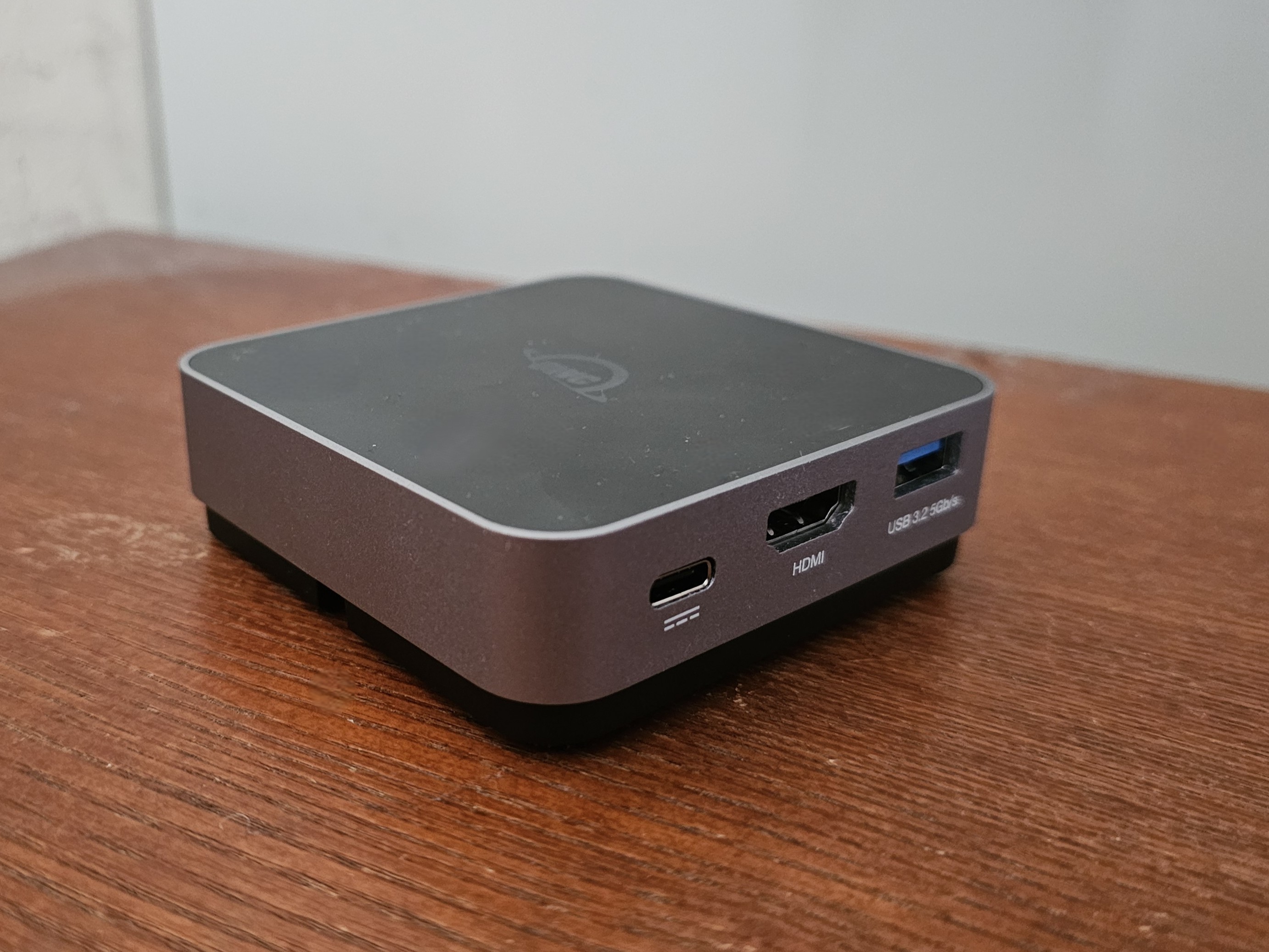
I’ve reviewed USB-C hubs and dongles that forego the traditional long, rectangular “dongle” form factor into something that’s a bit more stable. Dongles do have a tendency to flop all over your desk, and the OWC Travel Dock feels like a cross between a traditional docking station and a dongle. And it’s cheap, too! Dongles are usually reserved as travel gear, and I think this would work well for an executive or someone who likes a tidier desk.
OWC USB-C Travel Dock: Further considerations
The “hidden” USB-C cable is a nice touch, though extended it’s a bit short. This was also a 5-in-1 hub, so while it provides the essentials (two USB-A ports for mouse and keyboard, Ethernet, and HDMI, plus USB-C charging input) there’s not much else. (Editor’s Note: OWC updated this dock with an additional SD card slot, increasing the price slightly.)
Read our full
OWC USB-C Travel Dock review
Monoprice 13-in-1 Dual-HDMI + DP MST Dock – Best premium USB-C hub
Pros
- Multiple display possibilities
- Tons of ports
Cons
- Confusing documentation
- Slow SD card slot
- High-speed ports can get clogged by the main 10Gbps USB-C connection
Best Prices Today:
Who should buy the Monoprice 13-in-1 Dual-HDMI + DP MST Dock?
If you own a modern laptop and want access to a ton of legacy ports for a reasonable price, this Monoprice hub/dock should be your choice. You need to own a modern laptop, though; a Microsoft Surface Book 2 with an 8th-gen Core chip inside didn’t produce any output over its USB-C port; several Samsung and Surface laptops with 12th-gen and 13th-gen Core chips from 2022 onward worked well, though. More recent laptops from 2024 on through 2026 should also work fine.
Monoprice 13-in-1 Dual-HDMI + DP MST Dock: Further considerations
If it looks like a hub or dongle, but is priced like a dock, is it a dock? You might not care, but it’s certainly on the pricey side.
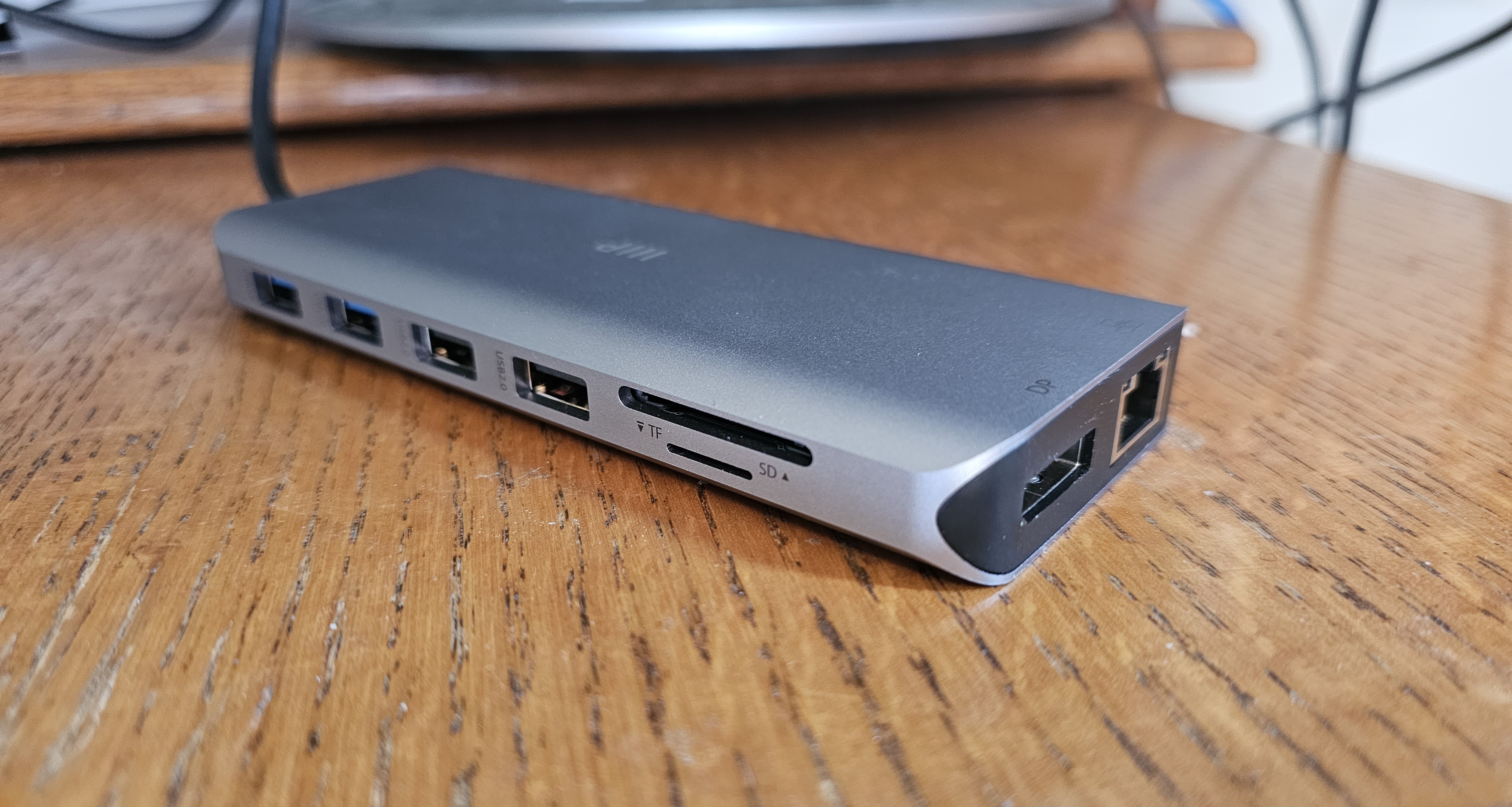
This 13-in-1 USB-C hub does it all, including connecting to two 4K displays (one at 60Hz, one at 30Hz). It does so by using support for built-in compression techniques within modern laptops to squeeze more effective throughput over the 10Gbps USB-C port. There are absolutely gobs of ports, including five USB-A ports (two at 480Mbps for mice and keyboards), two HDMI 1.2 connections, and even a DisplayPort port.
There’s even a power input jack, so you can use your laptop’s charger and feed up to a tested 87W into the laptop. There aren’t any USB-C ports, but the assumption is that you can use your laptop for that.
Read our full
Monoprice 13-in-1 Dual-HDMI + DP MST Dock review
Dockcase Smart USB-C Hub 10-in-1 Explorer Edition – Best premium USB-C hub runner-up
Pros
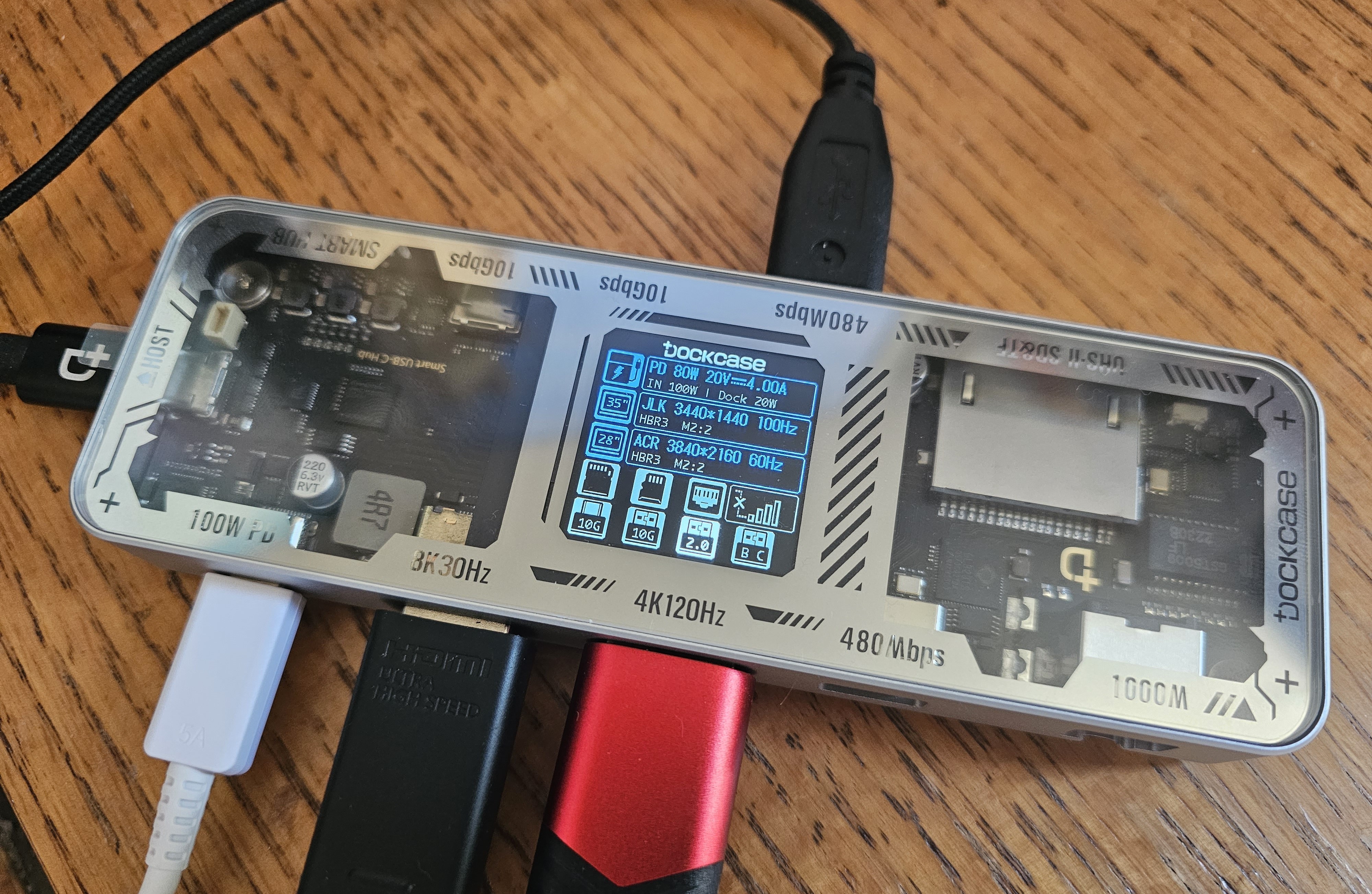
- Detailed, informative LCD display
- Excellent information and controls
- Top-notch performance
Cons
- No manual?!
- Some instability
- More charging power needed
- Demands an up-to-date laptop for best results
Price When Reviewed:
$159.99
Best Prices Today:
43% off original price$89.99
Who should buy the Dockcase Smart USB-C Hub 10-in-1 Explorer Edition?
Nerds. Yep, this is one of the nerdiest products I’ve ever used, and I like and loathe how it just lets you sort of discover what it can do. But it tells you what your laptop is connecting to and how it’s working! It even reports glitches! I love that.
Are you the type of person who owns an OBD scanner to diagnose any issues with your car? If you are, this is the USB-C hub for you.
The Dockcase Smart USB-C Hub 10-in-1 Explorer Edition: Further considerations
Part of me loves the sheer nerdiness of the Dockcase 10-in-1 Dock, if only because I’ve never seen anything like it in terms of the information it offers.
Note that Dockcase offers alternatives: There’s a $69.99 6-in-1 dock, and a newer Dockcase “Visual Smart” 10-in-1 dock that eliminates some of the labeled ports in favor of a jet-black aesthetic. I prefer the nerdier version with lots of ports.
Not only is the metal hub larger than most, with multiple external connectors that designate a premium hub, but there’s an actual display: A small LCD screen provides a detailed look at what devices are connected to each port and what their capabilities are. Put another way, the Dockcase Smart USB-C Hub 10-in-1 feels more like an OBD2 diagnostic device for your car, or a USB multimeter.
As a dock, it’s excellent. As a tool, it can use some improvement: The interface is extremely clunky, and Dockcase really doesn’t even have a manual that explains it all. But this device is also small enough that it fulfills the requirements of a docking station without it being ungainly.
Read our full
Dockcase Smart USB-C Hub 10-in-1 Explorer Edition review
Mokin 160W GaN All in One Docking Station – Best full-sized USB-C docking station
Pros
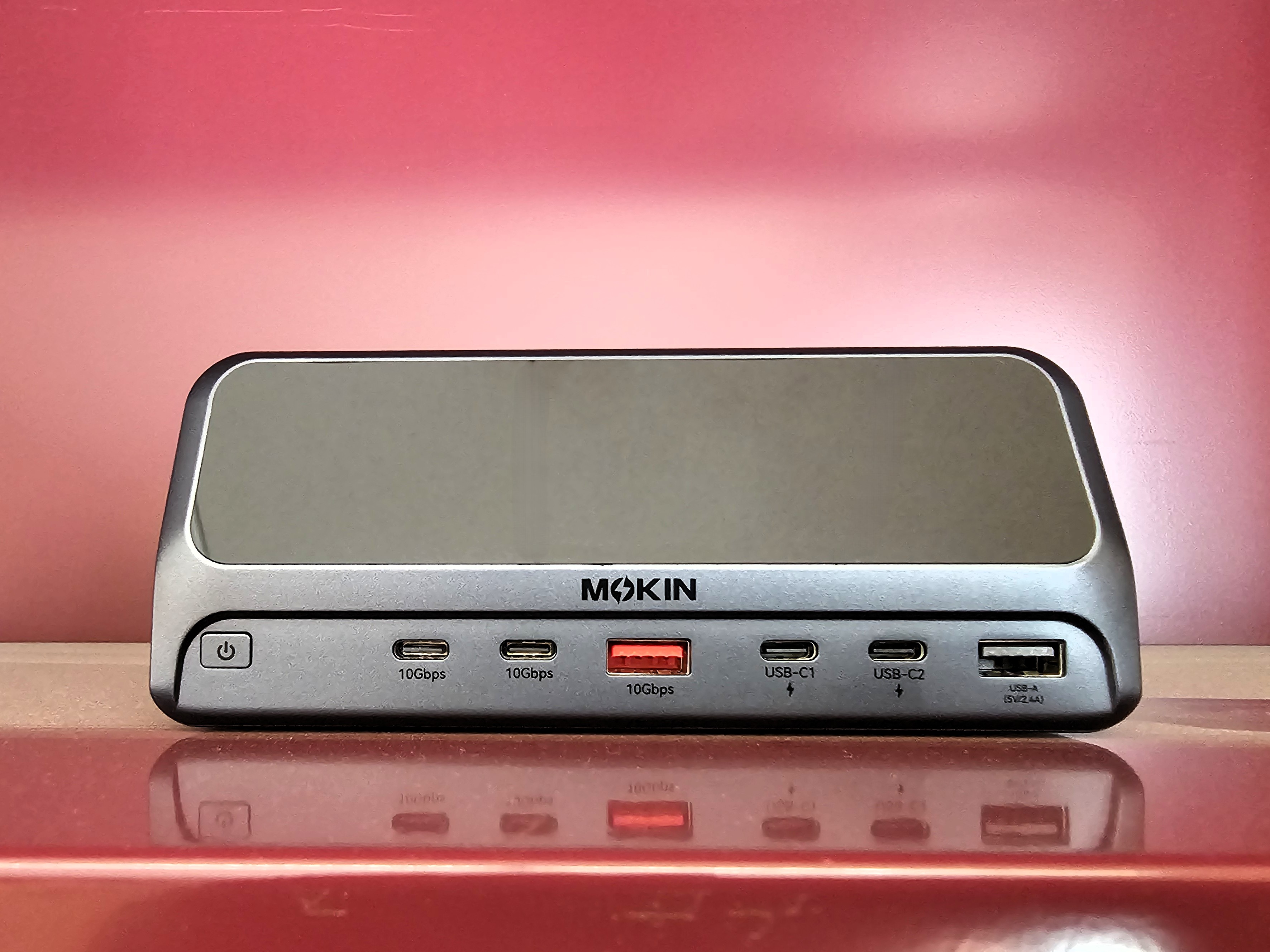
- Informative LCD screen
- Excellent performance
- Nice mix of USB-A, USB-C ports
- Charging power easily exceeds smartphone needs
Cons
- Odd mix of powered and unpowered data-only ports
Price When Reviewed:
$99.99
Best Prices Today:
Who should buy the Mokin 160W GaN All in One Docking Station?
For those of you who want to know what’s going on under the hood of your USB-C docking station, this dock is for you. This dock always reports how much power it’s supplying, but when you insert or detach a monitor cable, it will alert you to what’s going on there, too. This might be a little too much information for some users, but if you’re the type of person who has a CPU widget floating on their desktop, this might be the dock for you.
Mokin 160W GaN All in One Docking Station: Further considerations
The split between data-only and charging ports is a little weird, especially if you’re using a mouse, keyboard, and webcam — and that extra USB-A port just isn’t available. (Really, who needs a power-only USB-A port?) But this dock pretty much nails your basic needs, offers a compact form factor, and is priced right, too.
Read our full
Mokin 160W GaN All in One Docking Station review
Ugreen 9-in-1 USB-C (Revodok) Docking Station CM615 – Best full-sized USB-C DisplayLink dock
Pros
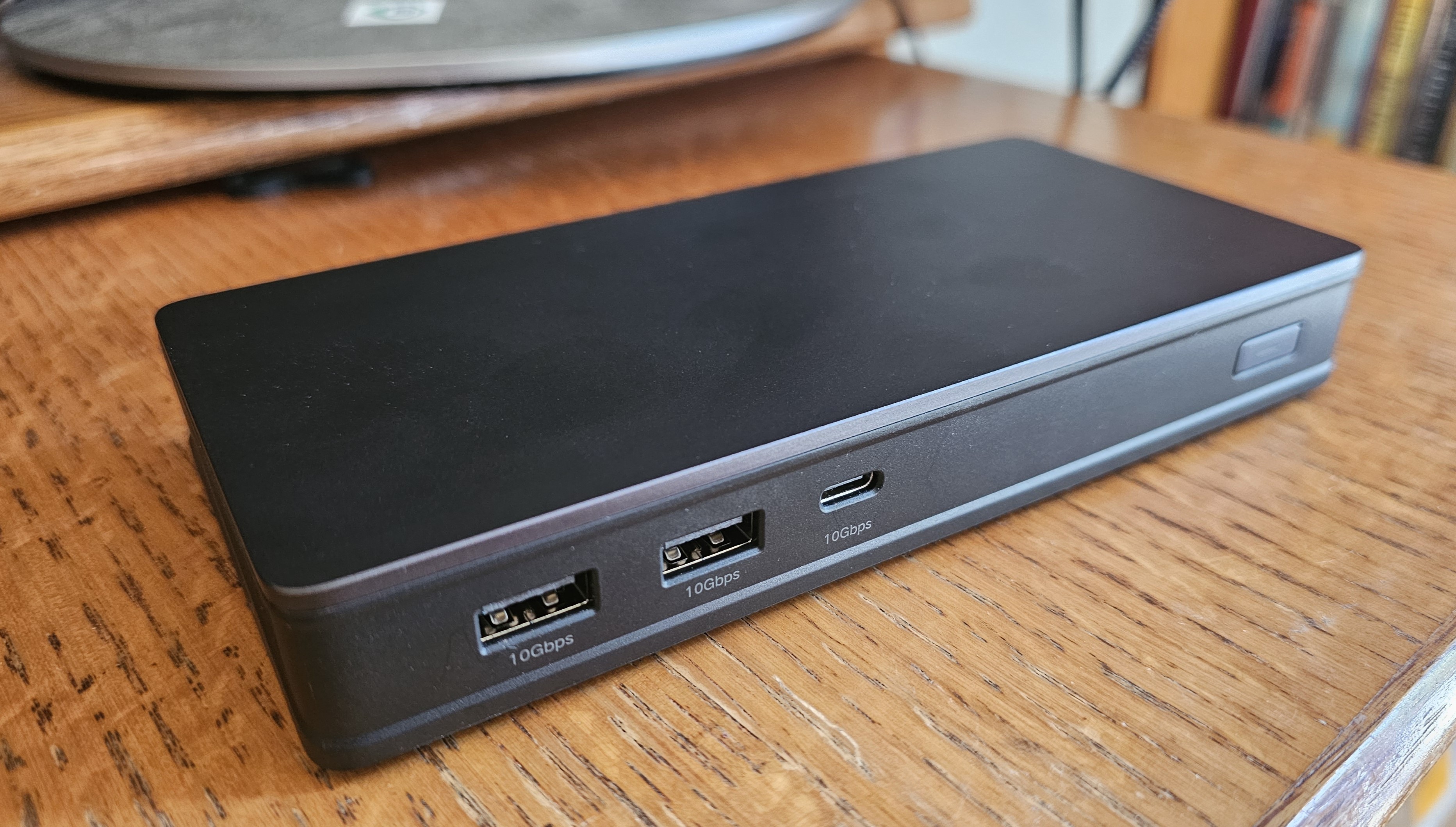
- Terrific price and value
- Excellent stability
- Great display port flexibility
- Support for two 4K60 displays
Cons
- Have to provide your own power supply
- Can get quite warm
- Mandatory software driver
Price When Reviewed:
$169.99
Best Prices Today:
25% off original price$125.98
Who should buy the Ugreen 9-in-1 USB-C (Revodok) Docking Station CM615?
DisplayLink docks fit between a USB-C dongle and a Thunderbolt dock, and I always think of a DisplayLink buyer as a small business owner or home worker who is focused on productivity and lots of high-end displays. DisplayLink docks excel for office work, but struggle in handling high frame rates for games.
This is our top pick for an upgraded DisplayLink dock, which has its own pros and cons — slightly more expensive than a USB-C docking station, but more features, too.
Ugreen 9-in-1 USB-C (Revodok) Docking Station CM615: Further considerations
Ugreen’s 9-in-1 USB-C docking station is typical of the brand: quality design and manufacture, obtuse naming, and pricing that seems to vary from one vendor to the next. But this DisplayLink dock offers an excellent mix of port flexibility at a solid price. There is one catch: It lacks any power input at all, and you’ll need to use your laptop’s USB-C power supply (or buy one) to charge both this dock and the laptop itself.
Like most DisplayLink docks, this dock was unusually stable, with no flickering between displays — one of the reasons I like DisplayLink docks. The price nails that sweet spot, too. Just remember to bring your smartphone charger.
Read our full
Ugreen 9-in-1 USB-C (Revodok) Docking Station CM615 review
Plugable USB-C Triple 4K HDMI Docking Station (UD-6950PDZ) – Best full-sized USB-C DisplayLink dock runner-up
Pros
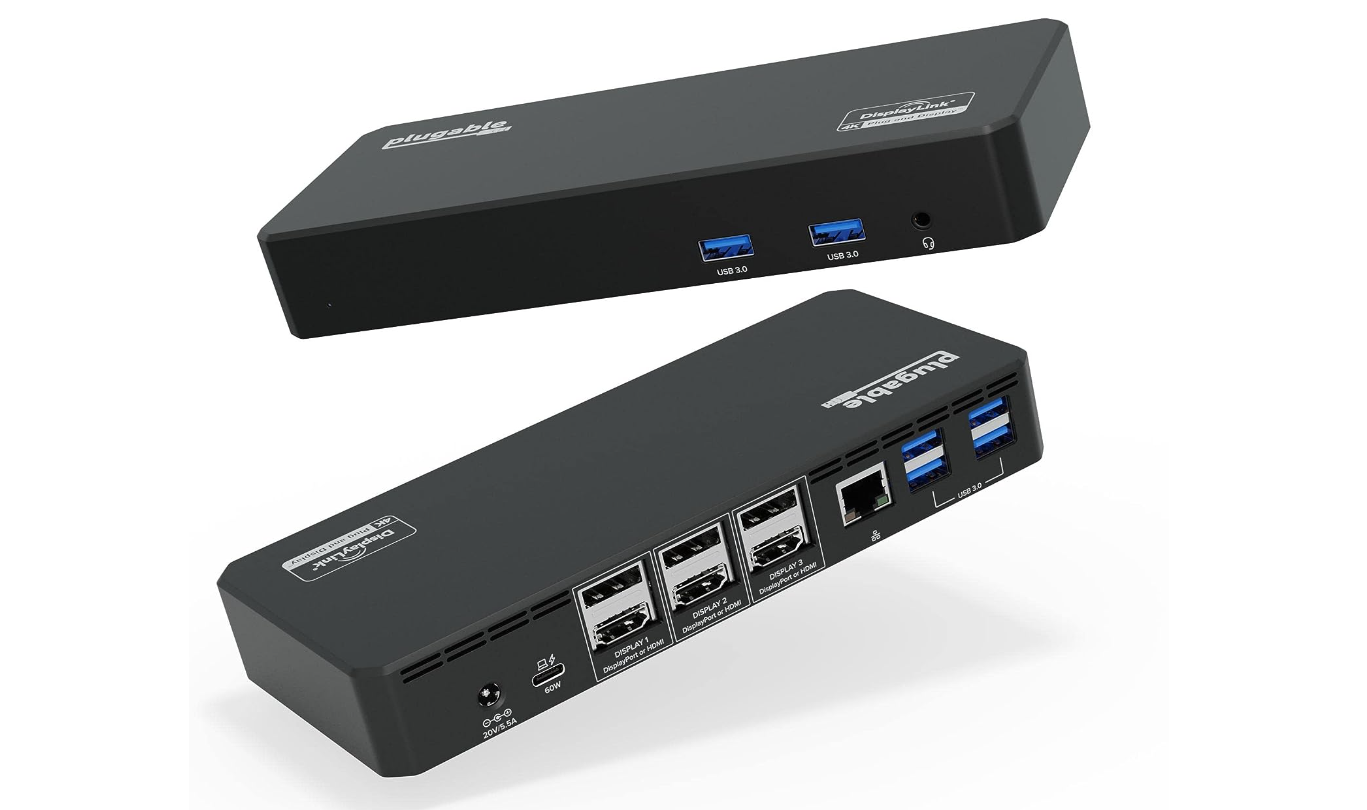
- Support for three 4K60 displays
- Six USB-A ports
- 60W of power
Cons
- Great, stable image quality breaks down slightly with video
- No USB-C or fast-charging ports
Price When Reviewed:
$199.95
Best Prices Today:
Who should buy the Plugable USB-C Triple 4K HDMI Docking Station (UD-6950PDZ)?
As noted in the best pick above, DisplayLink docks work best for a home office, with an emphasis on productivity. You’ll want to avoid gaming.
Plugable USB-C Triple 4K HDMI Docking Station (UD-6950PDZ): Further considerations
Plugable’s dock means that you can connect to three 4K displays, even if you don’t absolutely have to. Most docks ask you to choose between DisplayPort and HDMI, or even use a direct Thunderbolt connection. Plugable offers both.
The performance of this dock was up to par, though keep in mind that DisplayLink uses compressed data running over a 10Gbps connection. Press it too hard, and you will see some degradation in video and storage performance.
Read our full
Plugable USB-C Triple 4K HDMI and DisplayPort Display Horizontal Docking Station (UD-6950PDZ) review
Other USB-C hub/dock reviews and features
How we test USB-C hubs
We test USB-C hubs/dongles slightly differently than docking stations. A separate article offers a detailed explanation on how we test USB-C hubs, but here’s a short summary: First we test the physical configuration, and how ports are spaced and whether filling one port impedes use of the port next to it.

We also run performance tests to make sure ports function as advertised. Finally, we consider price and weight it against functionality and build quality. More complex hubs usually command more money, but that’s not always the case!
Who curated this article?
My name is Mark Hachman, and I’ve been working as a technology reporter and reviewer for 30 years. I review USB-C hubs/dongles, Thunderbolt docking stations, and DisplayLink docks, so I have a good handle on the different types of I/O technologies being used and what will be best for you. I’ve been reviewing these devices since work-from-home became popular in 2020, realizing pretty quickly that home users wanted a mix of displays and legacy peripherals.
How to choose the best USB-C hub
You’ll want to do a careful of assessment of your work equipment and your needs in order to find the right hub or dock for yourself.
First, take stock of your peripherals
Here’s where to start: Take a look at the peripherals you own, or plan to buy. Do you have an old external hard drive that uses a traditional USB-A cable? Do you manually back up photos from an SLR camera via its SD card? Or is your Wi-Fi connection unreliable enough that you’d prefer Ethernet? Figure out what ports you’ll need. This advice is for Windows users; Macs have their own limitations on USB-C connections.
Keep in mind that you may want to use both a mouse and keyboard, and possibly connect a printer, too. You can disconnect a keyboard to print, but it’s kind of a pain. Even if you own a modern 2026 laptop, you may still have hardware from several years ago. A hub bridges your laptop to its peripherals, but can serve as a bridge to the past, too.

This laptop has several USB-C ports, but if yours has just one, you’ll want to daisy-chain the laptop’s power cord by plugging it directly into the hub, like so.
Next, check out what ports your laptop already has
It’s also important to take stock of your laptop or tablet’s ports: Does it have one USB-C port or two? If your device only has one port, is there a separate charging connection? If your laptop or tablet has a USB-C port and uses it exclusively for charging, you’ll want to buy a USB-C hub with a dedicated charging input port.